

Texas A&M researchers have unlocked a new way to harness astatine-211, a rare and powerful isotope that may revolutionize cancer treatment.
Astatine is the rarest naturally occurring element on the planet and among the least explored in the periodic table, largely because its name, derived from the Greek word for “unstable,” accurately reflects its fleeting nature.
Researchers at Texas A&M University have now overcome this challenge through the use of cyclotron beams and advanced chemical techniques, creating a new process to produce, purify, and transport astatine-211 (At-211). This isotope, though highly radioactive and with a brief half-life of just 7.2 hours, holds remarkable potential for targeted cancer treatment.
Often called the “perfect” or “goldilocks” isotope, At-211 can deliver focused radiation that destroys cancer cells while minimizing harm to surrounding healthy tissue. The Texas A&M Cyclotron Institute now produces this groundbreaking isotope using its K150 cyclotron, supported by the U.S. Department of Energy (DOE) Isotope Program.
Since 2023, Texas A&M has been one of only two institutions in the nation authorized to supply astatine for medical research and therapy through the National Isotope Development Center (NIDC) as part of its University Isotope Network.
“Targeted alpha therapy is a potentially transformative cancer therapeutic of great interest due to its ability to cause large amounts of damage near a tumor cell while keeping the healthy surrounding tissue and organs intact,” said Texas A&M Distinguished Professor and Regents Professor of Chemistry Dr. Sherry J. Yennello, who serves as director of the Cyclotron Institute and whose research group leads the institute’s At-211 program. “We are one of a handful of U.S. centers capable of routinely producing astatine in medically relevant quantities and delivering it to nearby facilities.”
The Alpha Particle Advantage
When astatine decays, it emits alpha particles, which are formed by the combination of two protons and two neutrons. For a variety of reasons, these alpha particles are highly effective at delivering potent energy capable of killing cancer cells. Unlike other types that can penetrate deeper into the body, damaging both healthy and cancerous tissue, alpha particles only travel a short distance before depositing their cell-destroying energy payload. Thus, when At-211 is positioned in or near cancerous tissue, its emitted alpha particles travel deep enough to destroy the cancer cells but leave surrounding healthy tissue minimally harmed.
Because of At-211’s short half-life, it loses its radioactivity quickly and therefore is less toxic than other longer-lived radiopharmaceuticals. In particular, At-211’s absence of secondary alpha decay radioactivity is key in maximizing its cancer-killing energy and efficiency, making it an attractive prospect for researchers and drug makers throughout the world. Already, it is being pioneered as an alpha-emitting treatment option in clinical trials for blood cancers and even explored in early-stage research and development for Alzheimer’s disease.
“Astatine-211’s availability remains the biggest hurdle to harnessing its potential to transform the future of nuclear medicine,” Yennello said. “Fortunately, the advances we’re making here at Texas A&M will go a long way toward addressing that.”
Countermeasures On A Column
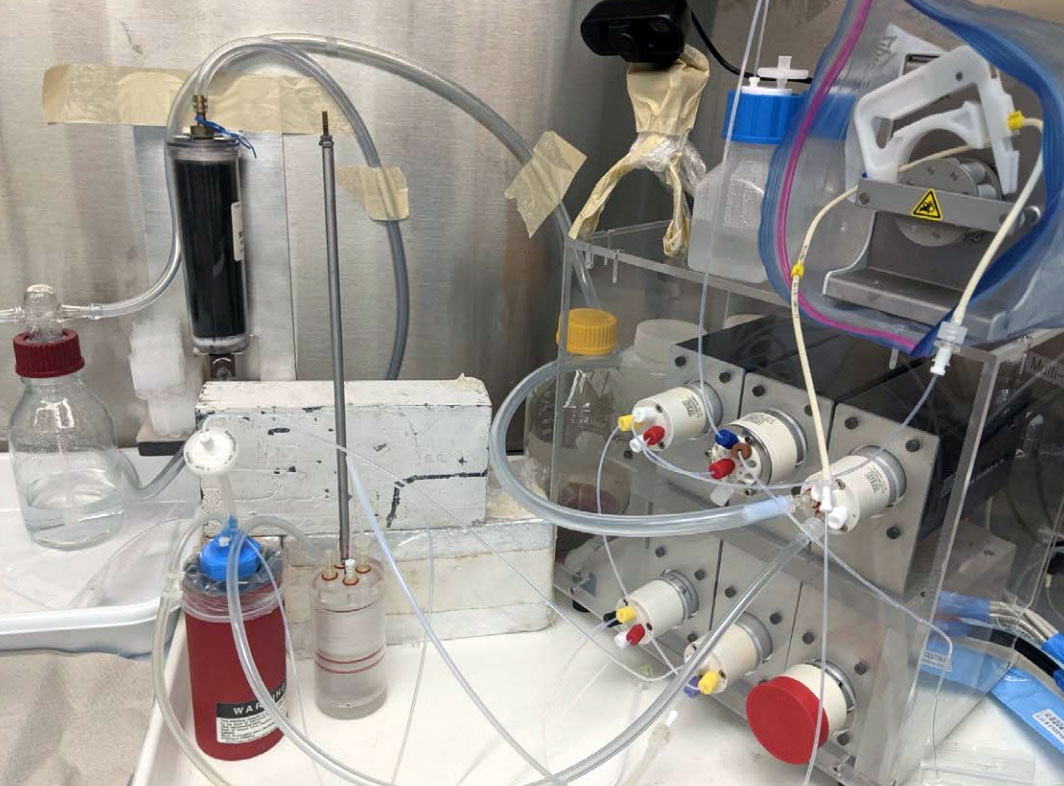
In one of their biggest advancements to date, the Texas A&M team has developed an automated system for separating and shipping At-211. This patent-pending device enables the radioisotope to be purified, or separated from the bismuth target, and loaded onto a shipping column as part of the process to incorporate it into a targeted alpha therapy drug. Yennello says the novel resin-column-trapping approach allows isotope producers to ship larger quantities of At-211 with less risk and less decay loss due to quicker separation than with other methods, further promoting its feasibility as a possible next-generation cancer treatment.
As tangible proof of concept, Texas A&M has delivered significant quantities of At-211 to collaborators at the University of Alabama at Birmingham and more than two dozen shipments to MD Anderson Cancer Center for the development of radiopharmaceuticals along with a better understanding of At-211’s unique chemical properties. Later today, Yennello teamed up with former MD Anderson radiochemist and current University of Texas Health Science Center at Houston professor Dr. Federica Pisaneschi to present a talk, titled “The Texas Two-Step,” at the 2025 World Astatine Community Meeting. The two detailed their collective experience producing, shipping, and exploiting At-211 for its radiopharmaceutical properties and therapeutic potential as part of the first-ever U.S.-based gathering of public and private sector researchers and commercial programs interested in advancing At-211’s use as a cancer therapeutic in clinical studies and healthcare facilities throughout the world. Yennello recently discussed the Texas A&M At-211 program on another significant global stage: the 26th International Symposium on Radiopharmaceutical Sciences, held in Queensland.
“Although clinical trials in humans are in the early stages, there are initiatives currently looking at astatine-211’s potential in Japan, several European countries, and the United States,” Yennello said. “I’m looking forward to sharing Texas A&M’s success in producing and supplying astatine-211 while also learning more about global progress in our common efforts to better understand its chemical properties and possible therapeutic advancement in oncology.”
The research is supported by the DOE Office of Science through the DOE Isotope Program, Texas A&M through the Bright Chair in Nuclear Science, and the Texas A&M University System Nuclear Security Office through a collaboration with Los Alamos National Laboratory.
Never miss a breakthrough: Join the SciTechDaily newsletter.
Follow us on Google and Google News.