
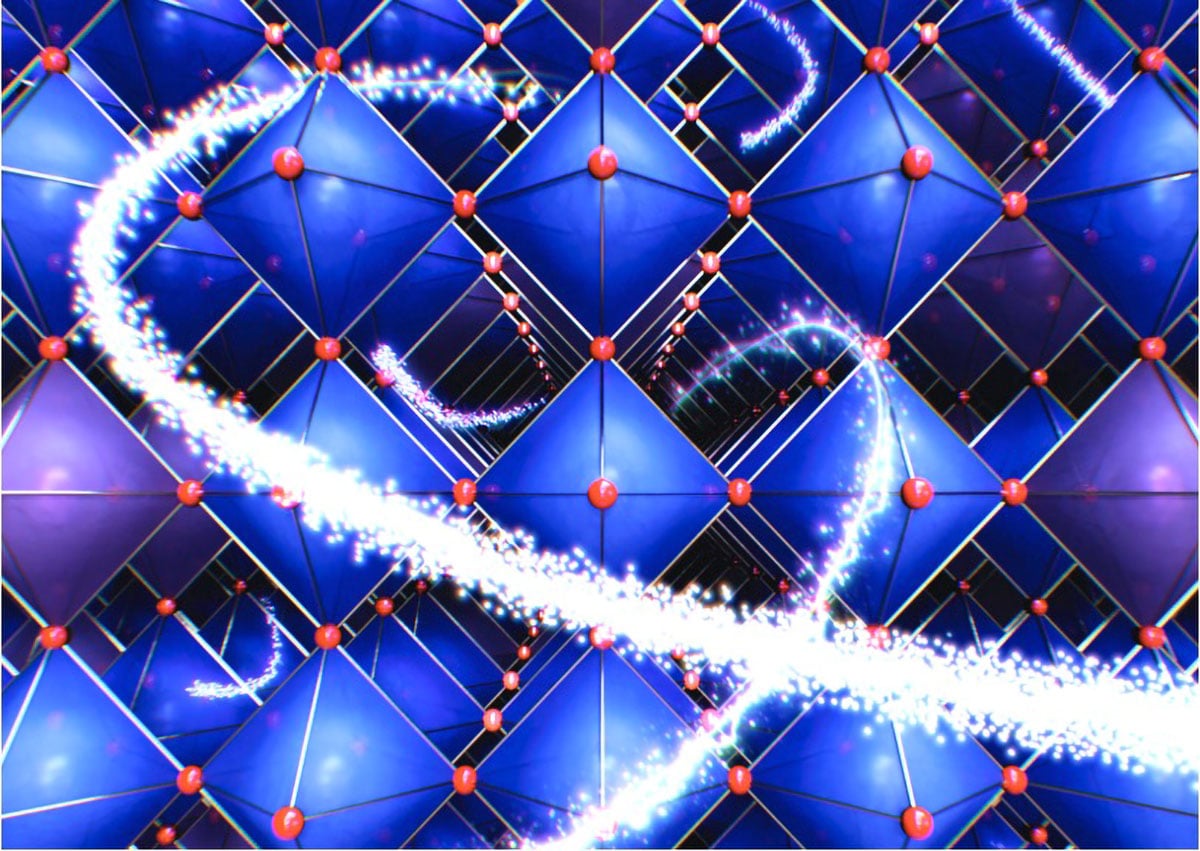
Researchers at Kyushu University have created a solid oxide fuel cell (SOFC) exhibiting exceptionally high proton conductivity at 300°C.
As worldwide energy needs continue to rise, scientists, industry leaders, and policymakers are collaborating to find reliable ways to meet growing demand. This effort has become increasingly urgent as nations work to confront climate change and reduce dependence on fossil fuels.
Among the most promising technologies being explored are solid-oxide fuel cells, or SOFCs. Unlike batteries, which store energy and then release it, fuel cells generate electricity by continuously converting chemical fuel into power as long as a fuel supply is available. Many people are already familiar with hydrogen fuel cells, which produce electricity and water from hydrogen gas.
SOFCs stand out for their high efficiency and long operational life. However, they have traditionally required extremely high operating temperatures of about 700-800°C. Systems built to withstand this heat must rely on specialized, expensive materials, which limits how widely the technology can be used.
In a new study published in Nature Materials, researchers at Kyushu University announce that they have created an SOFC capable of efficient operation at only 300°C. According to the team, this achievement could enable affordable, low-temperature SOFC designs and significantly speed up the transition of this technology from the laboratory to real-world applications.
Understanding the Role of the Electrolyte
The heart of an SOFC is the electrolyte, a ceramic layer that carries charged particles between two electrodes. In hydrogen fuel cells, the electrolyte transports hydrogen ions (a.k.a. protons) to generate energy. However, the fuel cell needs to operate at the extremally high temperatures to run efficiently.
“Bringing the working temperature down to 300℃ it would slash material costs and open the door to consumer-level systems,” explains Professor Yoshihiro Yamazaki from Kyushu University’s Platform of Inter-/Transdisciplinary Energy Research, who led the study. “However, no known ceramic could carry enough protons that fast at such ‘warm’ conditions. So, we set out to break that bottleneck.”
Electrolytes are composed of different combinations of atoms arranged in a crystal lattice structure. It’s between these atoms that a proton would travel. Researchers have explored different combinations of materials and chemical dopants—substances that can alter the material’s physical properties—to improve the speed at which protons travel through electrolytes.
“But this also comes with a challenge,” continues Yamazaki. “Adding chemical dopants can increase the number of mobile protons passing through an electrolyte, but it usually clogs the crystal lattice, slowing the protons down. We looked for oxide crystals that could host many protons and let them move freely—a balance that our new study finally struck.”
The Breakthrough: Scandium-Doped Oxides
The team found that two compounds, barium stannate (BaSnO3) and barium titanate (BaTiO3), when doped with high concentrations of scandium (Sc), were able achieve the SOFC benchmark proton conductivity of more that 0.01 S/cm at 300°C, a conductivity level comparable to today’s common SOFC electrolytes at 600-700°C.
“Structural analysis and molecular dynamics simulations revealed that the Sc atoms link their surrounding oxygens to form a ‘ScO₆ highway,’ along which protons travel with an unusually low migration barrier. This pathway is both wide and softly vibrating, which prevents the proton-trapping that normally plagues heavily doped oxides,” explains Yamazaki. “Lattice-dynamics data further revealed that BaSnO3 and BaTiO3 are intrinsically ‘softer’ than conventional SOFC materials, letting them absorb far more Sc than previously assumed.”
The findings overturn the trade-off between dopant level and ion transport, offering a clear path for low-cost, intermediate-temperature SOFCs.
“Beyond fuel cells, the same principle can be applied to other technologies, such as low-temperature electrolyzes, hydrogen pumps, and reactors that convert CO2 into valuable chemicals, thereby multiplying the impact of decarbonization. Our work transforms a long-standing scientific paradox into a practical solution, bringing affordable hydrogen power closer to everyday life,” concludes Yamazaki.
Reference: “Mitigating proton trapping in cubic perovskite oxides via ScO6 octahedral networks” by Kota Tsujikawa, Junji Hyodo, Susumu Fujii, Kazuki Takahashi, Yuto Tomita, Nai Shi, Yasukazu Murakami, Shusuke Kasamatsu and Yoshihiro Yamazaki, 8 August 2025, Nature Materials.
DOI: 10.1038/s41563-025-02311-w
Funding: Japan Science and Technology Agency, Japan Society for the Promotion of Science, Kyushu University
Never miss a breakthrough: Join the SciTechDaily newsletter.
Follow us on Google and Google News.
2 Comments
It’s not just the “green stuff.” Hydrogen can provide fuel to power military drones (for long flights with minimal signature), and it also provides the buoyancy so the drones can stay airborne longer and travel further. Indeed, with their hefty hydrogen load, the drones themselves become flying bombs that can silently crash into enemy assets — be they on air, at sea, or on land. Meanwhile, the Trump administration has unwittingly cut off nearly all research on hydrogen fuel cells and is spending next to nothing on the hydrogen drone warfare, which is the future.
The problem with hydrogen is the low overall fuel cycle efficiency. You lose energy when you crack water into H2 and O2, you lose more energy (you have to expend energy, so it’s effectively a loss) when you compress it, and every time you transfer it and want to maintain the same pressure, you have to compress it again. But compressing it generates heat, so you also have to use cooling systems, so more energy loss. It’s basic physics, there’s no way around it. Overall, a typical fuel cell system will be lucky if it sees 40% overall efficiency, and it’s usually lower than that. Compared to battery systems, which exceed 80%, fuel cells just can’t compete economically and are only suited to small niche edge cases.