
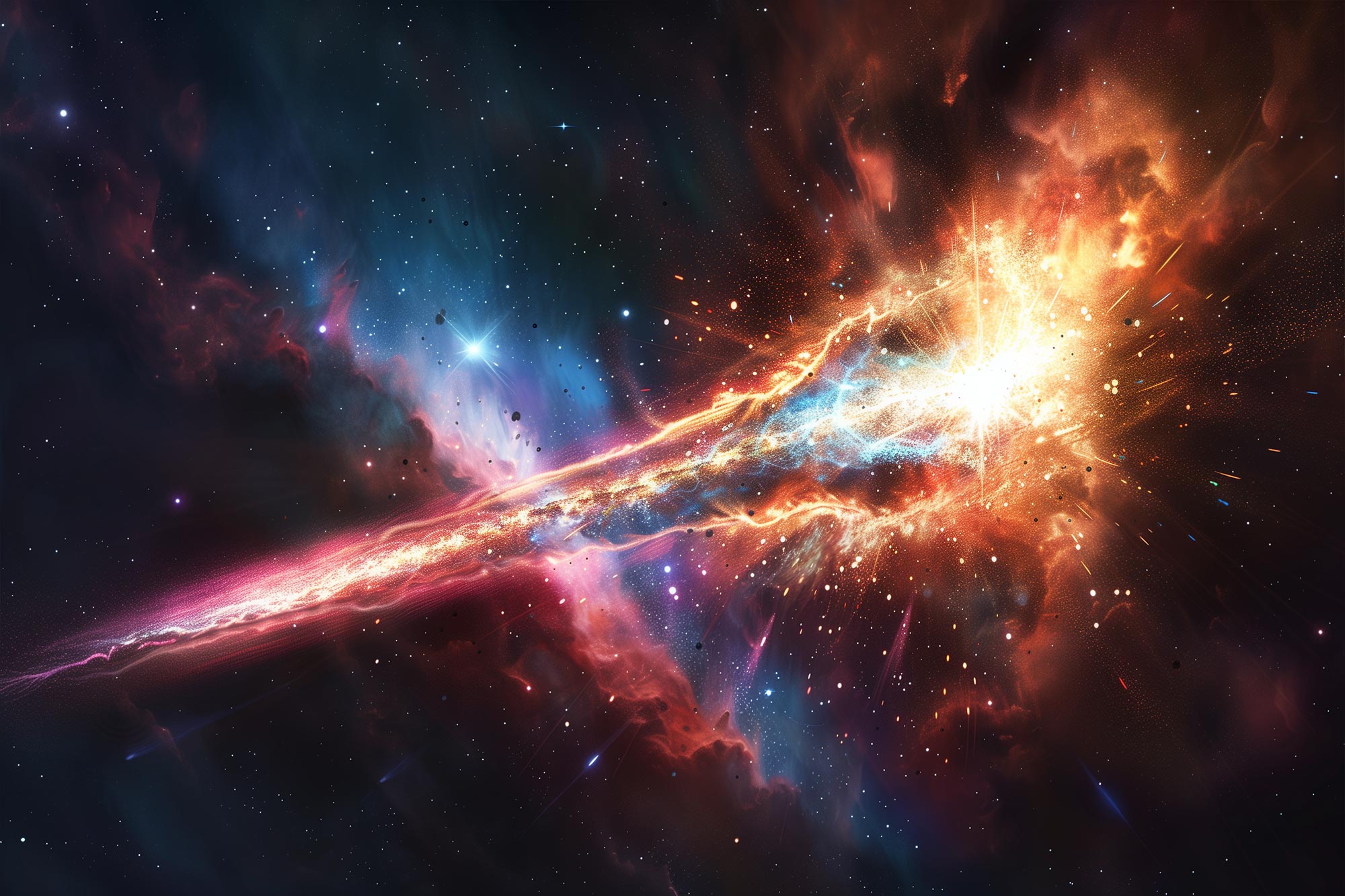
Researchers have unveiled a cosmic cycle where carbon, created in the explosions of stars, travels through space via a process involving the circumgalactic medium—a kind of stellar conveyor belt.
This cycle is crucial for the formation of new stars and planets, ensuring galaxies like ours continually evolve and recycle materials.
The Crucial Role of Carbon and Stellar Origins
Life on Earth depends on carbon — but carbon itself owes its existence to stars. Nearly all elements heavier than hydrogen and helium, including carbon, oxygen, and iron, are created in the intense heat of stellar cores. When stars die, they scatter these elements into space. In a remarkable process of cosmic recycling, planets like Earth form by incorporating these star-made materials, such as the iron in Earth’s core, the oxygen in its atmosphere, and the carbon in living organisms.
Galactic Recycling: The Journey of Carbon
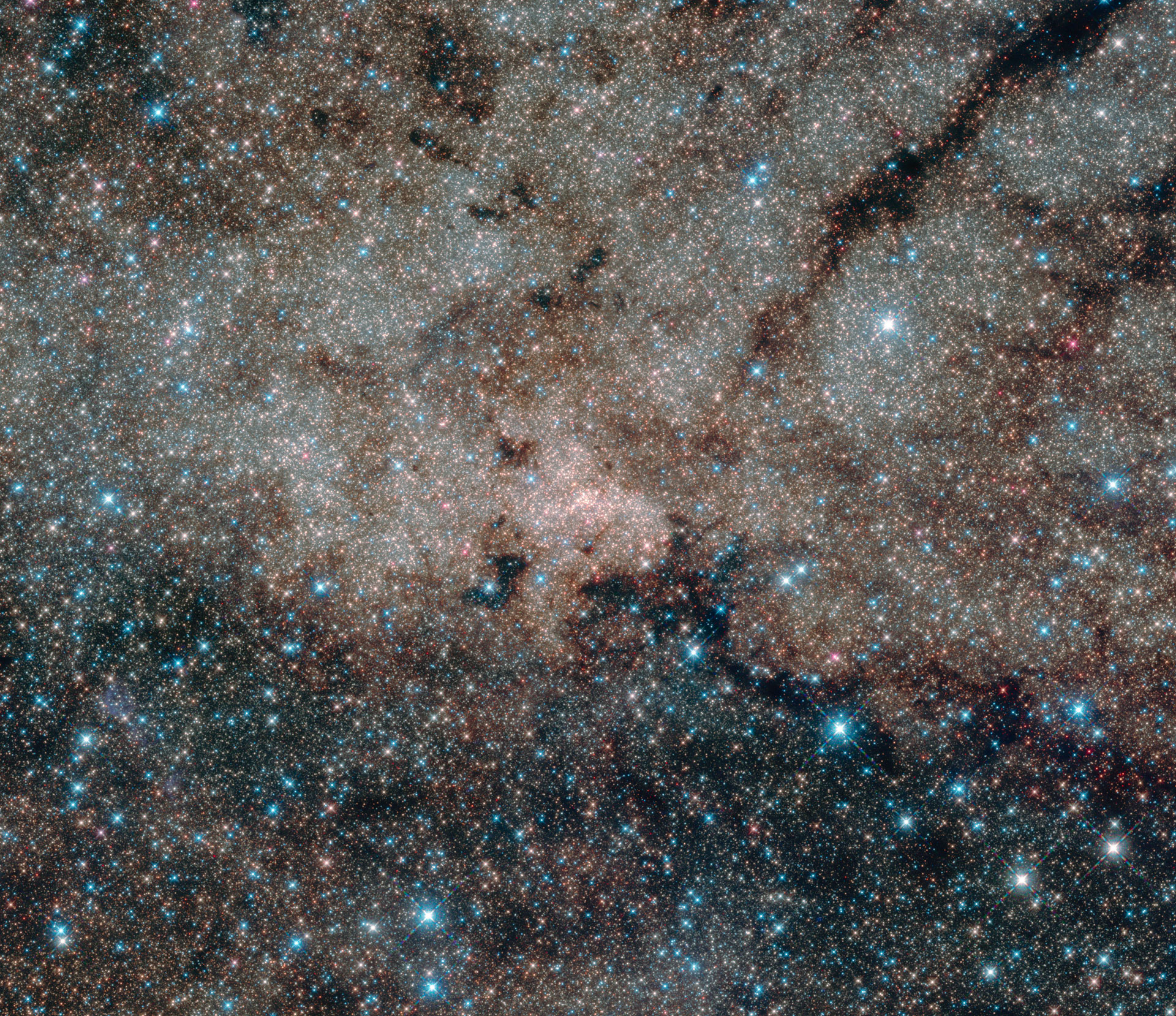
Now, researchers from the U.S. and Canada have confirmed that carbon and other elements forged in stars don’t just wander aimlessly through space waiting to be repurposed. In galaxies like ours, where stars are still forming, these elements take a complex route. They travel on vast currents extending far into intergalactic space, only to circle back to their home galaxy. Known as the circumgalactic medium, these currents act like massive conveyor belts, ejecting material from the galaxy and drawing it back in. Gravity and other forces then shape this recycled matter into planets, moons, asteroids, comets, and even new stars.
The Circumgalactic Medium: A Galactic Conveyor Belt
“Think of the circumgalactic medium as a giant train station: It is constantly pushing material out and pulling it back in,” said team member Samantha Garza, a University of Washington doctoral candidate. “The heavy elements that stars make get pushed out of their host galaxy and into the circumgalactic medium through their explosive supernovae deaths, where they can eventually get pulled back in and continue the cycle of star and planet formation.”
Garza is lead author on a paper describing these findings that was published on December 27 in the Astrophysical Journal Letters.

Discovering the Cosmic Recycling Process
“The implications for galaxy evolution, and for the nature of the reservoir of carbon available to galaxies for forming new stars, are exciting,” said co-author Jessica Werk, UW professor and chair of the Department of Astronomy. “The same carbon in our bodies most likely spent a significant amount of time outside of the galaxy!”
In 2011, a team of scientists for the first time confirmed the long-held theory that star-forming galaxies like ours are surrounded by a circumgalactic medium — and that this large, circulating cloud of material includes hot gases enriched in oxygen. Garza, Werk and their colleagues have discovered that the circumgalactic medium of star-forming galaxies also circulates lower-temperature material like carbon.
“We can now confirm that the circumgalactic medium acts like a giant reservoir for both carbon and oxygen,” said Garza. “And, at least in star-forming galaxies, we suggest that this material then falls back onto the galaxy to continue the recycling process.”
Implications for Galaxy Evolution
Studying the circumgalactic medium could help scientists understand how this recycling process subsides, which will happen eventually for all galaxies — even ours. One theory is that a slowing or breakdown of the circumgalactic medium’s contribution to the recycling process may explain why a galaxy’s stellar populations decline over long periods of time.
“If you can keep the cycle going — pushing material out and pulling it back in — then theoretically you have enough fuel to keep star formation going,” said Garza.
Probing the Cosmic Reservoir with Hubble
For this study, the researchers used the Cosmic Origins Spectrograph on the Hubble Space Telescope. The spectrograph measured how light from nine distant quasars — ultra-bright sources of light in the cosmos — is affected by the circumgalactic medium of 11 star-forming galaxies. The Hubble readings indicated that some of the light from the quasars was being absorbed by a specific component in the circumgalactic medium: carbon, and lots of it. In some cases, they detected carbon extending out almost 400,000 light years — or four times the diameter of our own galaxy — into intergalactic space.
Future research is needed to quantify the full extent of the other elements that make up the circumgalactic medium and to further compare how their compositions differ between galaxies that are still making large amounts of stars and galaxies that have largely ceased star formation. Those answers could illuminate not just when galaxies like ours transition into stellar deserts, but why.
Reference: “The CIViL* Survey: The Discovery of a C iv Dichotomy in the Circumgalactic Medium of L* Galaxies” by Samantha L. Garza, Jessica K. Werk, Trystyn A. M. Berg, Yakov Faerman, Benjamin D. Oppenheimer, Rongmon Bordoloi and Sara L. Ellison, 27 December 2024, The Astrophysical Journal Letters.
DOI: 10.3847/2041-8213/ad9c69
Co-authors on the paper are Trystyn Berg, research fellow at the Herzberg Astronomy and Astrophysics Research Centre in British Columbia; Yakov Faerman, a UW postdoctoral researcher in astronomy; Benjamin Oppenheimer, a research fellow at the University of Colorado Boulder; Rongmon Bordoloi, assistant professor of physics at North Carolina State University; and Sara Ellison, professor of physics and astronomy at the University of Victoria. The research was funded by NASA and the National Science Foundation.
Never miss a breakthrough: Join the SciTechDaily newsletter.
Follow us on Google and Google News.
1 Comment
Thank you for all these wonderful information in science. I appreciate you.