
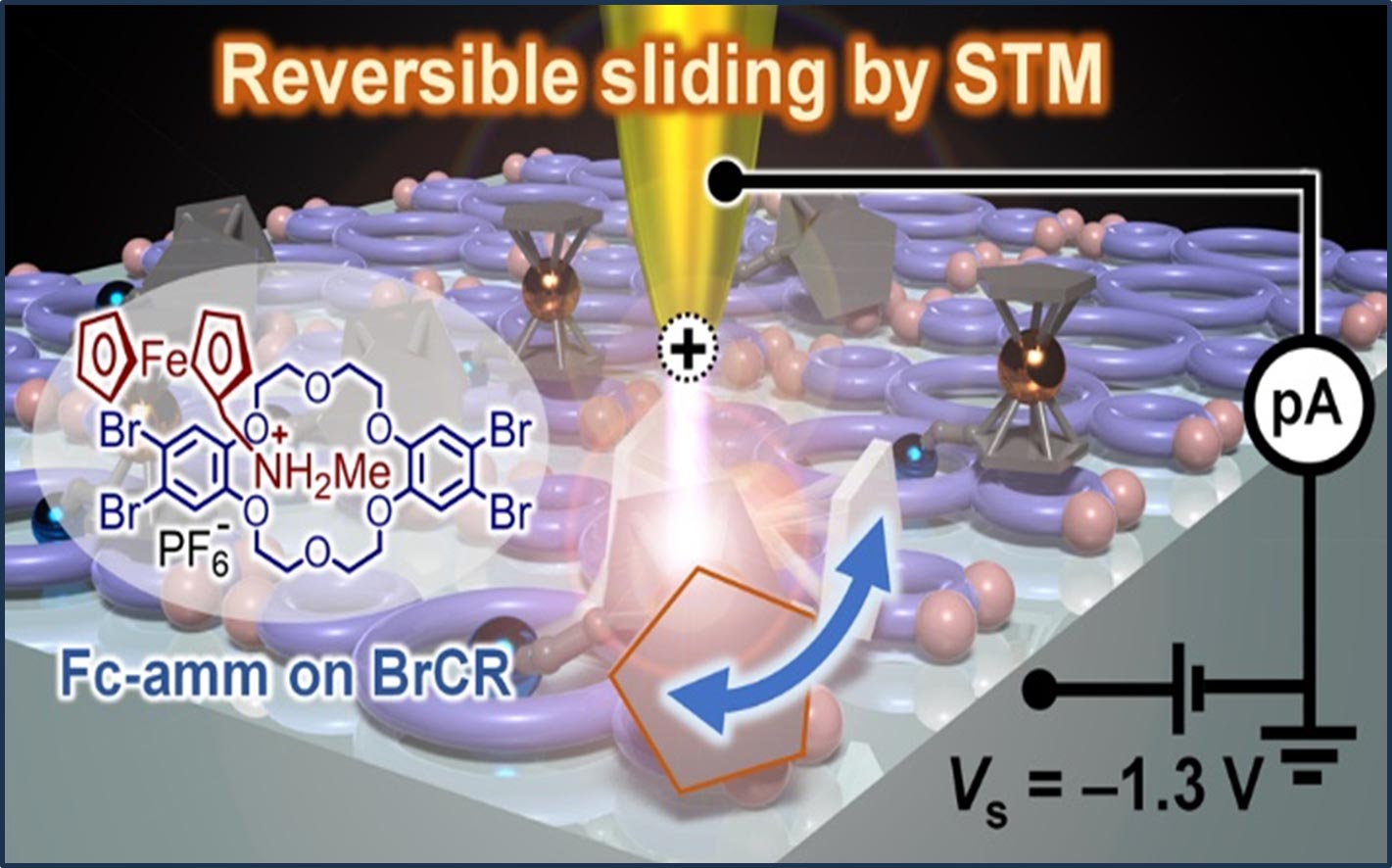
Researchers have successfully stabilized ferrocene molecules on a flat substrate for the first time, enabling the creation of an electronically controllable sliding molecular machine.
Artificial molecular machines, composed of only a few molecules, hold transformative potential across diverse fields, including catalysis, molecular electronics, medicine, and quantum materials. These nanoscale devices function by converting external stimuli, such as electrical signals, into controlled mechanical motion at the molecular level.
Ferrocene—a unique drum-shaped molecule featuring an iron (Fe) atom sandwiched between two five-membered carbon rings—is a standout candidate for molecular machinery. Its discovery, which earned the Nobel Prize in Chemistry in 1973, has positioned it as a foundational molecule in this area of study.
The appeal of ferrocene lies in its remarkable property: a change in the electronic state of the Fe ion, from Fe²⁺ to Fe³⁺, induces a 36° rotation of the carbon rings around the molecule’s central axis. This rotation can potentially be controlled with external electrical signals, enabling precise manipulation at the molecular level.
Despite its promise, a significant challenge has hindered ferrocene’s practical application. When adsorbed onto surfaces, particularly flat noble metal substrates, ferrocene decomposes near room temperature, even under ultra-high vacuum conditions. Until recently, no reliable method had been found to anchor isolated ferrocene molecules onto a surface without triggering decomposition.
Breakthrough in Ferrocene Stabilization
In a groundbreaking study, a research team led by Associate Professor Toyo Kazu Yamada from the Graduate School of Engineering at Chiba University, Japan, including Professor Peter Krüger from the Faculty of Engineering at Chiba University, Professor Satoshi Kera of the Institute for Molecular Science, Japan, and Professor Masaki Horie of National Tsing Hua University, Taiwan, has finally overcome this challenge. They have successfully created the world’s smallest electrically controlled molecular machine.
“In this study, we successfully stabilized and adsorbed ferrocene molecules onto a noble metal surface by pre-coating it with a two-dimensional crown ether molecular film. This is the first direct experimental evidence of ferrocene-based molecular motion at the atomic scale,” remarks Prof. Yamada. Their findings were published in the journal Small on November 30, 2024.
To stabilize the ferrocene molecules, the team first modified them by adding ammonium salts, forming ferrocene ammonium salts (Fc-amm). This improved durability and ensured that the molecules could be securely fixed to the surface of the substrate. These new molecules were then anchored onto a monolayer film made up of crown ether cyclic molecules, which were placed on a flat copper substrate. Crown ether cyclic molecules have a unique structure with a central ring that can hold a variety of atoms, molecules, and ions.
Mechanism of Stabilization and Molecular Motion
Prof. Yamada explains, “Previously, we found that crown ether cyclic molecules can form a monolayer film on flat metal substrates. This monolayer traps the ammonium ions of Fc-amm molecules in the central ring of crown ether molecules, preventing the decomposition of ferrocene by acting as a shield against the metal substrate.”
Next, the team placed a scanning tunneling microscopy (STM) probe on top of the Fc-amm molecule and applied an electrical voltage, which caused a lateral sliding motion of the molecules. Specifically, when a voltage of −1.3 volts is applied, a hole (vacant space left by an electron) enters the electronic structure of the Fe ion, switching it from Fe2+ to Fe3+ state. This triggered the rotation of the carbon rings accompanied by a lateral sliding motion of the molecule. Density functional theory calculations showed that this lateral sliding motion occurs due to the Coulomb repulsion between the positively charged Fc-amm ions. Importantly, when the voltage is removed, the molecule returns to its original position, demonstrating that the motion is reversible and can be precisely controlled using electrical signals.
“This study opens exciting possibilities for ferrocene-based molecular machinery. Their ability to perform specialized tasks at the molecular level can lead to revolutionary innovations across many scientific and industrial fields, including precision medicine, smart materials, and advanced manufacturing,” says Prof. Yamada, highlighting the potential applications of their technology.
In summary, this study presents a crucial breakthrough in the design and control of molecular machines that can lead to significant advancements in numerous fields.
Reference: “Reversible Sliding Motion by Hole-Injection in Ammonium-Linked Ferrocene, Electronically Decoupled from Noble Metal Substrate by Crown-Ether Template Layer” by Fumi Nishino, Peter Krüger, Chi-Hsien Wang, Ryohei Nemoto, Yu-Hsin Chang, Takuya Hosokai, Yuri Hasegawa, Keisuke Fukutani, Satoshi Kera, Masaki Horie and Toyo Kazu Yamada, 30 November 2024, Small.
DOI: 10.1002/smll.202408217
Funding: JSPS KAKENHI, the Murata Science Foundation, Shorai Foundation for Science and Technology, TEPCO Memorial Foundation, Cooperative Research by Institute for Molecular Science, Casio Science Foundation
Never miss a breakthrough: Join the SciTechDaily newsletter.
Follow us on Google and Google News.