
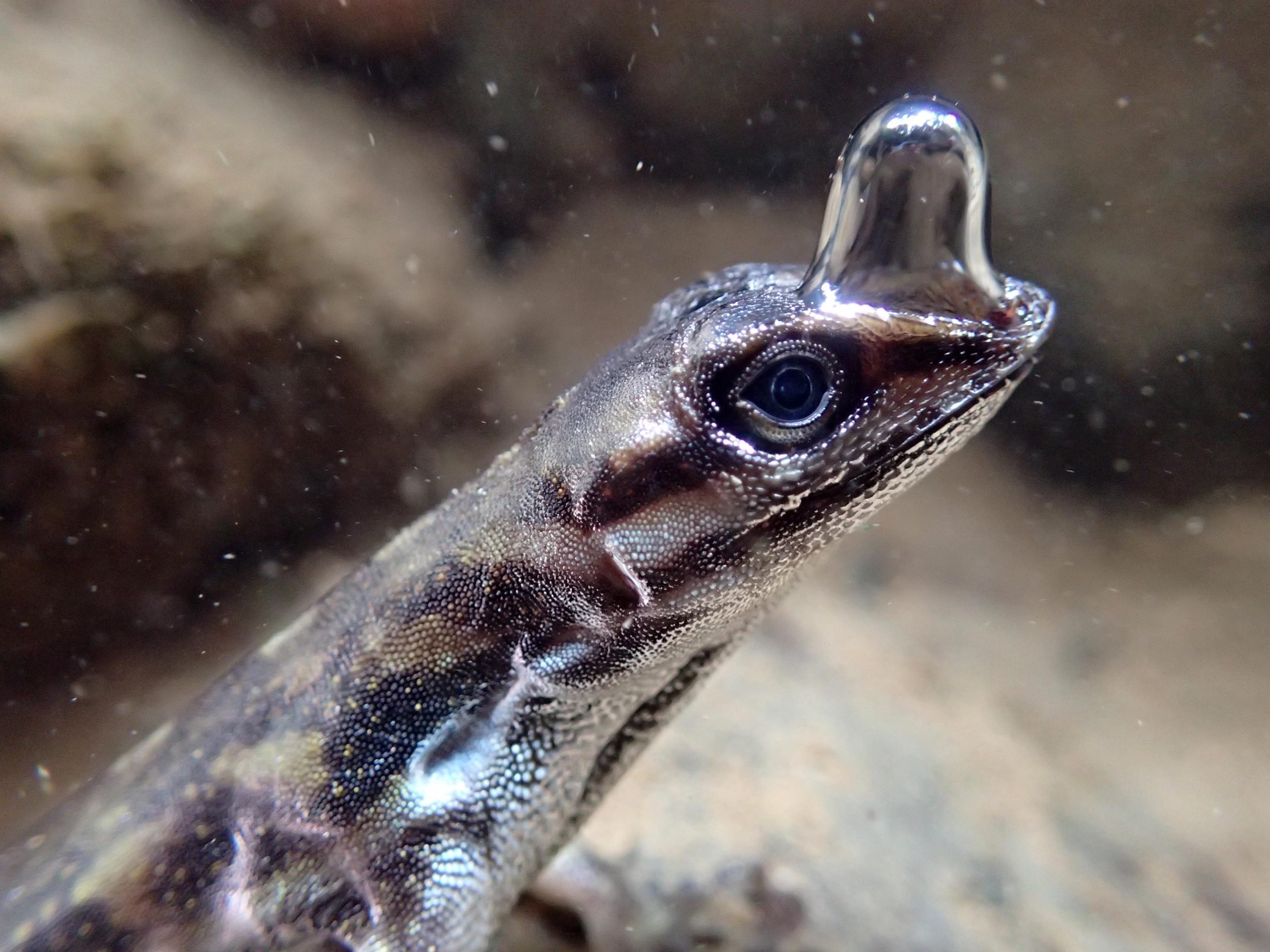
Anole lizards evolved a scuba-like bubble rebreathing system, enabling long underwater dives and a unique respiratory adaptation.
A team of evolutionary biologists including faculty at Binghamton University, State University of New York have shown that some Anolis lizards, or anoles, have adapted to rebreathe exhaled air underwater using a bubble clinging to their snouts.
Semi-aquatic anoles live along neotropical streams and frequently dive for refuge, remaining underwater for up to 16 minutes. Lindsey Swierk, assistant research professor of biological sciences at Binghamton University, documented this behavior in a Costa Rican anole species in 2019. She had been shocked to see an anole submerge itself for such long periods and used a GoPro underwater to document the behavior.
“It’s easy to imagine the advantage that these small, slow anoles gain by hiding from their predators underwater — they’re really hard to spot!” says Swierk. “But the real question is how they’re managing to stay underwater for so long.”
The researchers conducted experiments documenting routine air-based underwater respiration in several distantly related semi-aquatic anole species. They found that semi-aquatic anoles can respire underwater by ”rebreathing” exhaled air that is trapped between their skin and surrounding water.
“We found that semi-aquatic anoles exhale air into a bubble that clings to their skin,” said lead author Chris Boccia, a recent master of science graduate from the University of Toronto. “The lizards then re-inhale the air, a maneuver we’ve termed ‘rebreathing’ after the scuba-diving technology.”
Hydrophobic Skin
The researchers believe that hydrophobic skin, which they observed in all sampled anoles, may have been exaptative, facilitating the repeated evolution of specialized rebreathing in species that regularly dive. Their analyses strongly suggest that specialized rebreathing is adaptive for semi-aquatic habitat specialists. Air-based rebreathing may enhance dive performance by incorporating dead space air from the buccal cavity or plastron into the lungs, facilitating clearance of carbon dioxide, or allowing uptake of oxygen from surrounding water (i.e., a ”physical gill” mechanism.) The team used an oxygen sensor inside the rebreathed bubbles to determine whether anoles were consuming oxygen from the bubble. In true “scuba-tank” fashion, the researchers discovered that the oxygen concentration in an anole’s air bubble decreases over the length of the dive, in support of this idea.
Slower Metabolism May Extend Dives
“The finding that different species of semi-aquatic anoles have evolutionarily converged to extract oxygen from their rebreathed air bubbles leads to other exciting questions,” says Swierk. “For example, the rate of oxygen consumption from the bubble decreases the longer an anole dives, which could possibly be explained a reduction in an anole’s metabolic rate with increased dive time.” Binghamton graduate student co-author, Alexandra Martin, is currently exploring whether body cooling during dives may help explain this phenomenon.
“Rebreathing had never been considered as a potential natural mechanism for underwater respiration in vertebrates,” says Luke Mahler, an assistant professor in EEB at the University of Toronto and Boccia’s thesis supervisor. “But our work shows that this is possible and that anoles have deployed this strategy repeatedly in species that use aquatic habitats.”
Swierk and Mahler are planning future projects to better understand the evolution of the physiology and behavior related to rebreathing. “Anoles are a remarkable group of lizards, and the number of ways that this taxon has diversified to take advantage of their environments is mind-boggling,” said Swierk.
For more on this research, read Evolutionary Biologists Just Discovered How Some Lizards Are Able to Breathe Underwater.
Reference: “Repeated evolution of underwater rebreathing in diving Anolis lizards” by Christopher K. Boccia, Lindsey Swierk, Fernando P. Ayala-Varela, James Boccia, Isabela L. Borges, Camilo Andres Estupiñán, Alexandra M. Martin, Ramón E. Martínez-Grimaldo, Sebastian Ovalle, Shreeram Senthivasan, Ken S. Toyama, María del Rosario Castañeda, Andrés García, Richard E. Glor and D. Luke Mahler, 12 May 2021, Current Biology.
DOI: 10.1016/j.cub.2021.04.040
Never miss a breakthrough: Join the SciTechDaily newsletter.
Follow us on Google and Google News.
2 Comments
Crocodilian mite have the same system the extra valve in the heart likely is a warm blooded system from there dinosaur ancestor dinosaur was allways was a fast animal .crocodilian skin is different from lizard it is turtle skin turtle is a semi aquatic animal gecko have different skin it is a advance lizard .tuatara have lizard skin but it’s ancestor did not .early thecodont came from aquatic animal .turtle is a protothecodont a crocodilian type of animal .early lizard came from the tree that why they have mostly have smooth skin and are primitive .gator is a dinosaur the top reptile they have heavyly armor skin because they have more of mammal lifestyle a warm blooded lifestyle they have to Match the firepower of the mammal that why they have primitive heavy skin there is a advitage with that skin but it is heavy and slow poor drag it’s lot more stress to live on land that why land predator become king of the water .the gator a bipedal theropod dinosaur with a human ankle does not need bipedalism most top predator today walk on 4 by Youtube bipedal video bipedalism still important to greatest dinosaur ever live the gator
Where can I learn more about your research in this area? I would like to know more about the principle of Anolis’ underwater breathing and the modular unit of his film. Thank you