
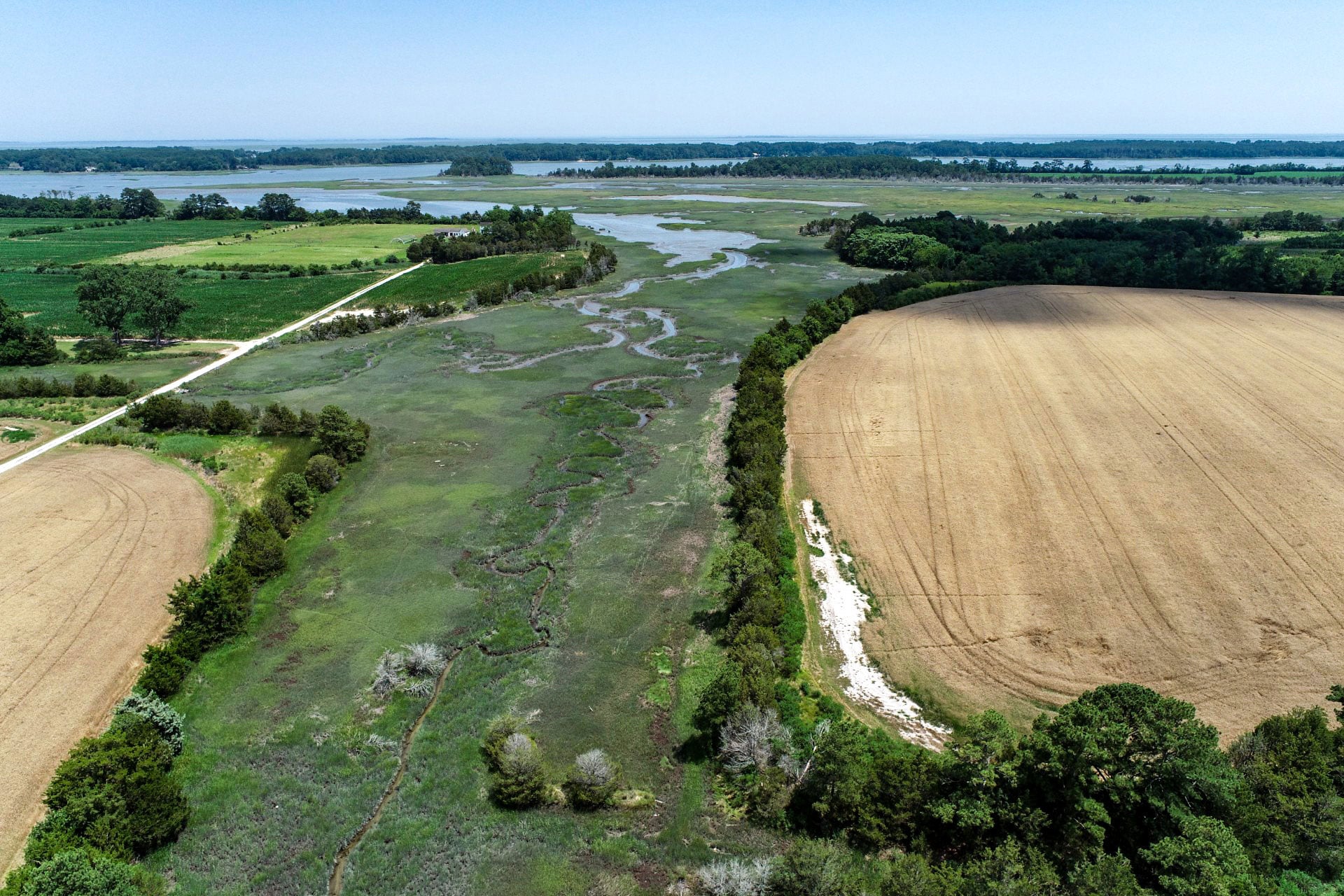
Coastal farmland in the Mid-Atlantic is being overtaken by rising seas faster than forests, revealing an overlooked rural front in climate-driven marsh migration.
Ghost forests, the eerie stands of dead trees left behind when saltwater moves inland, have become a stark sign of sea level rise along the Mid-Atlantic coast. Yet a new Nature Sustainability study led by William & Mary’s Batten School & VIMS finds that coastal farmland in the region is being lost even faster, with marshes advancing into agricultural land at nearly twice the rate seen in forests.
Drawing on decades of satellite data and recent field measurements, the study found that about 25,000 acres of farmland disappeared in the Chesapeake and Delaware Bay watersheds between 1984 and 2022 because of sea level rise. These losses occurred even though farmers had taken steps to protect their land.
“There’s this assumption that we’ll never let sea level rise consume farmland, that people will protect valuable land. And it’s just wrong,” said Matt Kirwan, coauthor and professor of marine science at the Batten School of Coastal & Marine Sciences & VIMS. “We found lots of examples where small levees were built at the edges of fields to prevent saltwater intrusion, but they only slowed down the loss. They couldn’t stop it.”
Measuring marsh encroachment
As sea levels rise because of human-driven climate change, saltwater can push inland through groundwater, tidal creeks, and storm surges. This saltwater intrusion slowly kills freshwater vegetation and allows salt-tolerant marsh grasses to take over. Scientists measure this shift by tracking how the border between dry land and marsh changes over time, a process known as retreat.
Instead of looking only at how far the marsh edge moved inland, which can be affected by the slope of the land, the authors also measured the elevation of that boundary. This method accounts for terrain differences and makes it easier to compare marsh expansion on farmland with marsh expansion in forests.
Sea level rise along the Mid-Atlantic coast is happening at about twice the global average. That makes the region especially vulnerable to these changes and a useful place to study how saltwater intrusion transforms coastal landscapes.
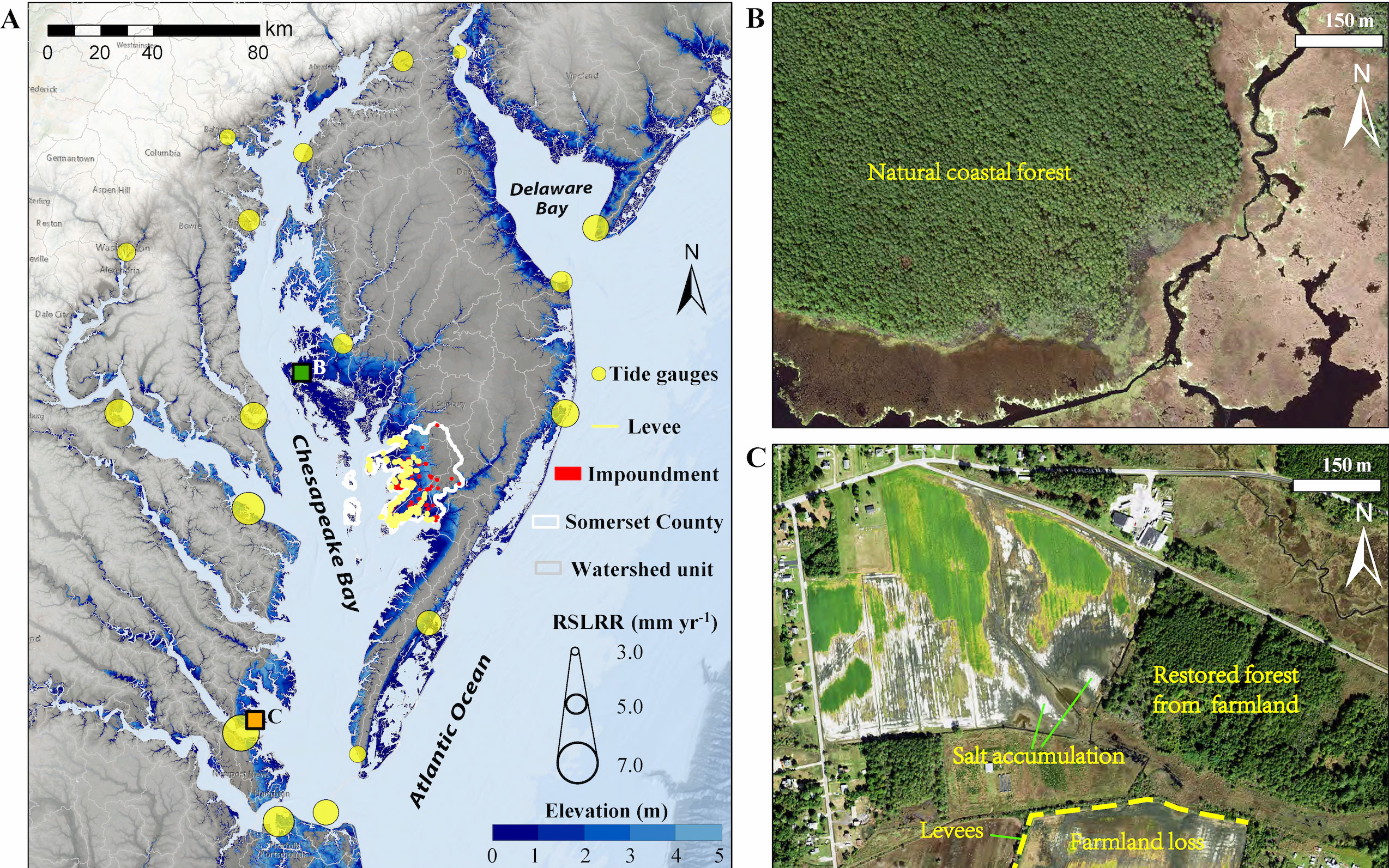
The study found that marsh encroachment can occur up to 7 times more often on agricultural land than on forestland in the Mid-Atlantic. Across the region, farmland appears to have intensified the effects of saltwater intrusion.
“We hypothesized, and most people would intuitively expect, that marshes would migrate slower into farmland, that forests are more vulnerable than farmland. But we found the opposite,” Kirwan said. “On farmland, it’s much more subtle. It’s a row of crops at the edge of the field that’s brown instead of green, but it still adds up to thousands of acres of lost agricultural production.”
Why coastal farmlands are vulnerable
The study examines the idea that the economic value of coastal farmland should encourage landowners to protect it from rising seas. In practice, farmers in the Mid-Atlantic have built levees, earthen berms, ditches, and other defenses to limit flooding and saltwater intrusion.
However, Virginia and Maryland began protecting tidal wetlands in the 1970s, and few new structural defenses have been built since then. That history raises questions about how protected coastal farmland really is.
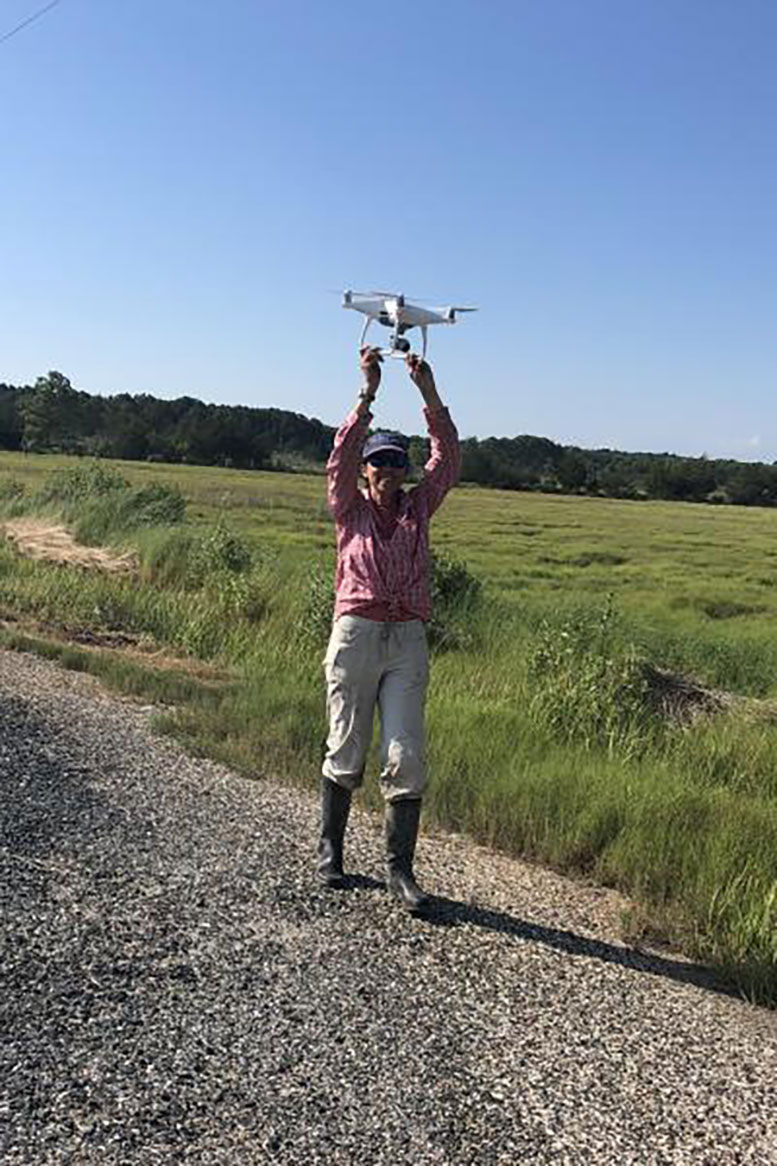
“Some of the berms are still being used and maintained, but a lot of them have been abandoned and are now surrounded by marsh,” said the study’s lead author and Batten School Ph.D. graduate Grace Molino ’25.
For the field portion of the study, Molino and coauthor Grace Levins, a former Batten School & VIMS student intern, visited six farm sites on the Eastern Shore. They found that levees and other structures did reduce saltwater intrusion, bringing the vertical retreat rate closer to what was seen in nearby forests.
Even so, the broader regional pattern showed that farmland remained more vulnerable to saltwater intrusion than forests. New construction is difficult because of complex permitting requirements, and maintained defenses still cannot fully stop farmland from becoming marsh. Crops are also biologically less durable than trees.
“It’s not that farmland is flat and therefore it retreats faster,” Kirwan said. “Trees have lifespans of hundreds of years. It can take decades to kill a tree. Agricultural crops have lifespans of less than a year.”
The overlooked impact of farmland on coastal resilience
Research and policy discussions about human impacts on coastal habitats often focus on urban flood defenses, such as seawalls and hardened shorelines, which can block wetlands from moving inland as seas rise. Yet heavily developed areas make up less than 15% of coastal watersheds in the United States. Most of the nation’s coastline is rural, and the human influence on those landscapes has received far less attention.
“It’s really underappreciated how large human impacts can be even in rural areas where you don’t have the big beach houses, you don’t have the big seawalls,” Kirwan said. “Everything’s more subtle, but they’re still having a big impact.”
Rural communities are also frequently left out of planning discussions about future flood protection and coastal adaptation. The study argues that scientists and policymakers need a different framework for understanding how these landscapes, and the people living on them, respond to marsh encroachment.
Studying those responses is not simple. Researchers often work on public land, where access is straightforward. To study privately owned farmland, Molino had to rely on traditional outreach, including cold calls and door-knocking. She said the effort paid off.
“The landowners there have this unbelievable wealth of knowledge,” Molino said. “Most of them have lived on the land for several generations and know a lot about the neighboring properties and how things have changed.”
At one Maryland site, a landowner who uses the property as a weekend hunting retreat during waterfowl season showed Molino two large impoundment structures he had built on fields that had become too salty for farming. One structure had received partial funding through a U.S. Department of Agriculture program that pays landowners to create wildlife habitat.
Molino said the visit showed how one landowner had responded to saltwater intrusion by changing the use of the land completely. She was also struck that a federal program was available to help support that choice.
“Individual landowner decisions have such a strong influence on the changes that we’re seeing on the coast,” Molino said. “It’s so important to actually get out into the field and talk with them and understand what’s driving these decisions.”
Marsh gains carry costs
Marshes are also threatened by sea level rise. If they cannot build soil quickly enough to keep up with higher tides, they need space to shift inland onto higher ground. In that sense, the loss of farmland can create a faster route for marsh migration and may strengthen coastal resilience. For farmers, however, that same process means losing productive land and income.
Molino believes science can help identify solutions that serve both coastal ecosystems and landowners. She pointed to the Batten School & VIMS mission of providing solutions-focused science and said these farmers are exactly the people she hopes such work can support.
The study has already helped at least one landowner directly. During a field visit, a landowner asked Molino to tell him if she discovered any breaches in his levees so he could repair them. After returning to the lab, she called him with the exact GPS coordinates of the breaches.
Reference: “Sea-level-driven land conversion amplified by coastal agriculture” by Grace D. Molino, Yaping Chen, Grace C. Levins and Matthew L. Kirwan, 18 May 2026, Nature Sustainability.
DOI: 10.1038/s41893-026-01835-6
Funding: U.S. National Science Foundation
Never miss a breakthrough: Join the SciTechDaily newsletter.
Follow us on Google and Google News.
3 Comments
“As sea levels rise because of human-driven CLIMATE CHANGE, saltwater can push inland through groundwater, tidal creeks, and storm surges. … Sea level rise along the Mid-Atlantic coast is happening at about twice the global average.”
Why is there no mention of subsidence, instead putting all the blame on “human-driven climate change?” Indeed, the second half of the quoted text suggests that about half of the relative sea level rise is the result of subsidence. The remainder can only be anthropogenic if all the absolute sea level rise can be attributed to humans. Unfortunately for alarmists, that is an assumption, not proven fact. We are still in a warm interglacial that started well before humans started to use fossil fuels, and there is no evidence suggesting that the current interglacial has peaked.
If attempts at slowing down undesirable affects of de facto climate change are based on false assumptions, then they are doomed to failure. Scientists who are unthinkingly swayed by a commonly accepted paradigm, without demanding incontrovertible proof, are doing the public a disservice. They are also accepting salaries that are unwarranted because of their inability or unwillingness to advance unpopular alternative working hypotheses. A real scientist is a skeptic at heart. That is why physicists are still testing Einstein’s Relativity Theory after more than a century, looking for a failure.
If you don’t trust me, then read this:
https://scitechdaily.com/submerging-skylines-major-east-coast-cities-including-nyc-and-dc-submerging-rapidly/
And this:
https://scitechdaily.com/why-is-the-eastern-u-s-sinking-the-answer-lies-in-an-ice-sheet-from-19000-years-ago/
If the rise in sea level is driven by eight billion humans adding CO2 to the atmosphere what possible realistic solution is there besides infrastructure innovation and adaptation….something that will, itself, add more CO2?
It was appropriate for you to start your first sentence with “if.” I’m not convinced that humans are driving the increase in CO2, nor that the CO2 is solely responsible for the increasing temperatures. Variations in climate have occurred long before humans evolved. Yet, the refrain is that humans are the only thing responsible for today’s warming. Occam’s Razor argues against the necessity of invoking anything other than natural causes for the increase in temperature. We are, after all, still in what geologists call an interglacial, a warm episode for which there is no evidence that it has yet peaked. Empirical evidence demonstrates that seasonal cycles in CO2 are the result of biological processes that are much larger than human emissions. NASA has demonstrated with surveillance satellites that the Earth is ‘Greening,’ or growing more vegetation, which becomes CO2 when it is decomposed by bacteria and fungi. One can expect that the CO2 from decomposition will lag the growing season by at least six-months, if not longer. See Fig. 2 here to see how fossil fuel emissions compare to the natural processes: https://wattsupwiththat.com/2022/03/22/anthropogenic-co2-and-the-expected-results-from-eliminating-it/
The alarmists who are blaming humans for increasing terrestrial and marine primary productivity increases are cherry picking data and not looking at the system in the context of interrelated processes.
There are plenty of things humans can be blamed for, such as over-fishing the oceans because of a population that is too large, or degradation of soil because of intensive agriculture supported by chemical fertilizers, but the accelerated production of CO2 from what we call Fossil Fuels, which will eventually oxidize whether humans use them or not, is probably not one of them.