
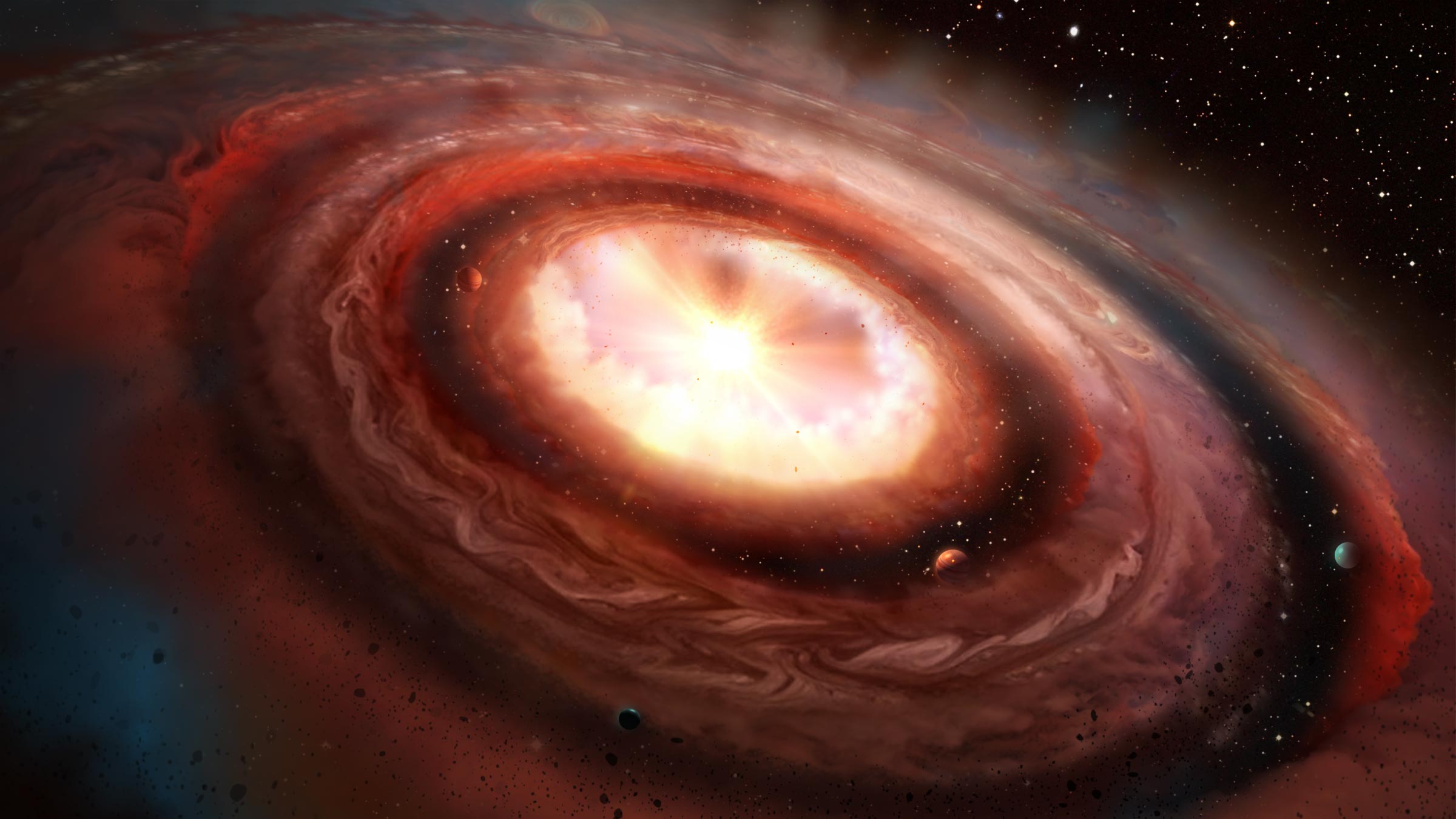
Researchers have developed a new model for planet formation that shows how disturbances in protoplanetary disks can quickly form gas giants. This process is more efficient than previously thought and aligns with recent observations of distant gas giants.
Our immediate cosmic neighborhood is our solar system. We know it well: the Sun at the center; then the rocky planets Mercury, Venus, Earth, and Mars; and then the asteroid belt; followed by the gas giants Jupiter and Saturn; then the ice giants Uranus and Neptune; and finally the Kuiper belt with its comets.
But how well do we really know our home? Previous theories have assumed that giant planets are formed by collisions and accumulations of asteroid-like celestial bodies, so-called planetesimals, and the subsequent accretion of gas over the course of millions of years. However, these models explain neither the existence of gas giants located far from their stars nor the formation of Uranus and Neptune.
Innovative Planet Formation Model
Astrophysicists from Ludwig Maximilian University of Munich (LMU), the ORIGINS cluster, and the Max Planck Institute for Solar System Research (MPS) have developed the first-ever model to incorporate all the necessary physical processes that play a role in planet formation. Using this model, they have shown that annular perturbations in protoplanetary disks, so-called substructures, can trigger the rapid formation of multiple gas giants. The results of the study match the latest observations and indicate that the formation of giant planets could happen more efficiently and quickly than previously thought.
“When a planet gets large enough to influence the gas disk, this leads to renewed dust enrichment farther out in the disk. In the process, the planet drives the dust – like a sheepdog chasing its herd – into the area outside its own orbit.”
Prof. Til Birnstiel
Dynamic Dust Accumulation and Planet Growth
With their model, the researchers demonstrate how millimeter-sized dust particles accumulate aerodynamically in the turbulent gas disk, and how this initial perturbation in the disk traps dust and prevents it from disappearing off in the direction of the star. This accumulation makes the growth of planets very efficient, as suddenly a lot of “building material” is available within a compact area and the right conditions for planet formation are present.
“When a planet gets large enough to influence the gas disk, this leads to renewed dust enrichment farther out in the disk,” explains Til Birnstiel, Professor of Theoretical Astrophysics at LMU and member of the ORIGINS Cluster of Excellence. “In the process, the planet drives the dust – like a sheepdog chasing its herd – into the area outside its own orbit.” The process begins anew, from inside to outside, and another giant planet can form. “This is the first time a simulation has traced the process whereby fine dust grows into giant planets,” observes Tommy Chi Ho Lau, lead author of the study and doctoral candidate at LMU.
Implications for Gas Giants Formation
In our solar system, the gas giants are situated at a distance of around 5 astronomical units (au) (Jupiter) to 30 au (Neptune) from the Sun. For comparison, the Earth is some 150 million kilometers from the Sun, which is equivalent to 1 au.
The study shows that in other planetary systems, a perturbation could set the process in motion at much larger distances and still happen very rapidly. Such systems have been observed frequently in recent years by the ALMA radio observatory, which has found gas giants in young disks at a distance beyond 200 au. However, the model also explains why our solar system apparently stopped forming additional planets after Neptune: the building material was simply used up.
The results of the study match current observations of young planetary systems that have pronounced substructures in their disks. These substructures play a decisive role in planet formation. The study indicates that the formation of giant planets and gas giants proceeds with greater efficiency and speed than previously assumed. These new insights could refine our understanding of the origin and development of the giant planets in our solar system and explain the diversity of observed planetary systems.
Reference: “Sequential giant planet formation initiated by disc substructure” by Tommy Chi Ho Lau, Til Birnstiel, Joanna Drążkowska and Sebastian Markus Stammler, 31 July 2024, Astronomy & Astrophysics.
DOI: 10.1051/0004-6361/202450464
Never miss a breakthrough: Join the SciTechDaily newsletter.
Follow us on Google and Google News.