
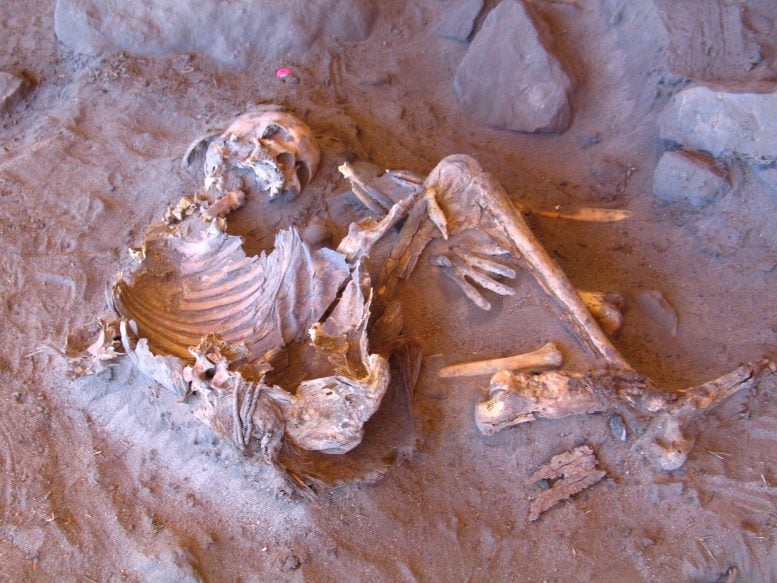
A new study reveals that a distinct North African human lineage lived in the Central Sahara over 7,000 years ago, during the African humid period. This population had been long isolated from other groups.
DNA analysis of two naturally mummified individuals from Libya, dating back over 7,000 years to the African Humid Period (also known as the Green Sahara), reveals the presence of a long-isolated human lineage in North Africa.
These individuals show no signs of sub-Saharan African ancestry, challenging the idea that the Green Sahara acted as a migration route between North and sub-Saharan Africa. Instead, the spread of herding in the region likely occurred through cultural exchange rather than large-scale population movement. Additionally, the genomes show significantly lower levels of Neandertal DNA compared to non-African populations, further supporting the isolation of this North African group.
A new study offers important new insights into the African Humid Period, which lasted from about 14,500 to 5,000 years ago. During this time, the Sahara was a green savanna dotted with lakes and rivers, creating favorable conditions for human settlement and the development of pastoralism. As the climate shifted and the region became arid, the Sahara transformed into the vast desert we see today. Because of the current harsh conditions, DNA preservation in the area is rare, making this ancient DNA study especially valuable.
Genomic analysis shows that the individuals from the Takarkori rock shelter trace most of their ancestry to a North African lineage that separated from sub-Saharan African populations around the same time modern humans began migrating out of Africa roughly 50,000 years ago.
This lineage remained isolated, demonstrating long-term genetic continuity in North Africa through the late Ice Age. Although this lineage no longer exists in a pure form, it remains a key part of the genetic makeup of modern North African populations, underscoring their distinct ancestry.

North Africa remained genetically isolated
The research also shows that these ancient individuals are closely related to 15,000-year-old foragers from Taforalt Cave in Morocco, associated with the Iberomaurusian stone tool tradition that predates the African Humid Period.
Both populations are equally distant from sub-Saharan African groups, suggesting that even when the Sahara was green and habitable, genetic exchange between North African and sub-Saharan populations remained limited—challenging previous assumptions about widespread contact during this time.

The study also sheds light on Neandertal ancestry, showing that the Takarkori individuals have ten-fold less Neandertal DNA than people outside Africa, but more than contemporary sub-Saharan Africans. “Our findings suggest that while early North African populations were largely isolated, they received traces of Neandertal DNA due to gene flow from outside Africa,” said senior author Johannes Krause, director at the Max Planck Institute for Evolutionary Anthropology.
The spread of pastoralism in the Green Sahara
“Our research challenges previous assumptions about North African population history and highlights the existence of a deeply rooted and long-isolated genetic lineage,” said first author Nada Salem from the Max Planck Institute for Evolutionary Anthropology. “This discovery reveals how pastoralism spread across the Green Sahara, likely through cultural exchange rather than large-scale migration.”
“The study highlights the importance of ancient DNA for reconstructing human history in regions like Central Northern Africa, providing independent support to archaeological hypotheses,” said senior author David Caramelli from the University of Florence. “By shedding light on the Sahara’s deep past, we aim to increase our knowledge of human migrations, adaptations, and cultural evolution in this key region,” added senior author Savino di Lernia from Sapienza University in Rome.
Reference: “Ancient DNA from the Green Sahara reveals ancestral North African lineage” by Nada Salem, Marieke S. van de Loosdrecht, Arev Pelin Sümer, Stefania Vai, Alexander Hübner, Benjamin Peter, Raffaela A. Bianco, Martina Lari, Alessandra Modi, Mohamed Faraj Mohamed Al-Faloos, Mustafa Turjman, Abdeljalil Bouzouggar, Mary Anne Tafuri, Giorgio Manzi, Rocco Rotunno, Kay Prüfer, Harald Ringbauer, David Caramelli, Savino di Lernia and Johannes Krause, 2 April 2025, Nature.
DOI: 10.1038/s41586-025-08793-7
Never miss a breakthrough: Join the SciTechDaily newsletter.
Follow us on Google and Google News.
3 Comments
Not authentic , this article seems to focus on Africans , specially how to erase the facial Saharan painting , through your dna
Regardless their African looking rock art as well as paintings, these individuals are not African at all .
By the way , who are North Africans . What are their mother race ancestry .
Who are their living descendants now .
they had already done a study on this and they actually provide the genetic markers. the fact that this article provides no genetic markers I should tell you everything that you need to know about the article; much the same way that most news outlets do not announce the race of the perpetrator… on top of this, the out of Africa hypothesis, which is just that; a hypothesis, was proven wrong in 2007 and 2013.
I don’t know why they keep printing this lie, but there is no “out of Africa” .