
Want to get the hottest ticket this summer without standing in line?
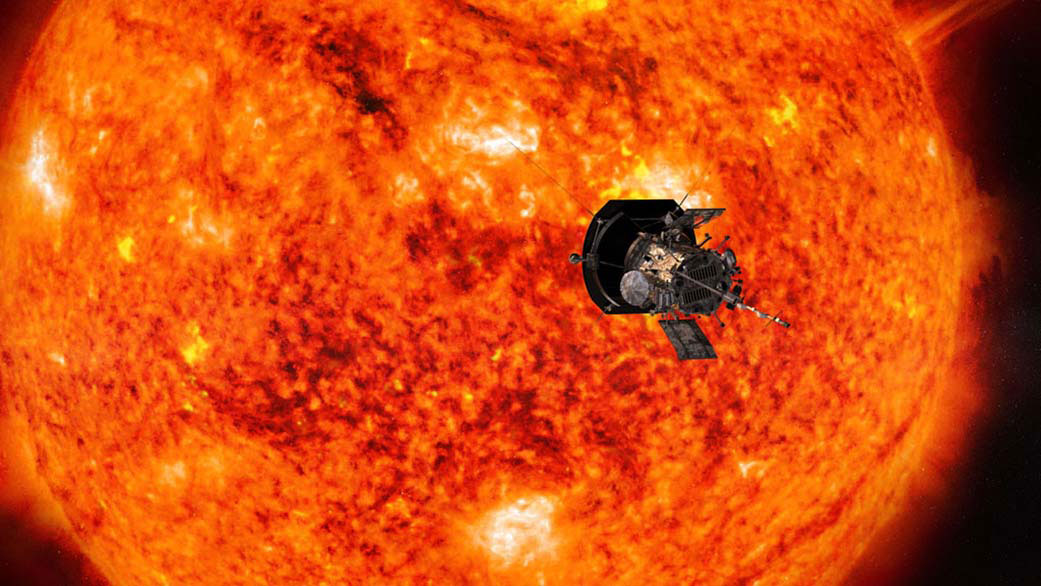
NASA is inviting people around the world to submit their names online to be placed on a microchip aboard NASA’s historic Parker Solar Probe mission launching in the summer of 2018. The mission will travel through the Sun’s atmosphere, facing brutal heat and radiation conditions — and your name will go along for the ride.
“This probe will journey to a region humanity has never explored before,” said Thomas Zurbuchen, the associate administrator for the Science Mission Directorate at NASA Headquarters in Washington. “This mission will answer questions scientists have sought to uncover for more than six decades.”
Understanding the Sun has always been a top priority for space scientists. Studying how the Sun affects space and the space environment of planets is the field known as heliophysics. The field is not only vital to understanding Earth’s most important and life-sustaining star, it supports exploration in the solar system and beyond.
Submissions will be accepted until April 27, 2018. Learn more and add your name to the mission here: http://go.nasa.gov/HotTicket
Star Trek’s William Shatner, on behalf of NASA, invites you to send your name where it’s never gone before: the Sun, by way of NASA’s Parker Solar Probe. Credit: NASA’s Goddard Space Flight Center/Rich Melnick
The spacecraft, about the size of a small car, will travel directly into the Sun’s atmosphere about 4 million miles from the star’s surface. The primary science goals for the mission are to trace how energy and heat move through the solar corona and to explore what accelerates the solar wind as well as solar energetic particles. The mission will revolutionize our understanding of the Sun, where changing conditions can spread out into the solar system, affecting Earth and other worlds.
To perform these unprecedented investigations, the spacecraft and instruments will be protected from the Sun’s heat by a 4.5-inch-thick carbon-composite shield, which will need to withstand temperatures outside the spacecraft that reach nearly 2,500 F (1,370 C). This state-of-the-art heat shield will keep the four instrument suites designed to study magnetic fields, plasma and energetic particles, and image the solar wind at room temperature.
The spacecraft speed is so fast, at its closest approach it will be going at approximately 430,000 mph (692,000 kph). That’s fast enough to get from Washington, D.C., to Tokyo in under a minute.
“Parker Solar Probe is, quite literally, the fastest, hottest — and, to me, coolest — mission under the Sun,” said project scientist Nicola Fox, of the Johns Hopkins Applied Physics Laboratory. “This incredible spacecraft is going to reveal so much about our star and how it works that we’ve not been able to understand.”
Honoring a Science Legend
In May 2017, NASA renamed the spacecraft from the Solar Probe Plus to the Parker Solar Probe in honor of astrophysicist Eugene Parker. The announcement was made at a ceremony at the University of Chicago, where Parker serves as the S. Chandrasekhar Distinguished Service Professor Emeritus, Department of Astronomy and Astrophysics.
This was the first time NASA named a spacecraft for a living individual.
NASA missions are most often renamed after launch and certification. In this case, given Parker’s accomplishments within the field, and how closely aligned this mission is with his research, the decision was made to honor him prior to launch, in order to draw attention to his important contributions to heliophysics and space science.
In the 1950s, Parker proposed a number of concepts about how stars — including our Sun — give off energy. He called this cascade of energy the solar wind, and he described an entire complex system of plasmas, magnetic fields, and energetic particles that make up this phenomenon. Parker also theorized an explanation for the superheated solar atmosphere, the corona, which is — contrary to what was expected by physics laws — hotter than the surface of the Sun itself. Many NASA missions have continued to focus on this complex space environment defined by our star.

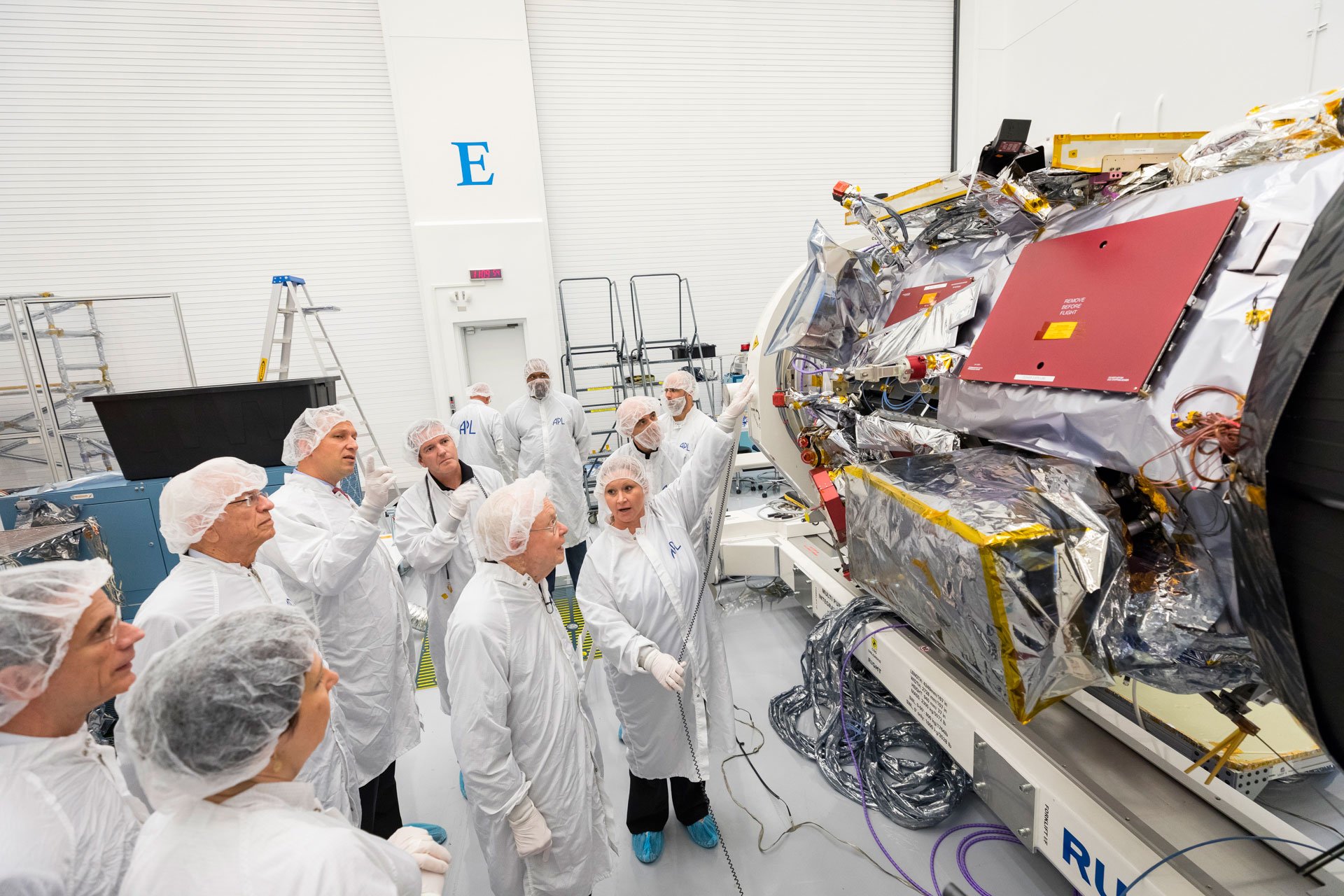
Parker Solar Probe is part of NASA’s Living with a Star Program, or LWS, to explore aspects of the Sun-Earth system that directly affect life and society. LWS is managed by the NASA’s Goddard Space Flight Center in Greenbelt, Maryland, for NASA’s Science Mission Directorate in Washington. The Johns Hopkins Applied Physics Laboratory, in Laurel, Maryland, manages the Parker Solar Probe mission for NASA. APL is designing and building the spacecraft and will also operate it.
Never miss a breakthrough: Join the SciTechDaily newsletter.
Follow us on Google and Google News.
1 Comment
..