

Adopting the American Heart Association’s Life’s Simple 7 habits, including exercise and healthy eating, may reduce dementia risk.
New research that followed female participants for two decades has found that seven healthy habits and lifestyle factors may play a role in lowering the risk of dementia. The preliminary study released on February 27, 2023, will be presented at the American Academy of Neurology’s 75th Annual Meeting being held in person in Boston and live online from April 22-27, 2023.
The seven cardiovascular and brain health factors, known as the American Heart Association’s Life’s Simple 7, are: being active, eating better, maintaining a healthy weight, not smoking, maintaining a healthy blood pressure, controlling cholesterol, and having low blood sugar.
“Since we now know that dementia can begin in the brain decades before diagnosis, it’s important that we learn more about how your habits in middle age can affect your risk of dementia in old age,” said Pamela Rist, ScD, of Brigham and Women’s Hospital in Boston, Massachusetts, and a member of the American Academy of Neurology. “The good news is that making healthy lifestyle choices in middle age may lead to a decreased risk of dementia later in life.”
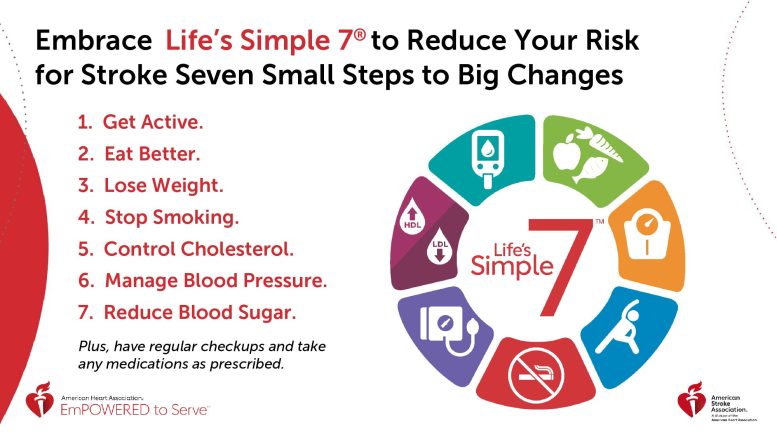
The American Heart Association’s Life’s Simple 7 is a set of health goals designed to help people improve their overall health and reduce their risk of heart disease, stroke, and other chronic conditions. These seven goals include:
- Manage blood pressure: Keeping your blood pressure within a healthy range can reduce your risk of heart disease and stroke.
- Control cholesterol: High levels of cholesterol in the blood can increase your risk of heart disease.
- Reduce blood sugar: High blood sugar levels can increase your risk of developing type 2 diabetes and other chronic conditions.
- Get active: Regular physical activity can improve your overall health and reduce your risk of chronic conditions.
- Eat better: A healthy diet can reduce your risk of chronic conditions and improve your overall health.
- Lose weight: Maintaining a healthy weight can reduce your risk of chronic conditions and improve your overall health.
- Stop smoking: Quitting smoking can reduce your risk of heart disease, stroke, and other chronic conditions.
By focusing on these seven goals, individuals can make positive lifestyle changes that can lead to better health outcomes and a lower risk of chronic conditions.
The study involved 13,720 female participants with an average age of 54 at the start of the study.
After 20 years of follow-up, researchers looked at Medicare data to identify those who had been diagnosed with dementia.
Of the participants, 1,771, or 13%, developed dementia.
For each of the seven health factors, participants were given a score of zero for poor or intermediate health and one point for ideal health, for a total possible score of 7. The average score was 4.3 at the start of the study and 4.2 10 years later.
After adjusting for factors like age and education, researchers found that for every increase of one point in the score, a participant’s risk of dementia decreased by 6%.
“It can be empowering for people to know that by taking steps such as exercising for half an hour a day or keeping their blood pressure under control, they can reduce their risk of dementia,” Rist added.
A limitation of the study was that researchers were unable to look at how changes in factors such as quitting smoking influenced the risk of dementia later in life.
The study was supported by the National Institutes of Health.
Never miss a breakthrough: Join the SciTechDaily newsletter.
Follow us on Google and Google News.
2 Comments
Why haven’t you informed the White House?
Old news with my same (nearly) old comments; undiagnosed long-term chronic nearly subclinical allergy reactions aggravated (or not) with FDA approved food poisoning (namely added MSG and soy; others) and related medical errors are the underlying causes of so much chronic illness and premature mortality among the elderly. Still a victim, of forty-two years and counting and free of any prescription drugs and living independently at age 79, “experience-based” medicine is superior to “evidence-based.” The AHA should know by now, as I’ve written them a couple of times already.