
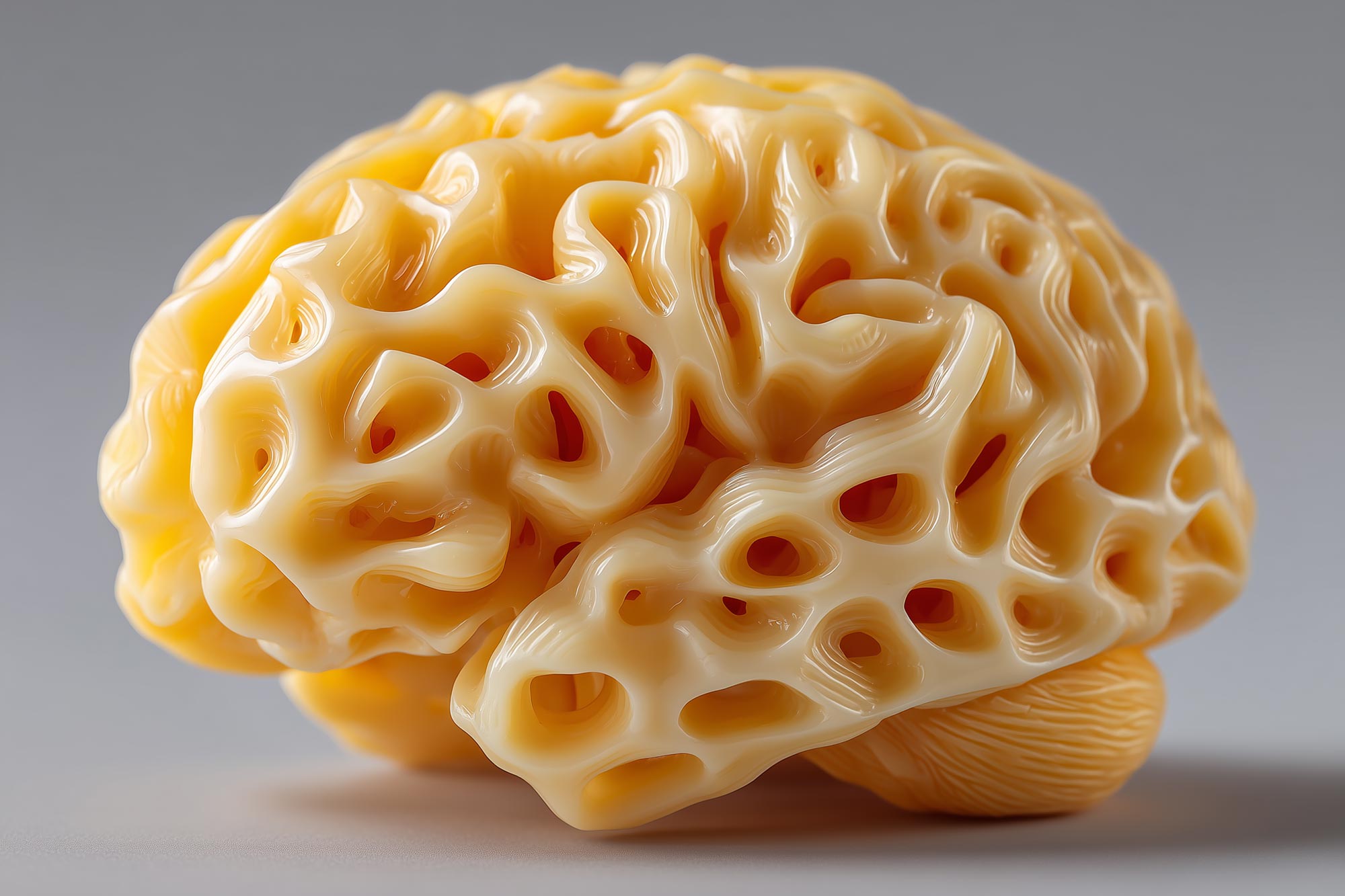
That slice of full-fat cheese might not just be indulgent—it could be linked to a healthier brain.
- A large new study suggests that people who regularly eat high-fat cheese and cream may have a lower risk of developing dementia later in life.
- High-fat cheeses are defined as containing more than 20% fat and include popular varieties such as cheddar, Brie, and Gouda.
- Participants who ate 50 grams or more of high-fat cheese each day showed a 13% lower risk of dementia compared with those who ate less than 15 grams daily.
- Those who consumed at least 20 grams of high-fat cream per day also had a reduced dementia risk, about 16% lower than people who did not consume cream.
- The same pattern was not seen with low-fat cheese, low-fat cream, milk, butter, or fermented milk products.
- Researchers say additional studies are needed to confirm these findings and to better understand whether certain high-fat dairy foods could help support brain health.
Full-Fat Dairy and Dementia Risk
A large new study suggests that people who eat more high-fat cheese and high-fat cream may have a lower chance of developing dementia later in life. The research was published today (December 17, 2025) in Neurology, the medical journal of the American Academy of Neurology. The findings show a relationship between these foods and dementia risk, but they do not prove that eating high-fat dairy prevents dementia.
High-fat cheeses are defined as containing more than 20% fat and include familiar varieties such as cheddar, Brie, and Gouda. High-fat creams usually contain 30-40% fat and include whipping cream, double cream, and clotted cream. In grocery stores, these products are typically labeled as “full-fat” or “regular.”
“For decades, the debate over high-fat versus low-fat diets has shaped health advice, sometimes even categorizing cheese as an unhealthy food to limit,” said Emily Sonestedt, PhD, of Lund University, Sweden. “Our study found that some high-fat dairy products may actually lower the risk of dementia, challenging some long-held assumptions about fat and brain health.”
How the Long-Term Study Was Conducted
The researchers examined health and diet data from 27,670 adults in Sweden. Participants were about 58 years old on average when the study began and were followed for roughly 25 years. Over that time, 3,208 people were diagnosed with dementia.
To assess diet, participants recorded everything they ate over the course of a week and answered detailed questions about how often they consumed different foods during the previous years. They also discussed their cooking and food preparation habits with the research team.
Cheese Intake and Dementia Outcomes
One key comparison focused on daily cheese consumption. Researchers looked at people who ate at least 50 grams of high-fat cheese per day and compared them with those who ate less than 15 grams daily. Fifty grams of cheese is roughly equal to two slices of cheddar or about half a cup of shredded cheese, and is approximately 1.8 ounces. A standard serving of cheese is one ounce.
By the end of the study, 10% of people in the higher cheese group had developed dementia, compared with 13% in the lower intake group. After accounting for factors such as age, sex, education, and overall diet quality, the researchers found that higher cheese consumption was associated with a 13% lower risk of dementia overall.
When specific forms of dementia were analyzed, the association was even stronger for vascular dementia. People who consumed more high-fat cheese had a 29% lower risk of developing this type.
The researchers also observed a lower risk of Alzheimer’s disease among people who ate more high-fat cheese, but only in those who did not carry the APOE e4 gene variant—a genetic risk factor for Alzheimer’s disease.
Cream Consumption and Dementia Risk
The study also examined high-fat cream intake. Researchers compared participants who consumed at least 20 grams of high-fat cream per day with those who did not consume any. Twenty grams of high-fat cream is about 1.4 tablespoons of heavy whipping cream. A recommended serving is about 1-2 tablespoons.
After adjusting for the same health and lifestyle factors, people who consumed high-fat cream daily had a 16% lower risk of developing dementia compared with those who avoided it entirely.
Not All Dairy Showed the Same Pattern
The protective association was not seen across all dairy products. The researchers found no link between dementia risk and low-fat cheese, low-fat cream, high- or low-fat milk, butter, or fermented milk, which includes yogurt, kefir, and buttermilk.
“These findings suggest that when it comes to brain health not all dairy is equal,” said Sonestedt. “While eating more high-fat cheese and cream was linked to a reduced risk of dementia, other dairy products and low-fat alternatives did not show the same effect. More research is needed to confirm our study results and further explore whether consuming certain high-fat dairy truly offers some level of protection for the brain.”
Study Limitations and What Comes Next
One limitation of the research is that all participants lived in Sweden, meaning the results may not apply to other populations. Sonestedt noted that eating habits also differ by country. In Sweden, cheese is often eaten uncooked, while in the United States, cheese is frequently heated or consumed with meat. Because of these differences, she emphasized the importance of conducting similar studies in the United States.
Reference: “High- and Low-Fat Dairy Consumption and Long-Term Risk of DementiaEvidence From a 25-Year Prospective Cohort Study” by Yufeng Du, Yan Borné, Jessica Samuelsson, Isabelle Glans, Xiaobin Hu, Katarina Nägga, Sebastian Palmqvist, Oskar Hansson and Emily Sonestedt, 17 December 2025, Neurology.
DOI: 10.1212/WNL.0000000000214343
The study was supported by the Swedish Research Council, the Swedish Heart and Lung Foundation, the Crafoord Foundation, the Magnus Bergvall Foundation, and the Albert Påhlsson Foundation.
Never miss a breakthrough: Join the SciTechDaily newsletter.
Follow us on Google and Google News.
2 Comments
Just a question:
Which kind of milk , cow milk, or goat milk?
Thanks
Cheese Gromit, a nice bit of Wensleydale.