
Close Menu
    Facebook X (Twitter) Instagram
    SciTechDaily
    • Biology
    • Chemistry
    • Earth
    • Health
    • Physics
    • Science
    • Space
    • Technology
    Facebook X (Twitter) Pinterest YouTube RSS
    SciTechDaily
    Home»Biology»Shaking Up Our Understanding: Ethereal Variant of Mysterious Plant Is Actually a New Species
    Biology

    Shaking Up Our Understanding: Ethereal Variant of Mysterious Plant Is Actually a New Species

    By Kobe UniversityJanuary 31, 2023No Comments5 Mins Read
    Facebook Twitter Pinterest Telegram LinkedIn WhatsApp Email Reddit
    Share
    Facebook Twitter LinkedIn Pinterest Telegram Email Reddit
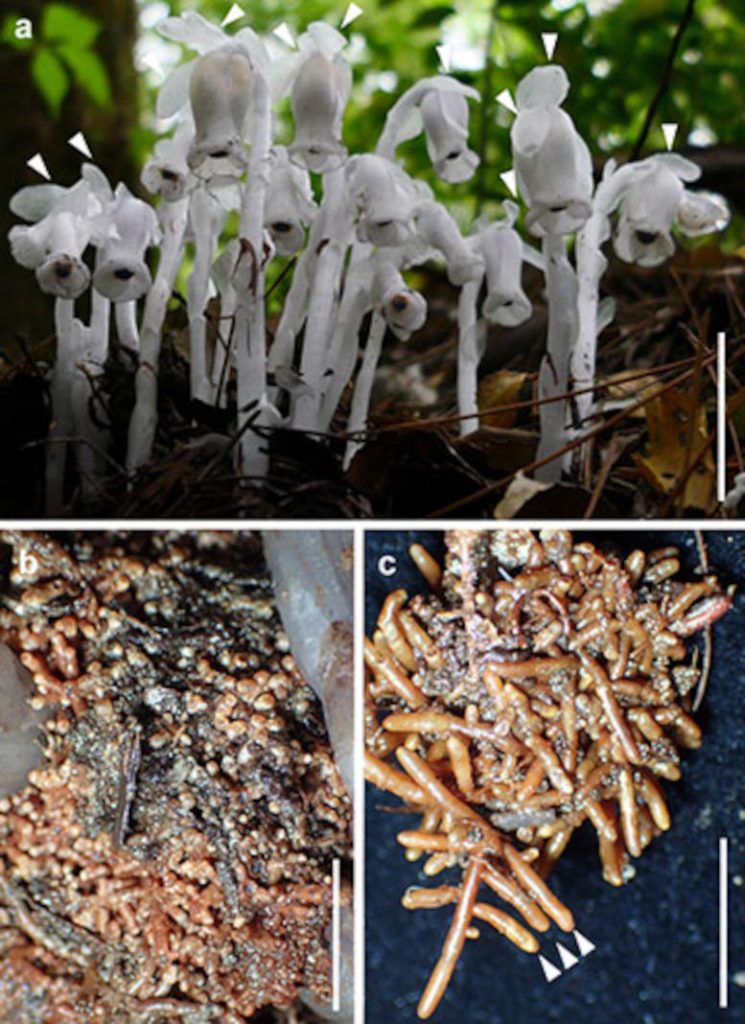
    M. humile Plants That Grow in the Same Locality As M. kirishimense
    (a). Flowering plants, (b). Underground part of the plant, (c). The rootball. As indicated by the arrowheads, the root tips are easily recognizable. Scale bar: 3 cm (a), 1 cm (b), 5 mm (c). Photographed by Hideo Shimada (a) and Kenji Suetsugu (b-c). Credit: Suetsugu, K., Hirota, S.K., Hsu, TC. et al. Monotropastrum kirishimense (Ericaceae), a new mycoheterotrophic plant from Japan based on multifaceted evidence. J Plant Res (2022).

    Plants Beyond Photosynthesis: The Mystery of Mycoheterotrophic Life

    It was once thought that green leaves and photosynthesis were essential for plants, however, some plants have evolved to obtain their nutrients from other organisms instead. One such plant is Monotropastrum humile, a ghostly-looking species that is widely found across East and Southeast Asia. This mycoheterotrophic plant thrives in woodlands with limited sunlight, obtaining its nutrients by feeding off the hyphae of fungi.

    Despite its wide distribution, it was previously believed that only one species of this plant existed in the world. However, Professor Suetsugu Kenji and colleagues have discovered that a variant found in Japan is actually a new species, shaking up our understanding of this unusual-looking genus of plants.
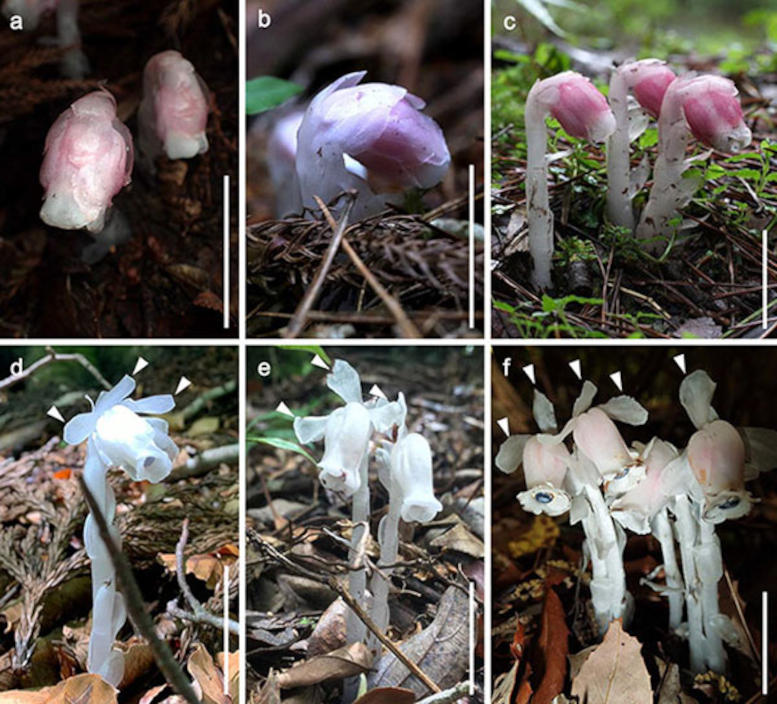
    Morphological Comparison of the Aboveground Parts of M. kirishimense and M. humile
    (a-c) M. kirishimense, (d-e) M. humile, (f). M. humile f. roseum (color variant of M. humile). The arrowheads indicate spreading sepals. Photographed by Masayuki Sato (a), Katsumi Iwahori (b), Shuichi Kurogi (c), Shin Terui (d), Kazushige Uemori (e), and Kenji Suetsugu (f). Credit: Suetsugu, K., Hirota, S.K., Hsu, TC. et al. Monotropastrum kirishimense (Ericaceae), a new mycoheterotrophic plant from Japan based on multifaceted evidence. J Plant Res (2022).

    It has rosy pink petals and stems resembling milk glass, giving it a beautiful, otherworldly appearance. As it was first found around Kirishima in Kagoshima Prefecture, Japan, the new species has been named Monotropastrum kirishimense.

    Originally, this new species was tentatively treated as a color variant of M. humile, known as M. humile f. roseum. Thus began an extensive and multifaceted 20-year study to determine how exactly these plants differed. Specimens were collected from throughout Japan and Taiwan, as well as Vietnam.

    Fungal Lineages Associated With M. kirishimense and M. humile
    M. kirishimense and M. humile (including color variant M. humile f. roseum) depend on different lineages of fungi. Credit: Suetsugu, K., Hirota, S.K., Hsu, TC. et al. Monotropastrum kirishimense (Ericaceae), a new mycoheterotrophic plant from Japan based on multifaceted evidence. J Plant Res (2022).

    Results of various analyses revealed morphological differences (Figures 1-3), including the following; M. kirishimense flowers and ovaries are more rounded than those of M. humile, and its rootball is more obscured by the surrounding soil (in contrast to M. humile’s protruding root tips). M. kirishimense individuals are shorter above ground (under 5cm) and longer below ground (over 10cm).

    The flowering season is different too; M. humile flowers bloom approximately 40 days earlier than M. kirishimense. As the two plant species have the same primary pollinator (the bumblebee Bombus diversus), this difference in flowering times can reduce heterospecific pollen deposition, helping to ensure conspecific mating, and thereby preventing them from producing hybrids.
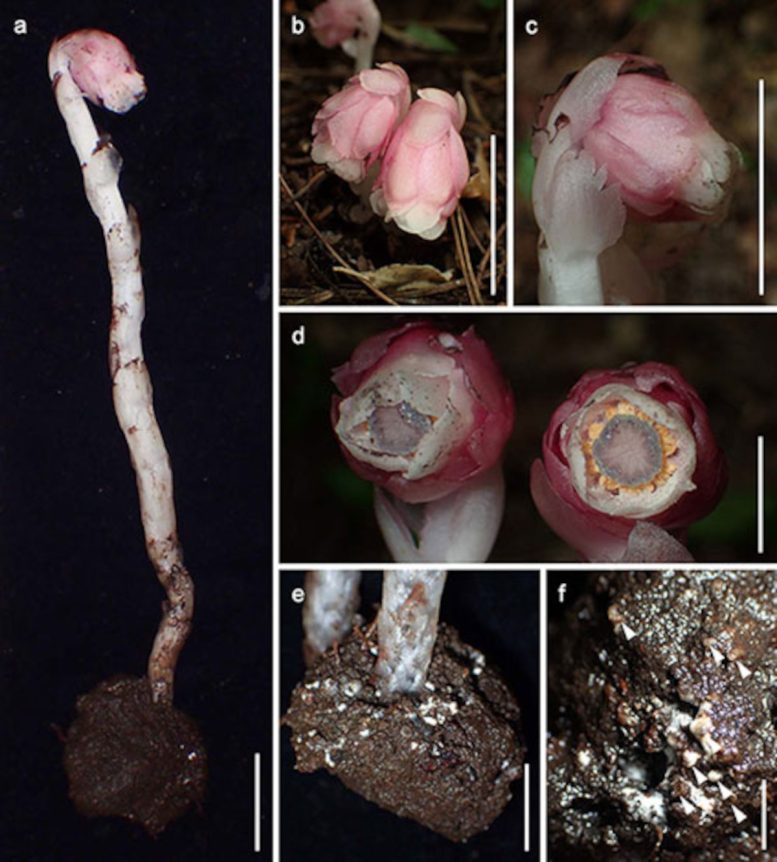
    M. kirishimense
    (a). An individual flowering plant, (b-d). Magnified flowers (e). Underground part of the plant, (f). Magnified image of the rootball. As indicated by the arrowheads, root tips are not apparent but white fungal hyphae are visible. Scale bar: 3 cm (a-c), 1 cm (d, e), 5 mm (f). Photographed by Kenji Suetsugu. Credit: Suetsugu, K., Hirota, S.K., Hsu, TC. et al. Monotropastrum kirishimense (Ericaceae), a new mycoheterotrophic plant from Japan based on multifaceted evidence. J Plant Res (2022).

    There are several other possible reasons why M. kirishimense and M. humile may have evolved into separate species. One possibility is that they have become specialized in feeding on different fungi, which has led to reproductive isolation, or the inability to produce offspring together. This process is known as resource partitioning and is one of the major ways that species can evolve from a common ancestor. Genetic analysis of mycobionts revealed that M. kirishimense has a consistent, specialized association with a particular lineage of fungi, whereas M. humile is associated with different lineages (Figure 4).

    Therefore, this study suggests that M. kirishimense may have evolved into a new species by relying on a specific type of fungus. In fact, the phylogenetic tree (a ‘family tree’ of the evolutionary history of a group of organisms) of the plants themselves shows that the genetic characteristics of M. kirishimense and M. humile can be separated into two clades (Figure 5). Based on the researchers’ analysis of various characteristics, it has been revealed that M. kirishimense is distinct from M. humile in terms of its appearance, flowering patterns, evolutionary history, and ecological relationships. Therefore, the researchers concluded that it should be recognized as an independent species.
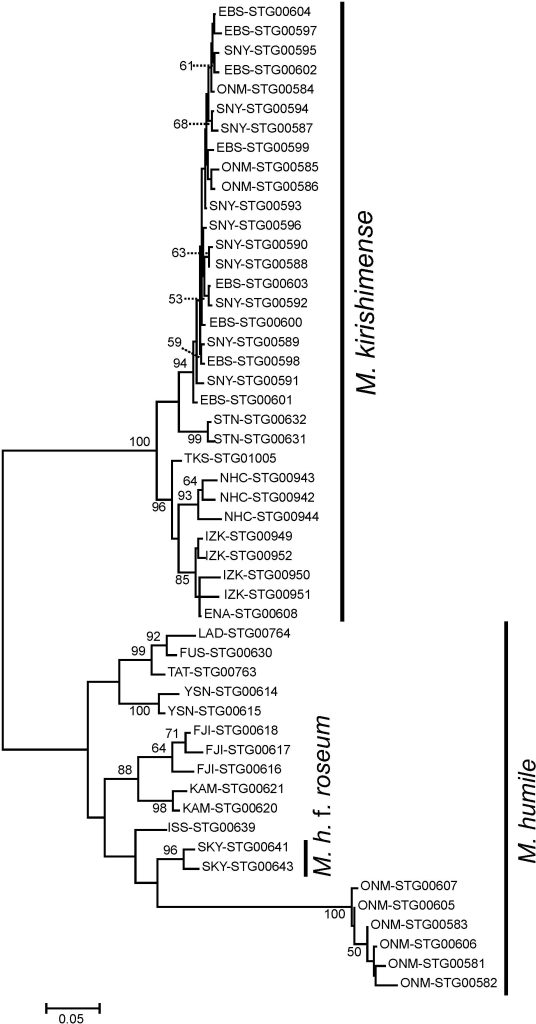
    The Phylogenetic Tree for M. kirishimense and M. humile
    The genetic characteristics of M. kirishimense and M. humile (including color variant M. humile f. roseum) are clearly separated. Credit: Suetsugu, K., Hirota, S.K., Hsu, TC. et al. Monotropastrum kirishimense (Ericaceae), a new mycoheterotrophic plant from Japan based on multifaceted evidence. J Plant Res (2022)

    Overall, the research group not only revealed that M. kirishimense is a distinct species but also deepened the understanding of plants in the Monotropastrum genus. Mycohetrotrophic plants are very vulnerable to extinction as they rely on specific ecosystems to survive and are usually found in old-growth forests. The newly recognized species, M. kirishimense, is rare and presumably endangered.

    Now that it has been identified as a new species, conservation efforts can be made to protect it. This study emphasizes the importance of combining various analysis methods, called integrative taxonomy, to fully understand and protect biodiversity.

    Reference: “Monotropastrum kirishimense (Ericaceae), a new mycoheterotrophic plant from Japan based on multifaceted evidence by Kenji Suetsugu, Shun K. Hirota, Tian-Chuan Hsu, Shuichi Kurogi, Akio Imamura and Yoshihisa Suyama, 29 November 2022, Journal of Plant Research.
    DOI: 10.1007/s10265-022-01422-8

    Never miss a breakthrough: Join the SciTechDaily newsletter.
    Follow us on Google and Google News.

    Biodiversity Ecology Fungi Plant Science Plants
    Share. Facebook Twitter Pinterest LinkedIn Email Reddit

    Related Articles

    ”Contrary to All Expectations” – Remote Plant Worlds of Tenerife Challenge Evolutionary Norms

    Rediscovery of the Elusive Fairy Lantern: Thismia kobensis Emerges After 30 Years

    Life Mystery Solved: What Determines the Lifespan of a Tree Leaf?

    Alien Species Predicted to Increase by 36% Worldwide by 2050

    Extent of Human Impact on the World’s Plant Life Revealed in New Research

    Disappearing Glaciers Puts Alpine Plants at Risk of Extinction

    World’s Largest Inventory of Known Plant Species Compiled by German Researchers

    A Glimpse Into the Future of Diverse Tropical Forests

    Chinese Plant Biodiversity at Risk Due to Human Activity

    Leave A Reply Cancel Reply

    • Facebook
    • Twitter
    • Pinterest
    • YouTube

    Don't Miss a Discovery

    Subscribe for the Latest in Science & Tech!

    Trending News

    The Universe Is Expanding Too Fast and Scientists Can’t Explain Why

    “Like Liquid Metal”: Scientists Create Strange Shape-Shifting Material

    Early Warning Signals of Esophageal Cancer May Be Hiding in Plain Sight

    Common Blood Pressure Drug Shows Surprising Power Against Deadly Antibiotic-Resistant Superbug

    Scientists Uncover Dangerous Connection Between Serotonin and Heart Valve Disease

    Scientists Discover a “Protector” Protein That Could Help Reverse Hair Loss

    Bone-Strengthening Discovery Could Reverse Osteoporosis

    Scientists Uncover Hidden Trigger Behind Stem Cell Aging

    Follow SciTechDaily
    • Facebook
    • Twitter
    • YouTube
    • Pinterest
    • Newsletter
    • RSS
    SciTech News
    • Biology News
    • Chemistry News
    • Earth News
    • Health News
    • Physics News
    • Science News
    • Space News
    • Technology News
    Recent Posts
    • Scientists Create Improved Insulin Cells That Reverse Diabetes in Mice
    • Scientists Stunned After Finding Plant Thought Extinct for 60 Years
    • A Common Diabetes Drug May Hold the Key to Stopping HIV From Coming Back
    • Ancient “Syphilis-Like” Disease in Vietnam Challenges Key Scientific Assumptions
    • Drinking Alcohol To Cope in Your 20s Could Damage Your Brain for Life
    Copyright © 1998 - 2026 SciTechDaily. All Rights Reserved.
    • Science News
    • About
    • Contact
    • Editorial Board
    • Privacy Policy
    • Terms of Use

    Type above and press Enter to search. Press Esc to cancel.