
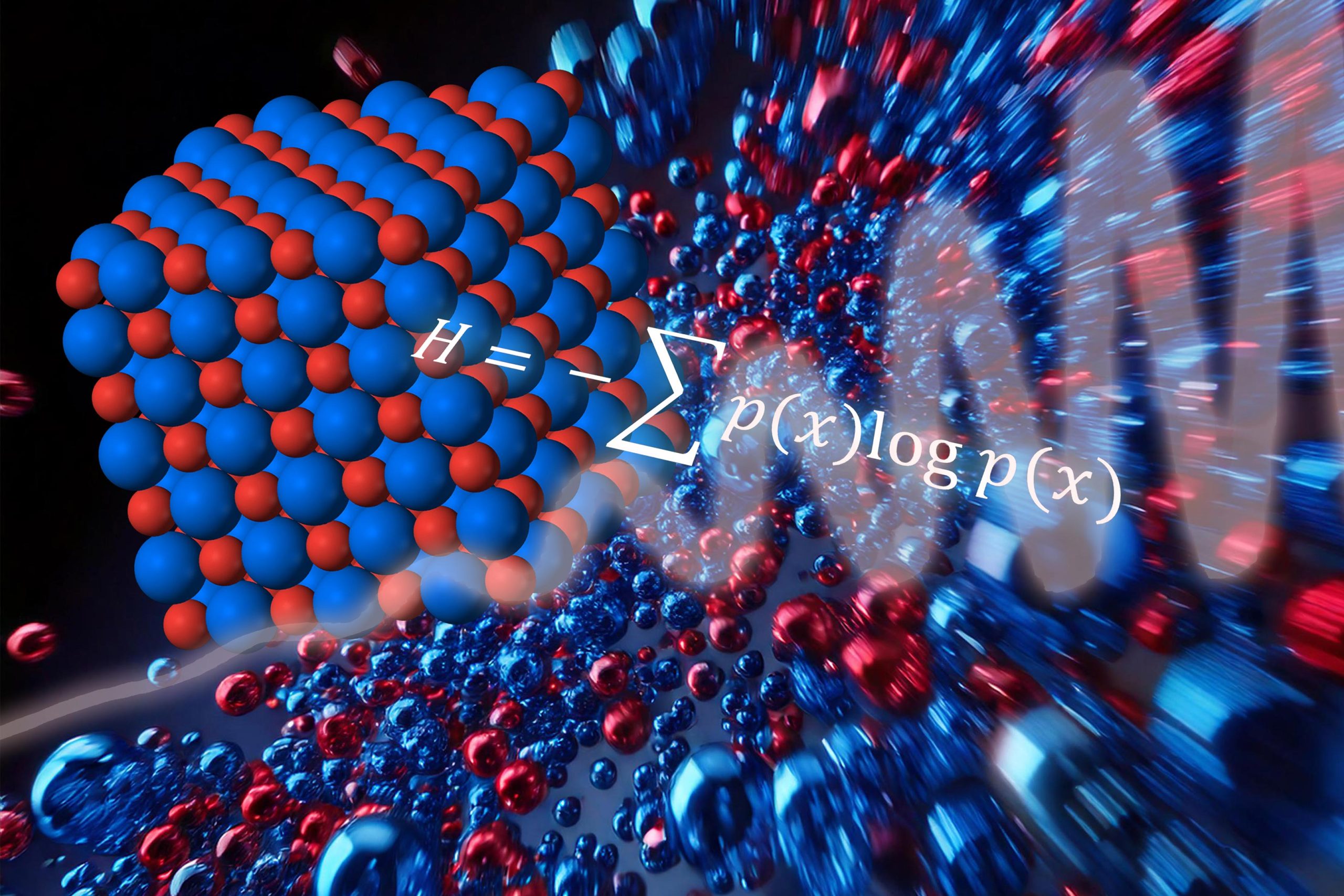
Entropy always increases, but in quantum systems, traditional entropy measures seem constant. TU Wien researchers resolved this paradox by considering Shannon entropy, which accounts for the uncertainty in measurements.
Their work proves that even in isolated quantum systems, disorder naturally grows, aligning quantum mechanics with thermodynamics.
The Paradox of Entropy in Quantum Physics
The second law of thermodynamics is one of the fundamental principles of nature. It states that in a closed system, entropy — the measure of disorder — must always increase over time. This explains why structured systems naturally break down: ice melts into water, and a shattered vase will never reassemble itself. However, quantum physics appears to challenge this rule. Mathematically, entropy in quantum systems seems to remain unchanged, raising a puzzling contradiction.
A research team at TU Wien investigated this apparent inconsistency and found that the answer depends on how entropy is defined. When entropy is measured in a way that aligns with quantum mechanics, the contradiction disappears. Just like in classical physics, entropy in quantum systems increases, leading initially ordered systems toward disorder.
Entropy and the Direction of Time
While entropy is often associated with disorder, the two are not identical. What seems disordered can be subjective, but entropy has a precise mathematical definition. It quantifies whether a system is in a highly specific state (low entropy) or one of many possible states that appear similarly random (high entropy).
“Entropy is a measure of whether a system is in a special, very particular state, in which case the system has low entropy, or whether it is in one of many states that look more or less the same, in which case it has high entropy,” explains Prof Marcus Huber from the Institute for Atomic and Subatomic Physics at TU Wien. If you start with a very specific state, for example, a box full of balls that are sorted exactly by color, then if you shake the box a little, a higher entropy mixed state will develop over time. This is simply due to the fact that only a few ordered states exist, but there are many that are similarly disordered.
“From a physical point of view, this is what defines the direction of time,” says Max Lock (TU Wien). “In the past, entropy was lower; the future is where entropy is higher.” However, quantum physics encounters a problem here: the mathematician and physicist John von Neumann showed that according to the laws of quantum physics, the entropy in a quantum system cannot change at all. If you have the full information about a quantum system, the so-called ‘von Neumann entropy’ always stays the same; it is impossible to say whether time is running forward or backward, each point in time is physically as good as any other.
The Quantum Information Gap
“But this view leaves out something important,” says Tom Rivlin (TU Vienna). “In quantum physics you can never actually have full information about a system. We can choose a property of the system that we want to measure – a so-called observable. This can be, for example, the location of a particle or its speed. Quantum theory then tells us the probabilities to obtain different possible measurement results. But according to quantum theory, we can never have full information about the system.”
Even if we know the probabilities, the actual result of a specific measurement remains a surprise. This element of surprise must be included in the definition of entropy. Instead of calculating the von Neumann entropy for the complete quantum state of the entire system, you could calculate an entropy for a specific observable. The former would not change with time, but the latter might.
Shannon Entropy: A Different Measure of Disorder
This type of entropy is called ‘Shannon entropy’. It depends on the probabilities with which different possible values are measured. ‘You could say that Shannon entropy is a measure of how much information you gain from the measurement,’ says Florian Meier (TU Wien). “If there is only one possible measurement result that occurs with 100% certainty, then the Shannon entropy is zero. You won’t be surprised by the result, you won’t learn anything from it. If there are many possible values with similarly large probabilities, then the Shannon entropy is large.”
Quantum Disorder Increases After All
The research team has now been able to show that if you start with a state of low Shannon entropy, then this kind of entropy increases in a closed quantum system until it levels off around a maximum value – exactly as is known from thermodynamics in classical systems. The more time passes, the more unclear the measurement results become and the greater the surprise that can be experienced when observing. This has now been proven mathematically and also confirmed by computer simulations that describe the behavior of several interacting particles.
“This shows us that the second law of thermodynamics is also true in a quantum system that is completely isolated from its environment. You just have to ask the right questions and use a suitable definition of entropy,” says Marcus Huber.
Quantum Thermodynamics and Future Applications
If you are investigating quantum systems that consist of very few particles (for example, a hydrogen atom with only a few electrons), then such considerations are irrelevant. But today, especially with regard to modern technical applications of quantum physics, we are often faced with the challenge of describing quantum systems that consist of many particles. “To describe such many-particle systems, it is essential to reconcile quantum theory with thermodynamics,” says Marcus Huber. “That’s why we also want to use our basic research to lay the foundation for new quantum technologies.”
Reference: “Emergence of a Second Law of Thermodynamics in Isolated Quantum Systems” by Florian Meier, Tom Rivlin, Tiago Debarba, Jake Xuereb, Marcus Huber and Maximilian P.E. Lock, 14 January 2025, PRX Quantum.
DOI: 10.1103/PRXQuantum.6.010309
Never miss a breakthrough: Join the SciTechDaily newsletter.
Follow us on Google and Google News.
1 Comment
In classical physics, entropy in quantum systems increases, leading initially ordered systems toward disorder. Mathematically, entropy in quantum systems seems to remain unchanged, raising a puzzling contradiction. Why Disorder Always Wins.
GOOD.
Ask the researchers:
1. Is the universe algebra, formula, or fraction?
2. How do you understand that quantum mechanics is mathematics?
3. What is the spacetime background of quantum?
4. What is the spacetime background of the ordered systems?
5. Are ordered systems related to time?
6. What is the relationship between time and space?
7. What physical characteristics do you think space should have?
8. Why are there so many paradoxes in physics today?
What one researcher see or touch about an elephant will be different, and what different researchers see or touch will be even more different. It is a scientific phenomenon, not the essence of nature. Scientific research guided by correct theories can enable researchers to think more.
According to the Topological Vortex Theory (TVT), spins create everything, spins shape the world. There are substantial distinctions between Topological Vortex Theory (TVT) and traditional physical theories. Grounded in the inviscid and absolutely incompressible spaces, TVT introduces the concept of topological phase transitions and employs topological principles to elucidate the formation and evolution of matter in the universe, as well as the impact of interactions between topological vortices and anti-vortices on spacetime dynamics and thermodynamics.
Within TVT, low-dimensional spacetime matter serves as the foundation for high-dimensional spacetime matter, and the hierarchical structure of matter and its interaction mechanisms challenge conventional macroscopic and microscopic interpretations. The conflict between Quantum Physics and Classical Physics can be attributed to their differing focuses: Quantum Physics emphasizes low-dimensional spacetime matter, whereas Classical Physics centers on high-dimensional spacetime matter.
Subatomic particles in the quantum world often defy the familiar rules of the physical world. The fact repeatedly suggests that the familiar rules of the physical world are pseudoscience. In the familiar rules of the physical world, two sets of cobalt-60 can form the mirror image of each other by rotating in opposite directions, and should receive the Nobel Prize for physics.
Please witness the grand performance of some so-called peer review publications (including PRL, PNAS, Nature, Science, etc.). https://scitechdaily.com/microscope-spacecrafts-most-precise-test-of-key-component-of-the-theory-of-general-relativity/#comment-854286. Some so-called academic publications (including PRL, PNAS, Nature, Science, etc.) are addicted to their own small circles and have deviated from science for a long time.
If the researchers are truly interested in science, please read: The Application of Inviscid and Absolutely Incompressible Spaces in Engineering Simulation (https://scitechdaily.com/microscope-spacecrafts-most-precise-test-of-key-component-of-the-theory-of-general-relativity/#comment-870077).