
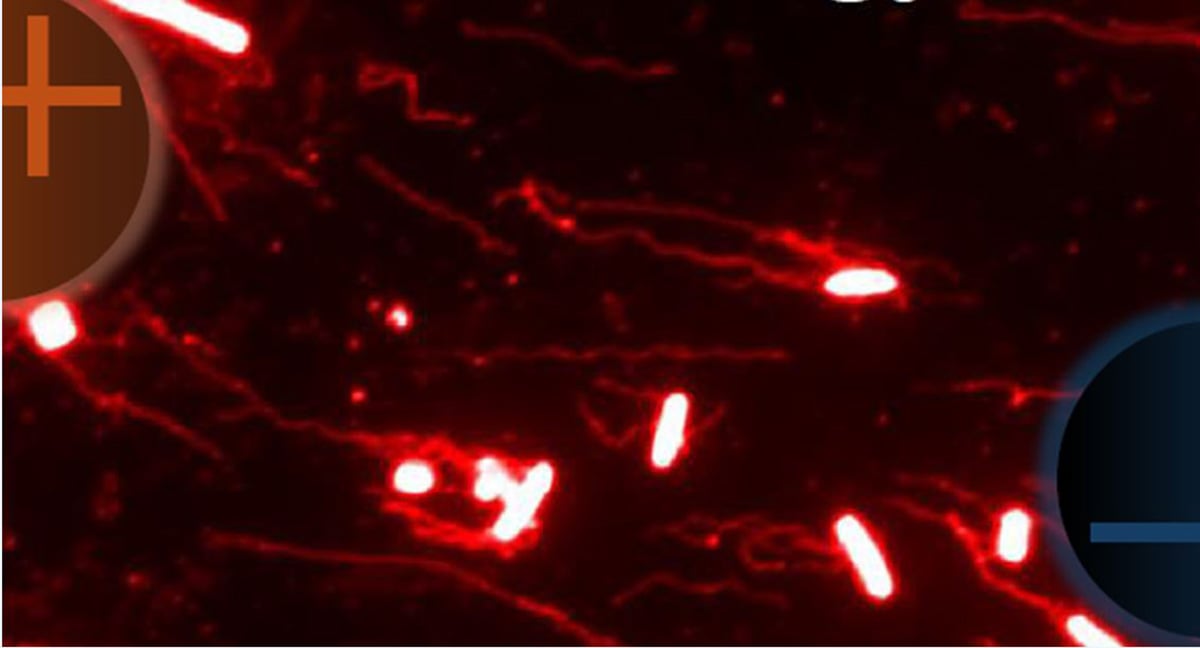
Research reveals an electric current in the gut that can attract pathogens such as Salmonella.
UC Davis scientists found that Salmonella uses electric signals in the gut to invade the body, a process called galvanotaxis, offering new insights into bacterial infections and potential treatments for diseases like IBD.
How do bad bacteria find entry points in the body to cause infection?
This question is fundamental for infectious disease experts and people who study bacteria. Harmful pathogens, like Salmonella, find their way through a complex gut system where they are vastly outnumbered by good microbes and immune cells. Still, the pathogens navigate to find vulnerable entry points in the gut that would allow them to invade and infect the body.
A team of UC Davis Health researchers has discovered a novel bioelectrical mechanism these pathogens use to find these openings. Their study was published in Nature Microbiology.
Bacteria breaking through the gated gut
Salmonella causes about 1.35 million illnesses and 420 deaths in the United States every year. To infect someone, this pathogen needs to cross the gut-lining border.
“When ingested, Salmonella find their way to the intestines. There, they are vastly outnumbered by over 100 trillion good bacteria (known as commensals). They are facing the odds of one in a million!” said the study’s lead author Yao-Hui Sun. Sun is a research scientist affiliated with the Departments of Internal Medicine, Ophthalmology and Vision Science, and Dermatology.
To learn how Salmonellae find their way in the intestine, the researchers observed the movement of S. Typhimurium bacteria (a strain of Salmonella) and compared it to that of a harmless strain of Escherichia coli (E. coli) bacteria.
Navigating a complex gut landscape
The intestine has a very complex landscape. Its epithelial structure includes villus epithelium and follicle-associated epithelium (FAE). Villus epithelium is made of absorptive cells (enterocytes) with protrusions that help with nutrient absorption.
FAE, on the other hand, contains M cells overlying small clusters of lymphatic tissue known as Peyer’s patches. These M cells are tasked with antigen sampling. They act as the immune system’s first line of defense against microbial and dietary antigens.
Findings
The research that was done on a mouse model showed that Salmonellae detect electric signals in FAE. They move toward this part of the gut where they find openings through which they can enter. This process of cell movement in response to electric fields is called galvanotaxis, or electrotaxis.
“Our study found that this ‘entry point’ has electric fields that the Salmonella bacteria take advantage of to pass,” said the study’s senior author Min Zhao. Zhao is a UC Davis professor of ophthalmology and dermatology and a researcher affiliated with the Institute for Regenerative Cures.
The study also showed that E. coli and Salmonella respond differently to bioelectric fields. They have opposite responses to the same electric cue. While E. coli clustered next to the villi, Salmonella gathered to FAE.
The study detected electric currents that loop by entering the absorptive villi and exiting the FAE.
“Notably, the bioelectric field in the gut epithelia is configured in a way that Salmonellae take advantage of to be sorted to the FAE and less so for E. coli,” explained Sun. “The pathogen seems to prefer the FAE as a gateway to invade the host and cause infections.”
Previous studies have indicated that bacteria use chemotaxis to move around. With chemotaxis, the bacteria sense chemical gradients and move towards or away from specific compounds. But the new study suggests that the galvanotaxis of Salmonella to the FAE does not occur through chemotaxis pathways.
“Our study presents an alternative or a complementary mechanism in modulating Salmonella targeting to the gut epithelium,” Zhao said.
Potential link to IBD and other gut disorders
The study might have the potential to explain complex chronic diseases, such as inflammatory bowel disease (IBD).
“This mechanism represents a new pathogen-human body “arms race” with potential implications for other bacterial infections as well as prevention and treatment possibilities,” Zhao said. “It is believed that the root cause of IBD is an excessive and abnormal immune response against good bacteria. It will be interesting to learn whether patients prone to have IBD also have aberrant bioelectric activities in gut epithelia.”
Reference: “Gut epithelial electrical cues drive differential localization of enterobacteria” by Yaohui Sun, Fernando Ferreira, Brian Reid, Kan Zhu, Li Ma, Briana M. Young, Catherine E. Hagan, Renée M. Tsolis, Alex Mogilner and Min Zhao, 20 August 2024, Nature Microbiology.
DOI: 10.1038/s41564-024-01778-8
Funding: National Institutes of Health, Defense Advanced Research Projects Agency, Fundação para a Ciência e Tecnologia, Air Force Office of Scientific Research, Office of Naval Research, National Eye Institute.
Never miss a breakthrough: Join the SciTechDaily newsletter.
Follow us on Google and Google News.