
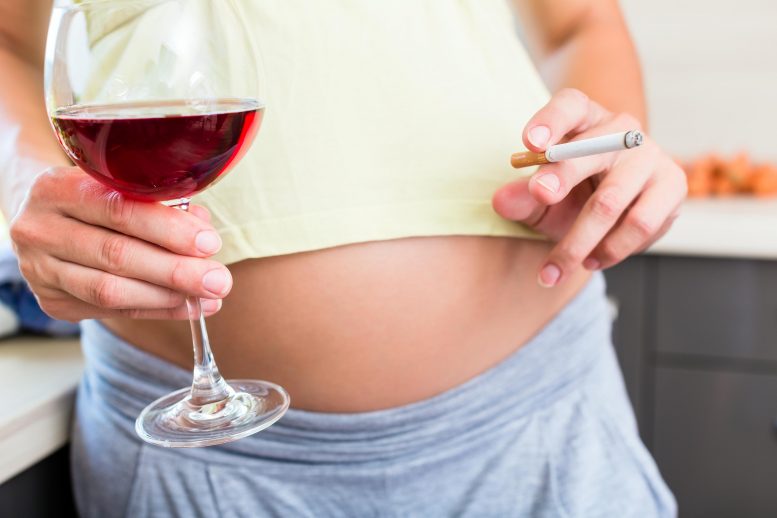
Children born to mothers who both drank and smoked beyond the first trimester of pregnancy have a 12-fold increased risk for Sudden Infant Death Syndrome (SIDS) compared to those unexposed or only exposed in the first trimester of pregnancy, according to a new study supported by the National Institutes of Health.
SIDS is the sudden, unexplained, death of an infant under one year of age. Many studies have shown that the risk of SIDS is increased by maternal smoking during pregnancy. Some studies have also found that prenatal alcohol exposure, particularly from heavy drinking during pregnancy, can increase SIDS risk. Now, the NIH-funded Safe Passage Study provides a look at how SIDS risk is influenced by the timing and amount of prenatal exposure to tobacco and alcohol. A report of the study appears in EclinicalMedicine, an online journal published by The Lancet.

“Ours is the first large-scale prospective study to closely investigate the association between prenatal alcohol and tobacco exposure and the risk of SIDS,” said first author Amy J. Elliott, Ph.D., of the Avera Health Center for Pediatric & Community Research in Sioux Falls, South Dakota. “Our findings suggest that combined exposures to alcohol and tobacco have a synergistic effect on SIDS risk, given that dual exposure was associated with substantially higher risk than either exposure alone.”
To conduct the study, a multi-center team of scientists from throughout the U.S. and in South Africa formed the Prenatal Alcohol in SIDS and Stillbirth (PASS) Network. From 2007 until 2015, PASS Network researchers followed the outcomes of nearly 12,000 pregnancies among women from two residential areas in Cape Town, South Africa; and five sites in the U.S., including two American Indian Reservations in South Dakota and North Dakota. The study sites were selected for their high rates of prenatal alcohol use and SIDS, and to include populations where the ethnic and socioeconomic disparities in SIDS remains understudied.
The researchers determined one-year outcomes for about 94 percent of the pregnancies. They found that 66 infants died during that time, including 28 SIDS deaths and 38 deaths from known causes. In addition to the almost 12-fold increased SIDS risk from combined smoking and drinking beyond the first trimester of pregnancy, they determined that the risk of SIDS was increased five-fold in infants whose mothers reported they continued smoking beyond the first trimester, and four-fold in infants whose mothers reported they continued drinking beyond the first trimester. These risks were in comparison to infants who were either not exposed to tobacco or alcohol during gestation or whose mothers quit tobacco or alcohol use by the end of the first trimester.
“The Safe Passage Study provides important new information about the role of dual exposures to prenatal smoking and drinking as risk factors for SIDS,” said co-first author Hannah C. Kinney, M.D., of the Department of Pathology at Boston Children’s Hospital and Harvard School of Medicine. “Our findings support the current recommendation of the U.S. Centers for Disease Control and Prevention, the U.S. Surgeon General, and the World Health Organization that women not drink or smoke during pregnancy, and emphasizes the significance of dual exposure, which provides the greatest risk for infant mortality.”
In a joint statement, the leaders of the NIH Institutes that provide primary funding for the Safe Passage Study said:
“These findings provide still more evidence of the vital importance of the early prenatal environment to healthy postnatal outcomes. Insofar as many women quit drinking and smoking only after they learn that they are pregnant, this study argues strongly for screening for substance use early in pregnancy and intervening as soon as possible. It also calls for stronger public health messaging regarding the dangers of drinking and smoking during pregnancy, and among women who plan to become pregnant.”
Reference: “Concurrent prenatal drinking and smoking increases risk for SIDS: Safe Passage Study report” by Amy J. Elliott, Hannah C. Kinney, Robin L. Haynes, Johan D. Dempers, Colleen Wright, William P. Fifer, Jyoti Angal, Theonia K. Boyd, Larry Burd, Elsie Burger, Rebecca D. Folkerth, Coen Groenewald, Gary Hankins, Dale Hereld, Howard J. Hoffman, Ingrid A. Holm, Michael M. Myers, Laura L. Nelsen, Hein J. Odendaal, Julie Petersen, Bradley B. Randall, Drucilla J. Roberts, Fay Robinson, Pawel Schubert, Mary Ann Sens, Lisa M. Sullivan, Tara Tripp, Peter Van Eerden, Shabbir Wadee, Marian Willinger, Daniel Zaharie and Kimberly A. Dukes, 20 January 2020, EclinicalMedicine.
DOI: 10.1016/j.eclinm.2019.100247
Never miss a breakthrough: Join the SciTechDaily newsletter.
Follow us on Google and Google News.