
Close Menu
    Facebook X (Twitter) Instagram
    SciTechDaily
    • Biology
    • Chemistry
    • Earth
    • Health
    • Physics
    • Science
    • Space
    • Technology
    Facebook X (Twitter) Pinterest YouTube RSS
    SciTechDaily
    Home»Space»A Fireball Flew Over Kyoto, Japan – Now Scientists Know What It Was and Where It Came From
    Space

    A Fireball Flew Over Kyoto, Japan – Now Scientists Know What It Was and Where It Came From

    By National Institutes of Natural SciencesJanuary 20, 2020No Comments3 Mins Read
    Facebook Twitter Pinterest Telegram LinkedIn WhatsApp Email Reddit
    Share
    Facebook Twitter LinkedIn Pinterest Telegram Email Reddit
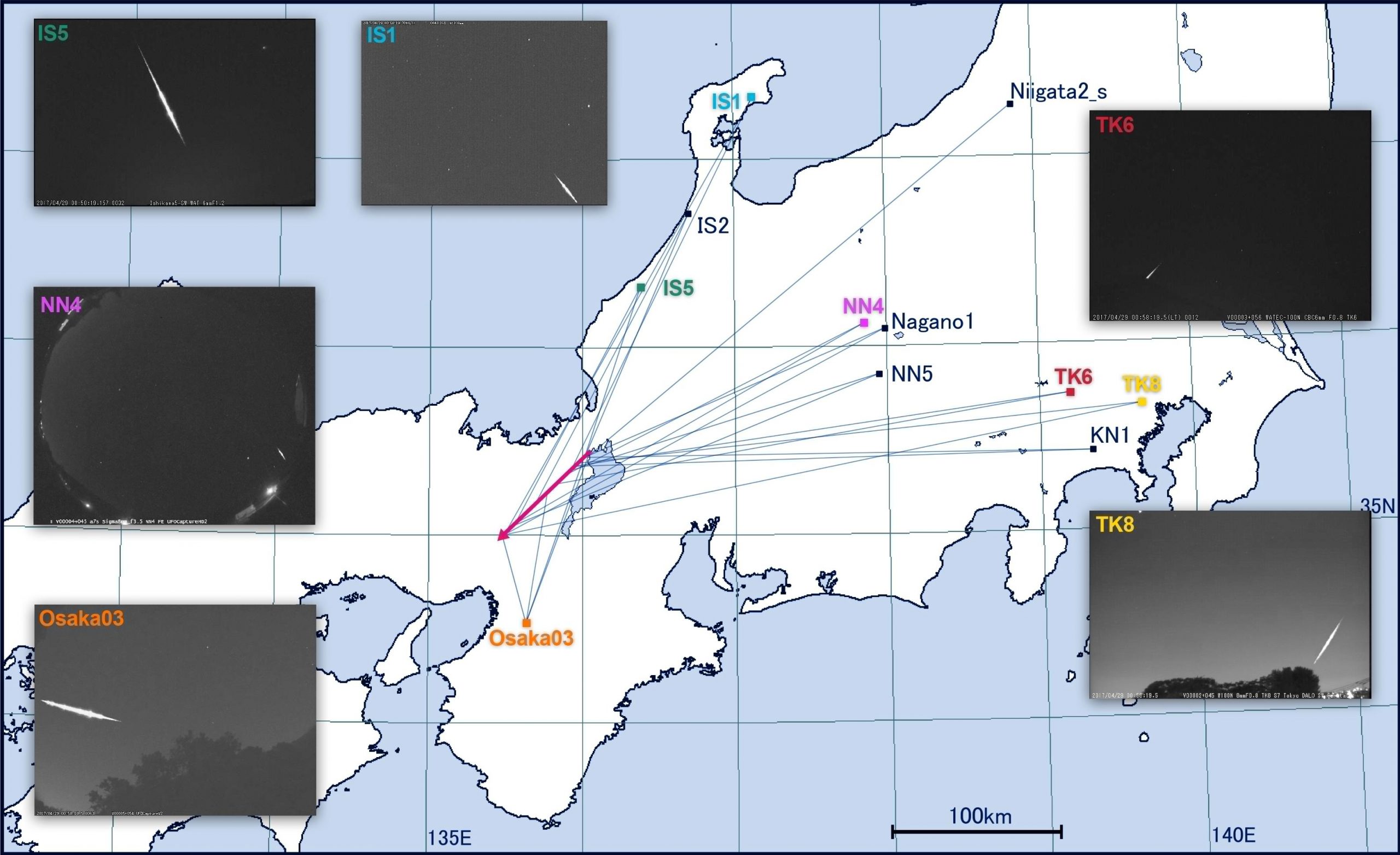
    2017 Fireball
    These are images capturing the 2017 fireball from different angles and a map showing where the cameras were located. Credit: NAOJ/Kasuga et al.

    At around 1 a.m. local standard time on April 29, 2017, a fireball flew over Kyoto, Japan. Compared to other fireballs spotted from Earth, it was relatively bright and slow. Now, scientists have determined not only what the fireball was, but also where it came from.

    “We uncovered the fireball’s true identity,” says Toshihiro Kasuga, paper author and visiting scientist at the National Astronomical Observatory of Japan and Kyoto Sangyo University. “It has a similar orbit to that of the near-Earth asteroid 2003 YT1, which is likely its parent body.”

    2003 YT1, a binary asteroid first detected in 2003, appears to have been active in the past, meaning it fissured and released dust particles, such as the one responsible for the 2017 fireball. It does not currently show any activity, though, according to Kasuga. However, the researchers found that the orbit, estimated radiant point, velocity and appearance date of the 2017 fireball are all consistent with dust particles that originated from 2003 YT1.

    “The potential break-up of the rock could be dangerous to life on Earth,” Kasuga says. “The parent body 2003 YT1 could break up, and those resulting asteroids could hit the Earth in the next 10 million years or so, especially because 2003 YT1 has a dust production mechanism.”

    The researchers found that this dust production mechanism, or the asteroid’s likelihood of releasing dust and rock particles, stems from its rotational instability in a process called the YORP effect. When the asteroid is warmed by the Sun, the energy results in a small thrust, which can produce a corresponding recoil, depending on the gravitational pull and other physical variables. The recoil can twist the asteroid, introducing a rotational change. The change can be at physical odds with the gravity and/or other forces, and force the asteroid to physically break — even just a little, a process which produces dust.

    “The released particles can enter Earth’s atmosphere and appear as fireballs, which is exactly what happened in 2017,” says Kasuga.

    According to Kasuga, that particular fireball was not a threat to Earth, as it was estimated to only be a few centimeters in size. Something so small would burn up before it reached the surface.

    “The 2017 fireball and its parent asteroid gave us a behind-the-scenes look at meteors,” says Kasuga. “Next, we plan to further research predictions for potentially hazardous objects approaching the Earth. Meteor science can be a powerful asset for taking advanced steps towards planetary defense.”

    Other contributors include Mikiya Sato, Masayoshi Ueda, and Yasunori Fujiwara, all of the Nippon Meteor Society. Chie Tsuchiya and Jun-Ichi Watanabe, both of the National Astronomical Observatory of Japan, also co-authored the paper.

    Reference: “A Fireball and Potentially Hazardous Binary Near-Earth Asteroid (164121) 2003 YT1” by Toshihiro Kasuga, Mikiya Sato, Masayoshi Ueda, Yasunori Fujiwara, Chie Tsuchiya and Jun-ichi Watanabe, 13 January 2020, The Astronomical Journal.
    DOI: 10.3847/1538-3881/ab4e1b

    Never miss a breakthrough: Join the SciTechDaily newsletter.
    Follow us on Google and Google News.

    Meteors NAOJ National Institutes of Natural Sciences
    Share. Facebook Twitter Pinterest LinkedIn Email Reddit

    Related Articles

    Cosmic Cradles and Graves: Tracing Life and Death of Stars in the Most Distant Galaxy

    Cosmic Shield: How Our Solar System Survived a Supernova

    Mysterious Cosmic Tadpole: A Strange Gas Cloud Dances With a Colossal Black Hole

    Earth-Like Exoplanets May Be More Common Than Previously Thought

    Unknown Physics on the Cosmic Scale? 1000 Supernova Explosions Chart the Expansion History of the Universe

    Astronomers Spot Stellar Eggs Near Center of the Milky Way Hatching Into Baby Stars

    Astronomers Analysis Reveals Outbound Comets Likely of Alien Origin

    HiCIAO Helps Reveal the Structure of Protoplanetary Disks

    ULIRG Arp 220 Developed From a Multiple Merger of Four or More Galaxies

    Leave A Reply Cancel Reply

    • Facebook
    • Twitter
    • Pinterest
    • YouTube

    Don't Miss a Discovery

    Subscribe for the Latest in Science & Tech!

    Trending News

    Scientists May Have Found the Key to Jupiter and Saturn’s Moon Mystery

    Scientists Uncover Brain Changes That Link Pain to Depression

    Saunas May Do More Than Raise Body Temperature – They Activate Your Immune System

    Exercise in a Pill? Metformin Shows Surprising Effects in Cancer Patients

    Hidden Oceans of Magma Could Be Protecting Alien Life

    New Study Challenges Alzheimer’s Theories: It’s Not Just About Plaques

    Artificial Sweeteners May Harm Future Generations, Study Suggests

    Splashdown! NASA Artemis II Returns From Record-Breaking Moon Mission

    Follow SciTechDaily
    • Facebook
    • Twitter
    • YouTube
    • Pinterest
    • Newsletter
    • RSS
    SciTech News
    • Biology News
    • Chemistry News
    • Earth News
    • Health News
    • Physics News
    • Science News
    • Space News
    • Technology News
    Recent Posts
    • Scientists Make Breakthrough on 40-Year-Old 2D Physics Puzzle
    • As Cities Invade the Amazon, Yellow Fever Makes a Dangerous Comeback
    • “Asian Flush” May Be a Hidden Trigger for Deadly Heart Damage
    • AI Could Detect Early Signs of Alzheimer’s in Under a Minute – Far Before Traditional Tests
    • What if Dark Matter Has Two Forms? Bold New Hypothesis Could Explain a Cosmic Mystery
    Copyright © 1998 - 2026 SciTechDaily. All Rights Reserved.
    • Science News
    • About
    • Contact
    • Editorial Board
    • Privacy Policy
    • Terms of Use

    Type above and press Enter to search. Press Esc to cancel.