
Fetal MRI studies reveal that even low alcohol consumption during pregnancy can disrupt brain development, affecting language and cognitive function.
Drinking alcohol even in low to moderate amounts during pregnancy can change the baby’s brain structure and delay brain development, according to a new MRI study. Next week at the annual meeting of the Radiological Society of North America (RSNA), the results of the study will be presented.
“Fetal MRI is a highly specialized and safe examination method that allows us to make accurate statements about brain maturation prenatally,” said Gregor Kasprian, M.D., senior study author. He is an associate professor of radiology from the Department of Biomedical Imaging and Image-guided Therapy of the Medical University of Vienna in Austria.
Fetal alcohol spectrum disorders are a range of conditions that can affect the fetus if alcohol is consumed while pregnant. Babies born with fetal alcohol spectrum diseases may develop behavioral problems, speech and language delays, and learning disabilities.
“Unfortunately, many pregnant women are unaware of the influence of alcohol on the fetus during pregnancy,” said Patric Kienast, M.D., lead author on the study. “Therefore, it is our responsibility not only to do the research but also to actively educate the public about the effects of alcohol on the fetus.” Kienast is a Ph.D. student in the Department of Biomedical Imaging and Image-Guided Therapy, Division of Neuroradiology and Musculoskeletal Radiology at the Medical University of Vienna.
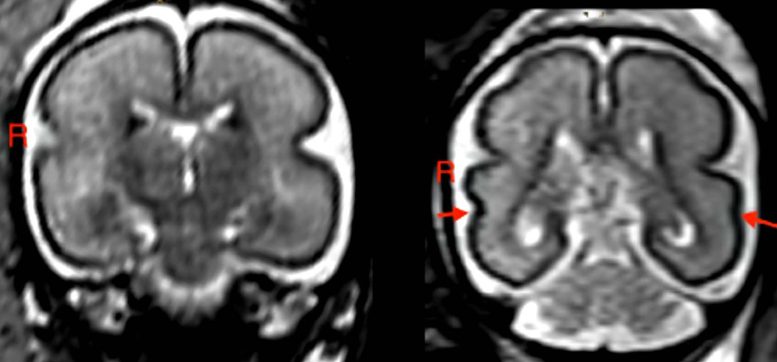
Researchers analyzed MRI exams of 24 fetuses with prenatal alcohol exposure for the study. At the time of MRI, the fetuses were between 22 and 36 weeks of gestation. Alcohol exposure was determined via anonymous surveys of the mothers. The questionnaires used were the Pregnancy Risk Assessment Monitoring System (PRAMS), a surveillance project of the Centers for Disease Control and Prevention and health departments, and the T-ACE Screening Tool, a measurement tool of four questions that identify risk drinking.
Specific Brain Regions Impacted by Alcohol Exposure
In fetuses with alcohol exposure, the fetal total maturation score (fTMS) was significantly lower than in the age-matched controls, and the right superior temporal sulcus (STS) was shallower. The STS is involved in social cognition, audiovisual integration and language perception.
“We found the greatest changes in the temporal brain region and STS,” Dr. Kasprian said. “We know that this region, and specifically the formation of the STS, has a great influence on language development during childhood.”
“Pregnant women should strictly avoid alcohol consumption. As we show in our study, even low levels of alcohol consumption can lead to structural changes in brain development and delayed brain maturation.” Patric Kienast, M.D.
Brain changes were seen in the fetuses even at low levels of alcohol exposure.
“Seventeen of 24 mothers drank alcohol relatively infrequently, with average alcohol consumption of less than one alcoholic drink per week,” Dr. Kienast said. “Nevertheless, we were able to detect significant changes in these fetuses based on prenatal MRI.”
Three mothers drank one to three drinks per week, and two mothers drank four to six drinks per week. One mother consumed an average of 14 or more drinks per week. Six mothers also reported at least one binge drinking event (exceeding four drinks on one occasion) during pregnancy.
The Importance of Myelination and Gyrification
According to the researchers, delayed fetal brain development could be specifically related to a delayed stage of myelination and less distinct gyrification in the frontal and occipital lobes.
The myelination process is critical to brain and nervous system function. Myelin protects nerve cells, allowing them to transmit information faster. Important developmental milestones in infants, such as language processing, rolling over, and crawling are directly linked to myelination.
Gyrification refers to the formation of the folds of the cerebral cortex. This folding enlarges the surface area of the cortex with limited space in the skull, enabling an increase in cognitive performance. When gyrification is diminished, functionality is reduced.
“Pregnant women should strictly avoid alcohol consumption,” Dr. Kienast said. “As we show in our study, even low levels of alcohol consumption can lead to structural changes in brain development and delayed brain maturation.”
It is unclear how these structural changes will affect brain development in these babies after birth.
“To assess this accurately, we need to wait for the children who were examined as fetuses at that time to get a little older, so that we can invite them back for further examinations,” Dr. Kienast said. “However, we can strongly assume that the changes we discovered contribute to the cognitive and behavioral difficulties that may occur during childhood.”
Co-authors are Marlene Stuempflen, M.D., Daniela Prayer, M.D., Benjamin Sigl, M.D., Mariana Schuette, M.D., Ph.D., and Sarah Glatter, M.D., M.M.Sc.
Meeting: 108th Scientific Assembly and Annual Meeting of the Radiological Society of North America
Never miss a breakthrough: Join the SciTechDaily newsletter.
Follow us on Google and Google News.
3 Comments
This is totally true! Alcohol effects feral development. There’s a few other things that effect fetal and early postnatal including vaccines. You should cover those as well, so people see the other risks that may not be talked about as frequently.
We adopted 4 children in the late 1970s- early 1980s knowing they had Fetal Alcohol Syndrome. The medical community was in the beginning stages of learning about FAS. The community in general knew little or nothing about it. I did not realize the lack of knowledge about FAS was still an issue. Through social media we are informed about every new virus , bacterial infection , side effect of obesity and health issues surely we can do better in informing about FAS .
Cigarettes too !
It changes the pathway development!