
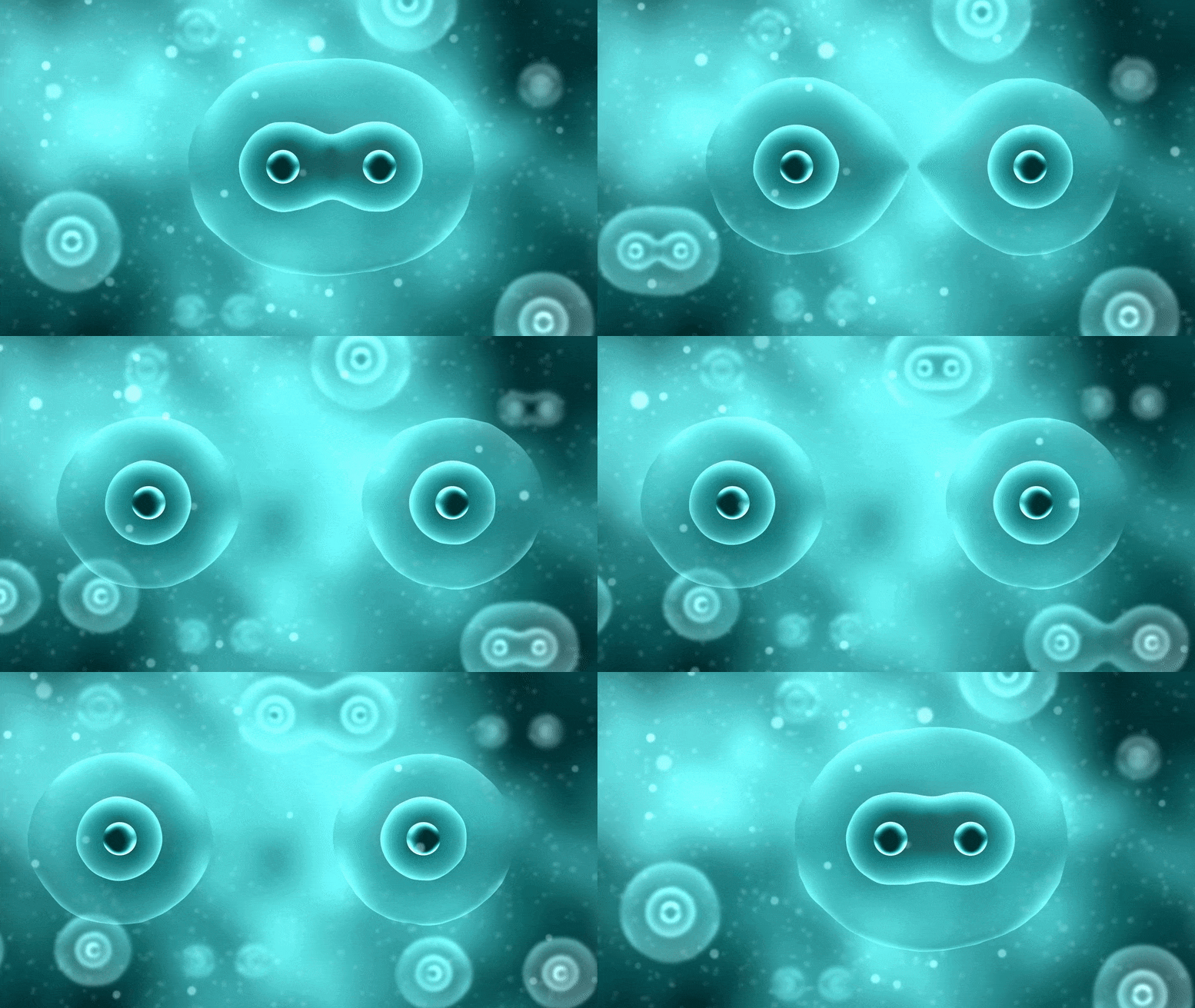
Cells make choices based not just on external signals such as growth factors, but also on information received from inside the cell.
Every day, humans make choices for themselves. To make sure a decision is made that is appropriate to the situation, these decisions often entail combining a range of contextual cues. Our senses provide us with the abundance of knowledge we need to make decisions. They pick up certain details about our surroundings, such as visual and auditory information, which our brain combines to build a holistic percept. This is known as multisensory or multimodal perception.
Cells Take Their Own State Into Account When Making Choices
Individual cells are no different than humans in this regard. They constantly make critical decisions, such as whether to divide or not. Therefore, researchers at the University of Zurich (UZH) extended the concept of contextual, multimodal perception found in humans to individual cells. Surprisingly, the scientists found that single cells make decisions much more autonomously than previously thought.
“Adequate decision-making by individual cells uses multimodal perception, allowing cells to integrate outside signals like growth factors with information from inside the cell, such as the number of cellular organelles,” says Lucas Pelkmans. Pelkmans is a professor at the Department of Molecular Life Sciences at UZH.
Sometimes, such inside cues can overrule the outside stimuli: e.g. in tumors, where the actual state of particular cells overrides the treatment with anti-proliferative drugs, thus making them treatment-resistant. “Such resistance to drugs is a major problem in the fight against cancer. The solution may come from taking into account the contextual cues that individual cells experience and ultimately altering them,” Pelkmans says.
Simultaneously Analyzing Dozens of Proteins in Millions of Cells
To test if cells decide according to contextual, multimodal perception as humans do, the scientists had to concurrently measure the activity of multiple signaling nodes – the cells’ outside sensors – as well as several potential cues from inside the cell, like the local environment and the number of cellular organelles. Everything had to be analyzed in single cells and across millions of cells. “To do this, we used ‘4i’, a method developed at UZH, which allows us to simultaneously visualize and quantify up to 80 different proteins and protein modifications in single cells using fluorescence microscopy,” states Bernhard Kramer, the first author of the study.
The researchers found that the variability in the activities of individual sensors across cells is closely linked to variation in internal cues. For example, the abundance of mitochondria, the cells’ power stations, fundamentally affects how an external stimulus is perceived by an individual cell. Additionally, each sensor integrates different cues from inside the cell. When the researchers evaluated an important decision of a single cell – namely to proliferate or to stay quiescent upon a growth stimulus – they found that the cell’s choice was mediated by the perception of multiple sensors and was predictably modulated by cues of the cell’s internal state.
Cells Make Decisions Intelligently
“For any specific decision of a cell, all outside signals and internal cues have to be viewed in concert. Single cells are thus able to make adequate context-dependent decisions – and are therefore clearly smarter than previously thought,” says Ph.D. candidate Kramer.
Reference: “Multimodal perception links cellular state to decision-making in single cells” by Bernhard A. Kramer, Jacobo Sarabia del Castillo and Lucas Pelkmans, 14 July 2022, Science.
DOI: 10.1126/science.abf4062
Never miss a breakthrough: Join the SciTechDaily newsletter.
Follow us on Google and Google News.