
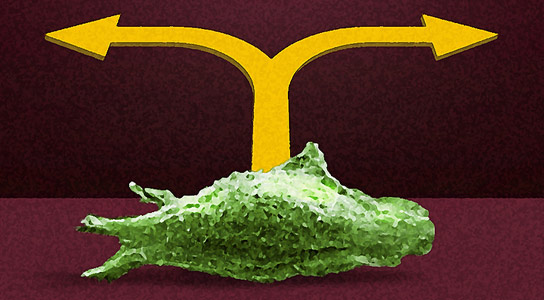
Yale University researchers are mapping the habits of cancer cells, determining which cues cause cancer cells to disperse and metastasize, how these cues are combined with other cues directing the invasion, and which cues hold sway when there are conflicting orders.
Using advanced technology and an approach that merges engineering and medicine, a Yale University-led team has compiled some of the most sophisticated data yet on the elaborate signaling networks directing highly invasive cancer cells. Think of it as a digital field guide for a deadly scourge.
“This is a very complex set of interactions and processes,” said Andre Levchenko, a Yale systems biologist and biomedical engineer, and director of the Yale Systems Biology Institute. “The systems biology approach acknowledges that complexity by analyzing how cancer cells migrate together and separately in response to complex cues.”
In a study published April 8 in the journal Nature Communications, Levchenko and his colleagues describe the intricate ways breast cancer cells respond to chemical cues in the human body. The idea is to determine which cues cause cancer cells to disperse and metastasize, how these cues are combined with other cues directing the invasion, and which cues hold sway when there are conflicting orders.
Until now, little has been known about how cells decide when and where to turn while traveling through the complex tissues. These cells often encounter contradictory directional cues — begging the questions: Which cues are stronger, and in what situations?
In this study, researchers focused on several cues. One is a protein called Epidermal Growth Factor (EGF), which acts as a strong, directional guidance signal to individual cancer cells. Another cue mediates a poorly understood phenomenon called “contact inhibition of locomotion” (CIL), in which cells act almost like bumper cars, stopping their forward motion on contact and moving away from each other.
Levchenko’s team found that when both EGF and CIL signals act upon a breast cancer cell, the cell acts as a tiny computer, making decisions about which cue dominates. If the EGF cue is weak, the cell can turn around if it encounters another cell; if the EGF cue is strong enough, the two cells will travel together. The researchers unraveled the molecular network that allows the cells to follow these cues and make appropriate decisions. In particular, they found the critical role of proteins called ephrins in mediating the CIL cue. These proteins, also found in other cell types, allow breast cancer cells to be repelled from each other, while ignoring other cells, such as fibroblasts. This knowledge allowed the investigators to suppress CIL, so that even weak EGF inputs could lead to coordinated movement of many cells.
“We have shown that migrating cells prioritize certain cues in the presence of others and thus can switch their migration mode, depending on what they see from the environment,” said first author Benjamin Lin, a postdoctoral associate in biomedical engineering at Yale.
Understanding the interplay of these signals may allow researchers to devise strategies for interfering with, or redirecting, cancer cells in motion. For example, if a traveling cancer cell received strong, artificial CIL cues so that its movement became less directed and invasive, and more chaotic, could that slow the onset of metastasis?
Historically, experiments on cancer cell movement have been unable to mimic the dynamic complexity of the human body. Now, using advanced biosensors and other technology, such experiments come much closer to replicating a realistic, biological environment.
“Scientists have studied quite well how individual cues affect cell migration. But in reality, cells are subject to multiple cues at the same time,” said co-author Takanari Inoue, an associate professor at Johns Hopkins University. “Our work is significant because we clearly demonstrated that cells do integrate multiple pieces of information and that the integration occurs at a place fairly upstream of the signal processing. I think we have been underestimating these cells’ capability to integrate different cues.”
Additional authors of the paper are Taofei Yin and Yi Wu of the University of Connecticut.
Reference: “Interplay between chemotaxis and contact inhibition of locomotion determines exploratory cell migration” by Benjamin Lin, Taofei Yin, Yi I. Wu, Takanari Inoue and Andre Levchenko, 8 April 2015, Nature Communications.
DOI: 10.1038/ncomms7619
Never miss a breakthrough: Join the SciTechDaily newsletter.
Follow us on Google and Google News.