
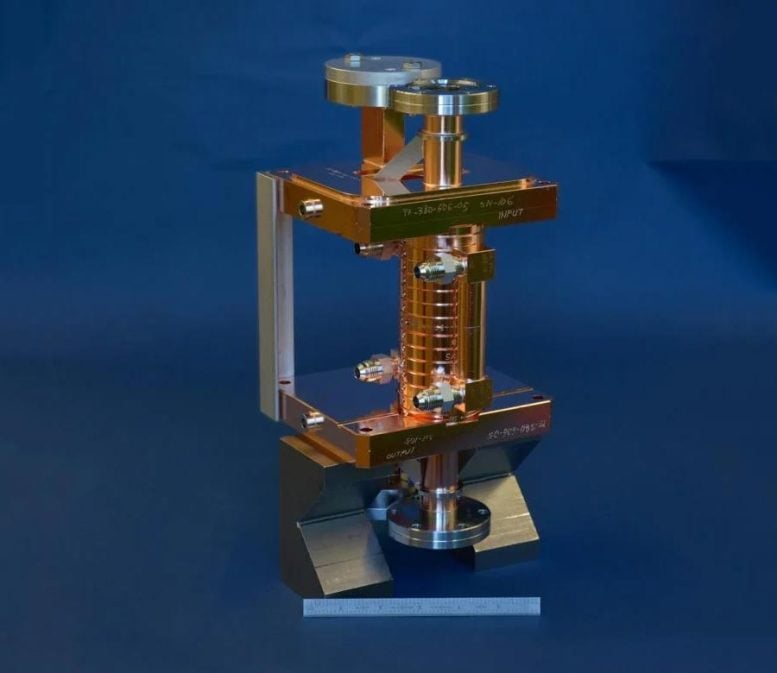
As research into ways to accelerate electrons with “X-band” microwaves rather than the S-band waves continues at SLAC, physicists have started commissioning the world’s most compact photoinjector – a device that spits out electrons when hit by light.
Accelerator physicists at SLAC have started commissioning the world’s most compact photoinjector – a device that spits out electrons when hit by light. Photoinjectors are used to generate electrons for free-electron lasers (FELs) like the Linac Coherent Light Source, among other things, and this development could enable much more compact FELs, as well as other types of accelerator-based facilities.
The device is just one facet of X-band research at SLAC, which aims to find ways to accelerate electrons with “X-band” microwaves rather than the S-band waves that currently boost electrons in the linear accelerator to relativistic speeds. X-band microwaves are four times shorter than S-band waves, and can accelerate electrons to higher energy more quickly.
They have been under investigation for more than two decades at SLAC as part of research for a next-generation linear collider.
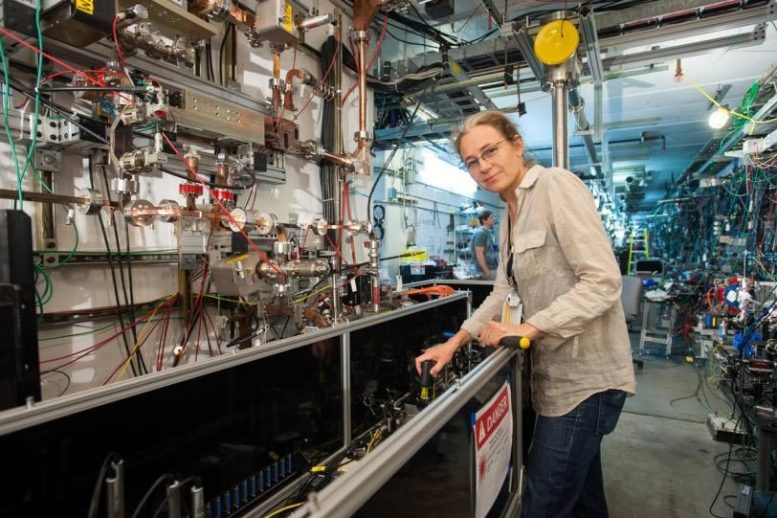
“SLAC has unique worldwide expertise in X-band technology,” said accelerator physicist Cecile Limborg of the X-Band Test Area (XTA). SLAC is also working on transferring more SLAC X-band technology to industry. Limborg said the technology is in high demand in FEL facilities such as the Swiss Light Source and FERMI@Elletra, as well as at the Compact Linear Collider project at CERN, where the technology was adopted in 2007 for the main positron and electron linacs.
SLAC’s expertise proved invaluable in the design of the little photoinjector. At about two inches wide and four inches long, it’s one-quarter the width of the device that provides electrons for the LCLS.
Despite the fact that it had to be built to more exacting requirements than for S-band technology – including tighter machine tolerances, more precision required to align parts and more robust inner surfaces that won’t break down under the more intense X-band fields – the device appears to work as expected.
“There was a very fast turn-on for this experiment – less than 18 months,” Limborg said. Limborg credits the support she received from several groups, including the Test Facilities team at the Next Linear Collider Test Assembly in End Station B, where the entire X-band assembly, including an X-band klystron and X-band accelerator, is located for testing.
“The laser group, the alignment group, the LCLS control systems group,” all contributed as well, she said. Limborg herself is a veteran of the team that built the S-band-driven LCLS photoinjector, and she drew on experience gained lab-wide during the LCLS project as well.
The photoinjector is a modified version of one developed 10 years ago here at SLAC. During the recent tests, said Limborg, electrons from the photoinjector needed only a single klystron to accelerate them to an energy of 50 MeV by the time they’d traveled 1.8 meters, “and this was after only a few days of commissioning,” she added.
In comparison, the electron bunches in the LCLS injector need two klystrons to power them up to 50 MeV in five meters. Limborg said she’s confident that the next round of tests will see the electrons reach 100 MeV in the same 1.8-meter (590-foot) distance. Those tests will probably be conducted using an improved version of the photoinjector already waiting in the wings.
Current X-band technology research has expanded beyond components for a future linear collider. Some of the photoinjector work, funded by SLAC’s High-Energy Physics General Accelerator Development program, is being done in collaboration with Lawrence Livermore National Laboratory. It’s aimed at developing an inverse Compton scattering-based gamma ray source, which would use the electron beam to boost photons to gamma-ray energies.
If funded, SLAC will provide the compact photoinjector and accelerator to generate and accelerate the electrons, and LLNL will provide a laser to boost light to gamma-ray energies.
But the research has other uses as well. “There’s a great potential for this X-band injector to be used as a driver for an X-ray free-electron laser like LCLS – in fact, a 180-meter-long design is workable according to calculations,” Limborg said. “That’s very nice.”
Limborg says she’s excited by the opportunity to work on X-band gun technology. “One good thing about our facility is that we’re a test facility,” she said. “I can try things.”
Never miss a breakthrough: Join the SciTechDaily newsletter.
Follow us on Google and Google News.