
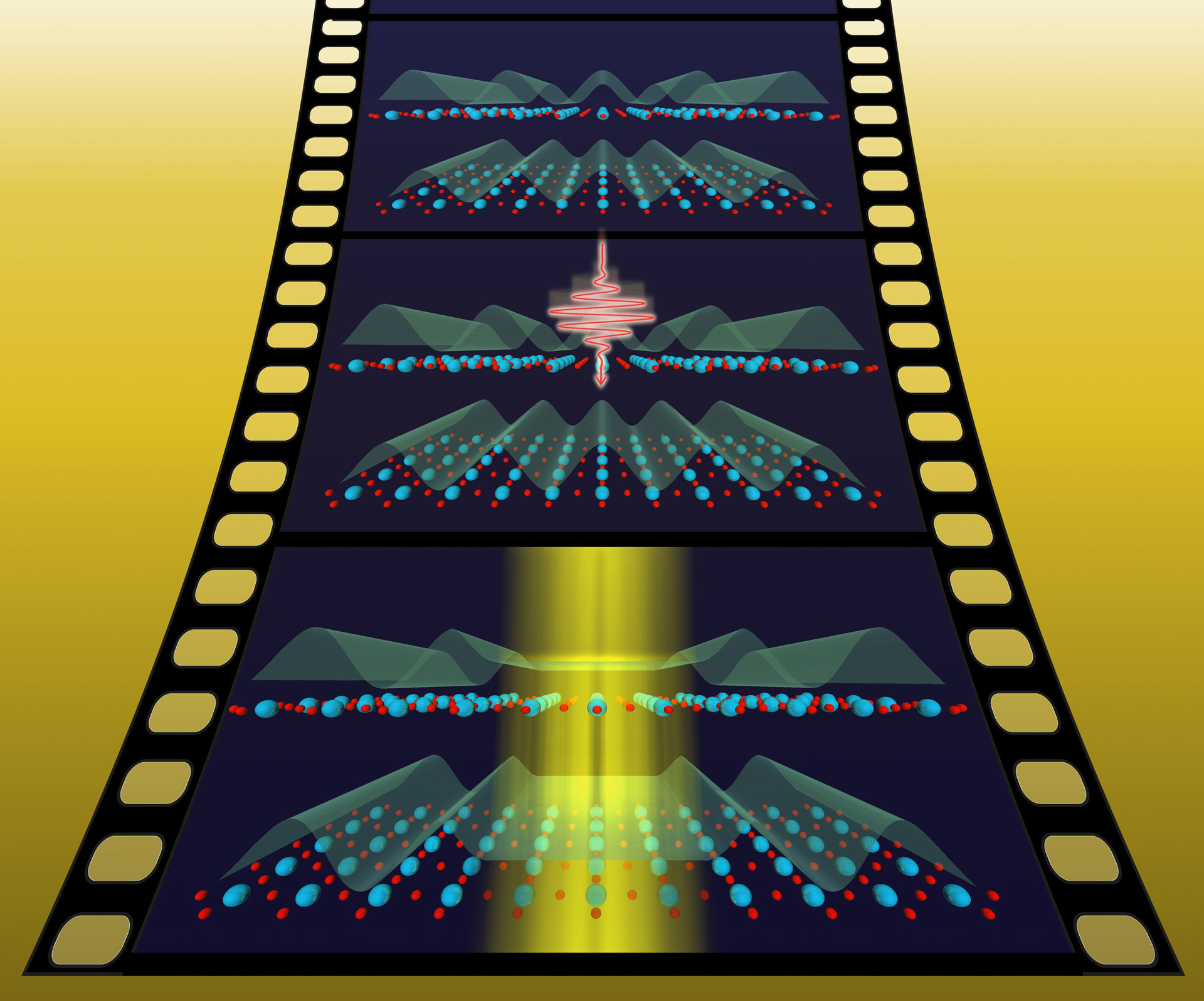
Scientists at SLAC National Accelerator Laboratory’s Linac Coherent Light Source used carefully timed pairs of laser pulses to capture ultrafast snapshots of light-driven superconductivity.
A new study pins down a major factor behind the appearance of superconductivity – the ability to conduct electricity with 100 percent efficiency – in a promising copper-oxide material.
Scientists used carefully timed pairs of laser pulses at SLAC National Accelerator Laboratory’s Linac Coherent Light Source (LCLS) to trigger superconductivity in the material and immediately take X-ray snapshots of its atomic and electronic behavior as superconductivity emerged.
They discovered that so-called “charge stripes” of increased electrical charge melted away as superconductivity appeared. Further, the results help rule out the theory that shifts in the material’s atomic lattice hinder the onset of superconductivity.
Armed with this new understanding, scientists may be able to develop new techniques to eliminate these charge stripes and help pave the way for room-temperature superconductivity, often considered the holy grail of condensed matter physics. The demonstrated ability to rapidly switch between the insulating and superconducting states could also prove useful in advanced electronics and computation.
The results, from a collaboration led by scientists from the Max Planck Institute for the Structure and Dynamics of Matter in Germany and the U.S. Department of Energy’s SLAC and Brookhaven national laboratories, were published online April 16, 2014, in the journal Physical Review Letters.
“The very short timescales and the need for high spatial resolution made this experiment extraordinarily challenging,” said co-author Michael Först, a scientist at the Max Planck Institute. “Now, using femtosecond X-ray pulses, we found a way to capture the quadrillionths-of-a-second dynamics of the charges and the crystal lattice. We’ve broken new ground in understanding light-induced superconductivity.”
Josh Turner, an LCLS staff scientist, said, “This represents a very important result in the field of superconductivity using LCLS. It demonstrates how we can unravel different types of complex mechanisms in superconductivity that have, up until now, been inseparable.”
He added, “To make this measurement, we had to push the limits of our current capabilities. We had to measure a very weak, barely detectable signal with state-of-the-art detectors, and we had to tune the number of X-rays in each laser pulse to see the signal from the stripes without destroying the sample.”
Ripples in Quantum Sand
The compound used in this study was a layered material consisting of lanthanum, barium, copper, and oxygen grown at Brookhaven Lab by physicist Genda Gu. Each copper oxide layer contained the crucial charge stripes.
“Imagine these stripes as ripples frozen in the sand,” said John Hill, a Brookhaven Lab physicist and coauthor on the study. “Each layer has all the ripples going in one direction, but in the neighboring layers they run crosswise. From above, this looks like strings in a pile of tennis racquets. We believe that this pattern prevents each layer from talking to the next, thus frustrating superconductivity.”
To excite the material and push it into the superconducting phase, the scientists used mid-infrared laser pulses to “melt” those frozen ripples. These pulses had previously been shown to induce superconductivity in a related compound at a frigid 10 Kelvin (minus 442 degrees Fahrenheit).
“The charge stripes disappeared immediately,” Hill said. “But specific distortions in the crystal lattice, which had been thought to stabilize these stripes, lingered much longer. This shows that only the charge stripes inhibit superconductivity.”
Stroboscopic Snapshots
To capture these stripes in action, the collaboration turned to SLAC’s LCLS X-ray laser, which works like a camera with a shutter speed faster than 100 femtoseconds, or quadrillionths of a second, and provides atomic-scale image resolution. LCLS uses a section of SLAC’s 2-mile-long linear accelerator to generate the electrons that give off X-ray light.
Researchers used the so-called “pump-probe” approach: an optical laser pulse strikes and excites (pumps) the lattice and an ultrabright X-ray laser pulse is carefully synchronized to follow within femtoseconds and measure (probe) the lattice and stripe configurations. Each round of tests results in some 20,000 X-ray snapshots of the changing lattice and charge stripes, a bit like a strobe light rapidly illuminating the process.
To measure the changes with high spatial resolution, the team used a technique called resonant soft X-ray diffraction. The LCLS X-rays strike and scatter off the crystal into the detector, carrying time-stamped signatures of the material’s charge and lattice structure that the physicists then used to reconstruct the rise and fall of superconducting conditions.
“By carefully choosing a very particular X-ray energy, we are able to emphasize the scattering from the charge stripes,” said Brookhaven Lab physicist Stuart Wilkins, another co-author on the study. “This allows us to single out a very weak signal from the background.”
Toward Superior Superconductors
The X-ray scattering measurements revealed that the lattice distortion persists for more than 10 picoseconds (trillionths of a second) – long after the charge stripes melted and superconductivity appeared, which happened in less than 400 femtoseconds. Slight as it may sound, those extra trillionths of a second make a huge difference.
“The findings suggest that the relatively weak and long-lasting lattice shifts do not play an essential role in the presence of superconductivity,” Hill said. “We can now narrow our focus on the stripes to further pin down the underlying mechanism and potentially engineer superior materials.”
Andrea Cavalleri, director of the Max Planck Institute, said, “Light-induced superconductivity was only recently discovered, and we’re already seeing fascinating implications for understanding it and going to higher temperatures. In fact, we have observed the signature of light-induced superconductivity in materials all the way up to 300 Kelvin (80 degrees Fahrenheit) – that’s really a significant breakthrough that warrants much deeper investigations.”
Other collaborators on this research include the University of Groningen, the University of Oxford, Diamond Light Source, the Lawrence Berkeley National Laboratory, Stanford University, the European XFEL, the University of Hamburg, and the Center for Free-Electron Laser Science.
The research conducted at the Soft X-ray Materials Science (SXR) experimental station at SLAC’s LCLS – a DOE Office of Science user facility – was funded by Stanford University, Lawrence Berkeley National Laboratory, the University of Hamburg and the Center for Free-Electron Laser Science (CFEL). Work performed at Brookhaven Lab was supported by the DOE’s Office of Science.
Reference: “Melting of Charge Stripes in Vibrationally Driven La1.875Ba0.125CuO4: Assessing the Respective Roles of Electronic and Lattice Order in Frustrated Superconductors” by M. Först, R. I. Tobey, H. Bromberger, S. B. Wilkins, V. Khanna, A. D. Caviglia, Y.-D. Chuang, W. S. Lee, W. F. Schlotter, J. J. Turner, M. P. Minitti, O. Krupin, Z. J. Xu, J. S. Wen, G. D. Gu, S. S. Dhesi, A. Cavalleri and J. P. Hill, 17 April 2014, Physical Review Letters.
DOI: 10.1103/PhysRevLett.112.157002
Never miss a breakthrough: Join the SciTechDaily newsletter.
Follow us on Google and Google News.