
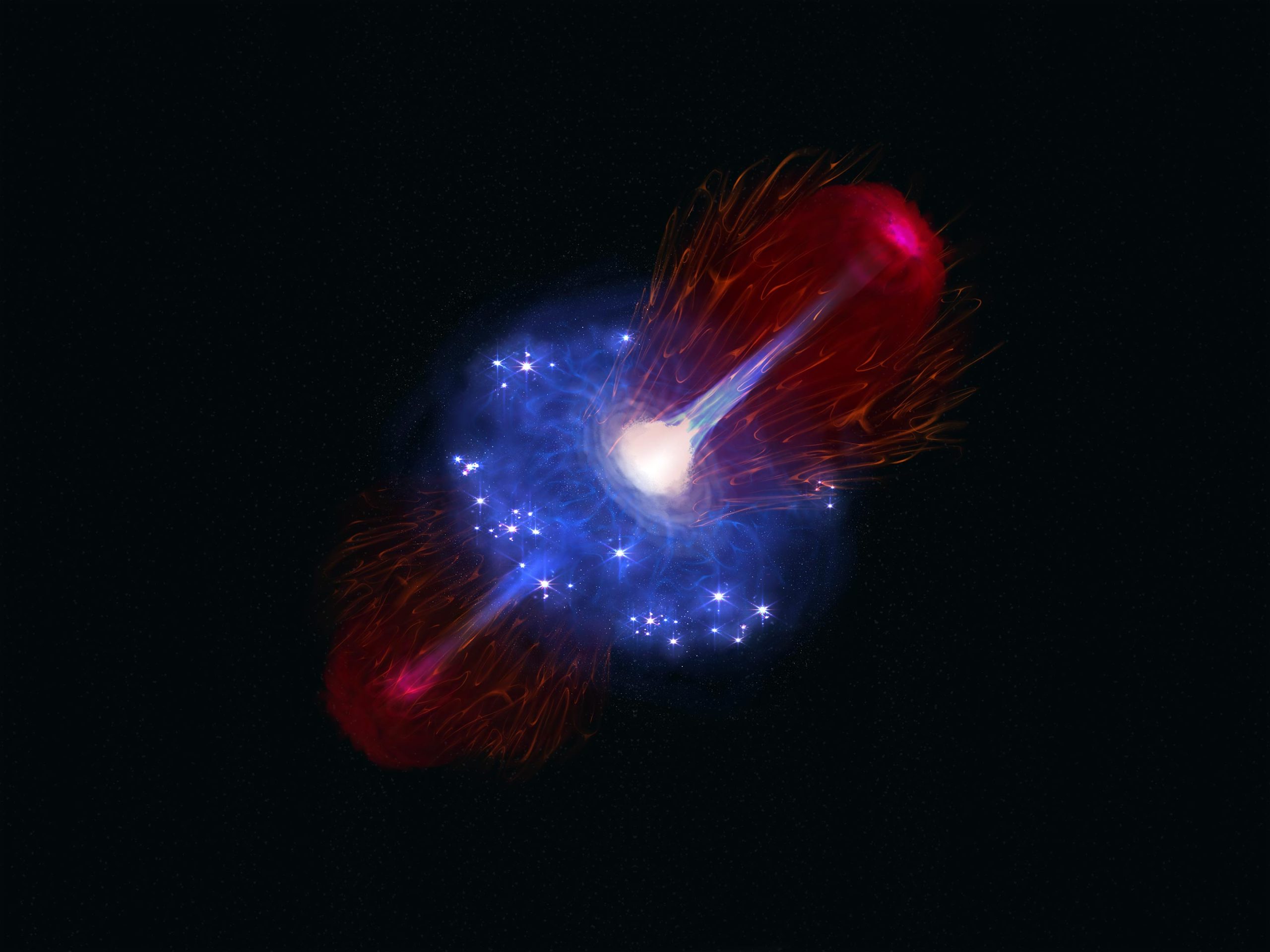
Astronomers have discovered a massive dormant black hole from the early universe, just 800 million years after the Big Bang, using the James Webb Space Telescope.
This black hole, with a mass 400 million times that of our Sun, challenges existing models of black hole growth due to its size and low accretion rate.
Unprecedented Black Hole Size and Behavior
Scientists have discovered a massive black hole in the early universe that appears to be “napping” after stuffing itself with too much food.
Similar to a bear hibernating after feasting on salmon, this black hole seems to have overeaten and entered a dormant state within its host galaxy.
An international team of astronomers, led by the University of Cambridge, detected this ancient black hole using the James Webb Space Telescope. It dates back to just 800 million years after the Big Bang.
Weighing in at an incredible 400 million times the mass of our Sun, this black hole ranks among the largest ever observed during that period of the universe’s development. It is so massive that it accounts for approximately 40% of its host galaxy’s entire mass — a stark contrast to black holes in the modern universe, which typically comprise only about 0.1% of their galaxy’s mass.
However, despite its gigantic size, this black hole is eating, or accreting, the gas it needs to grow at a very low rate – about 100 times below its theoretical maximum limit – making it essentially dormant.
Challenging Black Hole Growth Models
Such an over-massive black hole so early in the universe, but one that isn’t growing, challenges existing models of how black holes develop. However, the researchers say that the most likely scenario is that black holes go through short periods of ultra-fast growth, followed by long periods of dormancy. Their results were reported in the journal Nature on December 18.
When black holes are ‘napping’, they are far less luminous, making them more difficult to spot, even with highly sensitive telescopes such as Webb. Black holes cannot be directly observed, but instead, they are detected by the tell-tale glow of a swirling accretion disc, which forms near the black hole’s edges. The gas in the accretion disc becomes extremely hot and starts to glow and radiate energy in the ultraviolet range.
“Even though this black hole is dormant, its enormous size made it possible for us to detect,” said lead author Ignas Juodžbalis from Cambridge’s Kavli Institute for Cosmology. “Its dormant state allowed us to learn about the mass of the host galaxy as well. The early universe managed to produce some absolute monsters, even in relatively tiny galaxies.”
Born Big or Growing in Bursts?
According to standard models, black holes form from the collapsed remnants of dead stars and accrete matter up to a predicted limit, known as the Eddington limit, where the pressure of radiation on matter overcomes the gravitational pull of the black hole. However, the sheer size of this black hole suggests that standard models may not adequately explain how these monsters form and grow.
“It’s possible that black holes are ‘born big’, which could explain why Webb has spotted huge black holes in the early universe,” said co-author Professor Roberto Maiolino, from the Kavli Institute and Cambridge’s Cavendish Laboratory. “But another possibility is they go through periods of hyperactivity, followed by long periods of dormancy.”
Simulating the Growth of a Monster
Working with colleagues from Italy, the Cambridge researchers conducted a range of computer simulations to model how this dormant black hole could have grown to such a massive size so early in the universe. They found that the most likely scenario is that black holes can exceed the Eddington limit for short periods, during which they grow very rapidly, followed by long periods of inactivity: the researchers say that black holes such as this one likely eat for five to ten million years, and sleep for about 100 million years.
“It sounds counterintuitive to explain a dormant black hole with periods of hyperactivity, but these short bursts allow it to grow quickly while spending most of its time napping,” said Maiolino.
The Dormant Majority
Because the periods of dormancy are much longer than the periods of ultra-fast growth, it is in these periods that astronomers are most likely to detect black holes. “This was the first result I had as part of my PhD, and it took me a little while to appreciate just how remarkable it was,” said Juodžbalis. “It wasn’t until I started speaking with my colleagues on the theoretical side of astronomy that I was able to see the true significance of this black hole.”
Due to their low luminosities, dormant black holes are more challenging for astronomers to detect, but the researchers say this black hole is almost certainly the tip of a much larger iceberg, if black holes in the early universe spend most of their time in a dormant state.
“It’s likely that the vast majority of black holes out there are in this dormant state – I’m surprised we found this one, but I’m excited to think that there are so many more we could find,” said Maiolino.
Reference: “A dormant overmassive black hole in the early Universe” by Ignas Juodžbalis, Roberto Maiolino, William M. Baker, Sandro Tacchella, Jan Scholtz, Francesco D’Eugenio, Joris Witstok, Raffaella Schneider, Alessandro Trinca, Rosa Valiante, Christa DeCoursey, Mirko Curti, Stefano Carniani, Jacopo Chevallard, Anna de Graaff, Santiago Arribas, Jake S. Bennett, Martin A. Bourne, Andrew J. Bunker, Stéphane Charlot, Brian Jiang, Sophie Koudmani, Michele Perna, Brant Robertson, Debora Sijacki, Hannah Übler, Christina C. Williams and Chris Willott, 18 December 2024, Nature.
DOI: 10.1038/s41586-024-08210-5
The observations were obtained as part of the JWST Advanced Deep Extragalactic Survey (JADES). The research was supported in part by the European Research Council and the Science and Technology Facilities Council (STFC), part of UK Research and Innovation (UKRI).
Never miss a breakthrough: Join the SciTechDaily newsletter.
Follow us on Google and Google News.
7 Comments
Has anyone considered that the hole was closed to keep the door shut from travelers, and possibly the long meteor that passed us and went around the sun flying back the way it came
, increasing speed leaving our galaxy, were also travelers checking us out. And we did nothing to let them know we knew they were there. I’d say we should be very worried about who they were scouting for. The moon is fake it was draged here to help protect the planet. Even has the rope burns on it to prove it. A dead planet to be used as a shield. We are just a science project.
Meth is bad…
Soon enough, GOD Is going to reveal Himself to humanity. HE blessed us with the James Webb telescope finally lifting off on Christmas Day just a few years ago. We all know that there were 2 attempts before that Christmas Day.
I can hardly wait for this to happen!!!
PRAISE GOD.
FINALLY! A Responsible, Well Educated Scholar and Scientist Steps Forward To Reveal To Us OUR TRUTH!!! Thank You Donna Thompson 🙄. (dont-cha jessss luvss dee interBet?)
I may have missed the answer to this question in the article above, but I want to ask whether these ~40% mass monsters stop eating for some as-yet unexplained reasons, or is it because they’re unable to grab hold of any passing food, having taken everything within reach already.
The large black hole kicked back and rested after so much rapid feeding, because the stars were proving themselv
es harder to grasp, and also, because they started to taste ‘funny.’
Outflows are ubiquitous in astrophysics. Despite different sizes, velocity and amount of transported energy, luminosity and degree of collimation, they have obvious morphological similarities. However, what is important for us, there is the picture of the outflows from everywhere and none of inflows into somewhere. That is an obvious asymmetry. There is no universal mechanism that can explain the origin of all these jets and outflows. There is no consensus about the exact ejection mechanism. The situation is even more severe, for in many cases researchers do not understand what constitutes content of the jets. Is it atomic, molecular or ionic gas, relativistic electrons or protons, or even electron-positron plasma? In this paper we have an opportunity to build a unified model of jets and outflows in the frame of our model [1, 2]. https://www.academia.edu/14194346/A_Gradient_Character_of_the_Outflows_and_Jets