
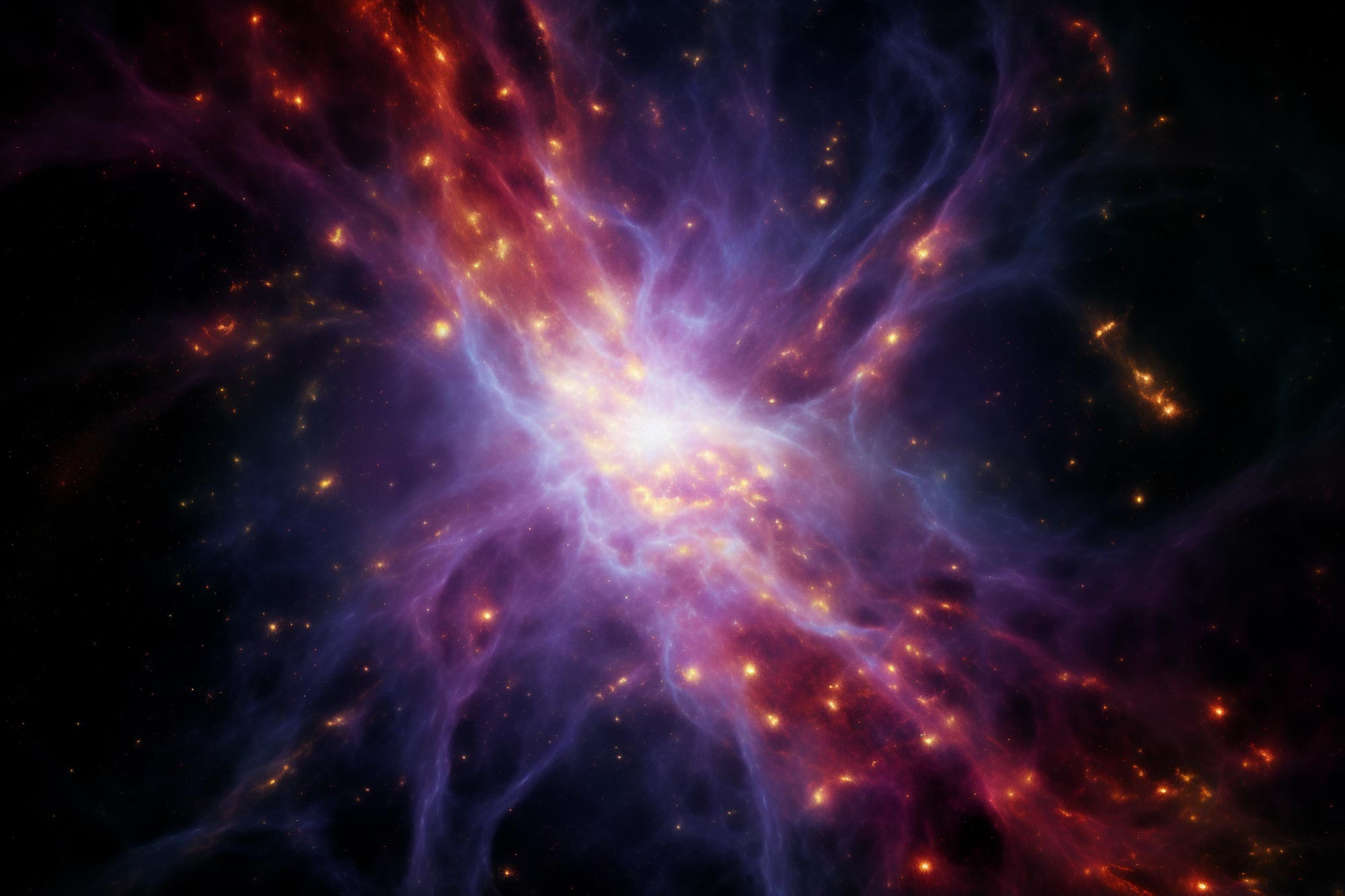
Researchers have uncovered new insights into the reaction pathways of the universe’s first molecule.
Shortly after the Big Bang, which took place around 13.8 billion years ago, the universe was a seething, dense expanse of extreme heat. In just a matter of seconds, it began to cool enough for the first atomic particles to come together, forming the lightest elements—hydrogen and helium. At this early stage, these elements were fully ionized, meaning their electrons were not yet bound to their nuclei. It would take another 380,000 years before the universe cooled sufficiently for neutral atoms to form. This process, known as recombination, allowed electrons to attach to nuclei, creating stable atoms and setting the stage for the first chemical interactions.
Among the earliest of these interactions was the creation of the helium hydride ion (HeH+), believed to be the first molecule ever to exist. This molecule formed when a neutral helium atom combined with a positively charged hydrogen nucleus. Its formation initiated a sequence of reactions that eventually led to molecular hydrogen (H₂), the most abundant molecule in the universe today.
After recombination, the universe entered what scientists call the “cosmic dark age.” During this time, space had become transparent, as free electrons were now bound to atoms, but no stars or other light sources had yet emerged. It would be several hundred million years before the first stars lit up the cosmos.
Why Simple Molecules Mattered for Star Formation
During this early phase of the universe, however, simple molecules such as HeH⁺ and H₂ were essential to the formation of the first stars. In order for the contracting gas cloud of a protostar to collapse to the point where nuclear fusion can begin, heat must be dissipated. This occurs through collisions that excite atoms and molecules, which then emit this energy in the form of photons. Below approximately 10,000 degrees Celsius, however, this process becomes ineffective for the dominant hydrogen atoms.

Further cooling can only take place via molecules that can emit additional energy through rotation and vibration. Due to its pronounced dipole moment, the HeH⁺ ion is particularly effective at these low temperatures and has long been considered a potentially important candidate for cooling in the formation of the first stars. Consequently, the concentration of helium hydride ions in the universe may significantly impact the effectiveness of early star formation.
During this period, collisions with free hydrogen atoms were a major degradation pathway for HeH⁺, forming a neutral helium atom and an H₂⁺ ion. These subsequently reacted with another H atom to form a neutral H₂ molecule and a proton, leading to the formation of molecular hydrogen.
Recreating the Early Universe in the Laboratory
Researchers at the Max-Planck-Institut für Kernphysik (MPIK) in Heidelberg have now successfully recreated this reaction under conditions similar to those in the early universe for the first time. They investigated the reaction of HeH⁺ with deuterium, an isotope of hydrogen containing an additional neutron in the atomic nucleus alongside a proton. When HeH⁺ reacts with deuterium, an HD⁺ ion is formed instead of H₂⁺, alongside the neutral helium atom.
The experiment was carried out at the Cryogenic Storage Ring (CSR) at the MPIK in Heidelberg — a globally unique instrument for investigating molecular and atomic reactions under space-like conditions. For this purpose, HeH⁺ ions were stored in the 35-metre-diameter ion storage ring for up to 60 seconds at a few kelvins (-267 °C), and were superimposed with a beam of neutral deuterium atoms. By adjusting the relative speeds of the two particle beams, the scientists were able to study how the collision rate varies with collision energy, which is directly related to temperature.
They found that, contrary to earlier predictions, the rate at which this reaction proceeds does not slow down with decreasing temperature, but remains almost constant. “Previous theories predicted a significant decrease in the reaction probability at low temperatures, but we were unable to verify this in either the experiment or new theoretical calculations by our colleagues,” explains Dr. Holger Kreckel from the MPIK.
“The reactions of HeH⁺ with neutral hydrogen and deuterium therefore appear to have been far more important for chemistry in the early universe than previously assumed,” he continues.
Implications for Star Formation and Cosmic Chemistry
This observation is consistent with the findings of a group of theoretical physicists led by Yohann Scribano, who identified an error in the calculation of the potential surface used in all previous calculations for this reaction. The new calculations using the improved potential surface now align closely with the CSR experiment.
Since the concentrations of molecules such as HeH⁺ and molecular hydrogen (H₂ or HD) played an important role in the formation of the first stars, this result brings us closer to solving the mystery of their formation.
Reference: “Experimental confirmation of barrierless reactions between HeH+ and deuterium atoms suggests a lower abundance of the first molecules at very high redshifts” by F. Grussie, J. Sahoo, Y. Scribano, D. Bossion, L. Berger, M. Grieser, L. W. Isberner, Á. Kálosi, O. Novotný, D. Paul, A. Znotins, X. Urbain and H. Kreckel, 24 July 2025, Astronomy & Astrophysics.
DOI: 10.1051/0004-6361/202555316
Never miss a breakthrough: Join the SciTechDaily newsletter.
Follow us on Google and Google News.
3 Comments
Hilarious
We are the stuff of which the veritable stars were made and the information that subtended their very birth.
The existence and length of the “dark ages” period remains debatable in cosmological history. One of the few probes is the redshifted 21cm line of neutral hydrogen, which has significant detection challenges on Earth due to atmosphere. Neutral hydrogen is also key to the production of molecular hydrogen. Still lots of guesswork here.