
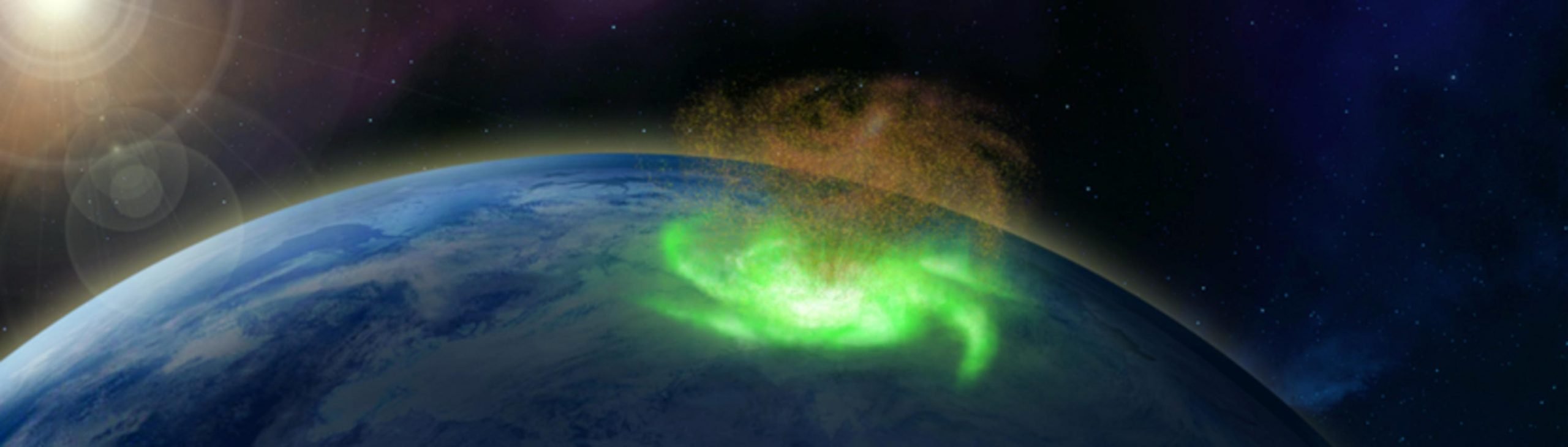
Researchers identified the first known space hurricane, a massive plasma vortex over the North Pole that rained electrons and lasted eight hours.
The first observations of a space hurricane have been revealed in Earth’s upper atmosphere, confirming their existence and shedding new light on the relationship between planets and space.
The unprecedented observations, made by satellites in August 2014, were only uncovered during retrospective analysis by scientists at the University of Reading, as part of a team led by Shandong University in China, that confirmed the hurricane and offered clues about its formation.
This analysis has now allowed a 3D image to be created of the 1,000km-wide (620mi-wide) swirling mass of plasma several hundred kilometers above the North Pole, raining electrons instead of water, and in many ways resembling the hurricanes we are familiar with in the Earth’s lower atmosphere.
Professor Mike Lockwood, space scientist at the University of Reading, said: “Until now, it was uncertain that space plasma hurricanes even existed, so to prove this with such a striking observation is incredible.”
Energy Transfer from Solar Wind Sparks Space Storms
“Tropical storms are associated with huge amounts of energy, and these space hurricanes must be created by unusually large and rapid transfer of solar wind energy and charged particles into the Earth’s upper atmosphere.
“Plasma and magnetic fields in the atmosphere of planets exist throughout the universe, so the findings suggest space hurricanes should be a widespread phenomena.”
A numerical model simulation of the magnetosphere (the large bubble around the Earth caused by the Earth’s magnetic field that protects Earth from solar wind) showing the hurricane activity during what should have been a very quiet solar wind period. The image is looking down on the North Pole of the Earth with the Sun off to the right, dawn to the bottom and dusk to the top. The colors show the field aligned currents that bring the momentum from the solar wind down into the ionosphere and they show the spiral arms that are so like an atmospheric hurricane. The vectors are flow of plasma in the magnetosphere. Credit: State Key Laboratory of Space Weather, Center for Space Science and Applied Research, Chinese Academy of Sciences, Beijing, China
Hurricanes occur in Earth’s lower atmosphere over warm bodies of water. When warm, moist air rises, it creates an area of low pressure near the surface that sucks in the surrounding air, causing extremely strong winds and creating clouds that lead to heavy rain.
Hurricanes have also been observed in the lower atmospheres of Mars, Jupiter, and Saturn, while enormous solar tornadoes have been seen in the atmosphere of the Sun. However, the existence of space hurricanes in the upper atmosphere of planets has not been detected before.
A Rare Event in Earth’s Ionosphere
The space hurricane analyzed by the team in Earth’s ionosphere was spinning in an anticlockwise direction, had multiple spiral arms, and lasted almost eight hours before gradually breaking down.
The team of scientists from China, the USA, Norway, and the UK used observations made by four DMSP (Defense Meteorological Satellite Program) satellites and a 3D magnetosphere modeling to produce the image. Their findings were published in Nature Communications.
The analysis involved checking data from the satellites, radars, and other sources for consistency, and to build up a full picture of what had happened and ensure that the mechanisms involved were understood.
The fact the hurricane occurred during a period of low geomagnetic activity suggests they could be more relatively common within our solar system and beyond. This highlights the importance of improved monitoring of space weather, which can disrupt GPS systems.
Reference: “A space hurricane over the Earth’s polar ionosphere” by Qing-He Zhang, Yong-Liang Zhang, Chi Wang, Kjellmar Oksavik, Larry R. Lyons, Michael Lockwood, Hui-Gen Yang, Bin-Bin Tang, Jøran Idar Moen, Zan-Yang Xing, Yu-Zhang Ma, Xiang-Yu Wang, Ya-Fei Ning and Li-Dong Xia, 22 February 2021, Nature Communications.
DOI: 10.1038/s41467-021-21459-y
Never miss a breakthrough: Join the SciTechDaily newsletter.
Follow us on Google and Google News.