
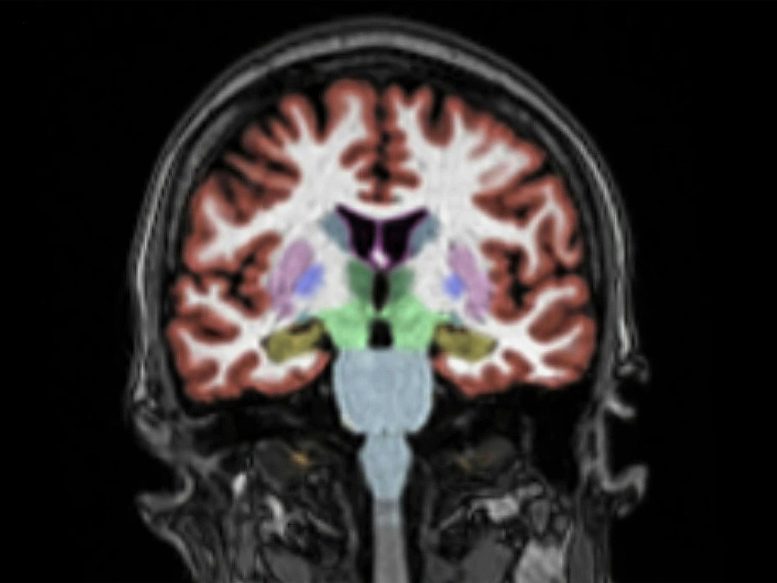
A study has found that long-duration space travel leads to significant expansion of brain ventricles, requiring approximately three years for full recovery. This discovery could impact future mission planning and the timing of repeated space travel.
As we enter a new era in space travel, a study looking at how the human brain reacts to traveling outside Earth’s gravity suggests frequent flyers should wait three years after longer missions to allow the physiological changes in their brains to reset.
Researchers studied brain scans of 30 astronauts from before and after space travel. Their findings, reported today in Scientific Reports, reveal that the brain’s ventricles expand significantly in those who completed longer missions of at least six months, and that less than three years may not provide enough time for the ventricles to fully recover.
Ventricles are cavities in the brain filled with cerebrospinal fluid, which provides protection, nourishment and waste removal to the brain. Mechanisms in the human body effectively distribute fluids throughout the body, but in the absence of gravity, the fluid shifts upward, pushing the brain higher within the skull and causing the ventricles to expand.
Brain Changes Increase with Mission Duration
“We found that the more time people spent in space, the larger their ventricles became,” said Rachael Seidler, a professor of applied physiology and kinesiology at the University of Florida and an author of the study. “Many astronauts travel to space more than one time, and our study shows it takes about three years between flights for the ventricles to fully recover.”
Seidler, a member of the Norman Fixel Institute for Neurological Diseases at UF Health, said based on studies so far, ventricular expansion is the most enduring change seen in the brain resulting from spaceflight.
“We don’t yet know for sure what the long-term consequences of this is on the health and behavioral health of space travelers,” she said, “so allowing the brain time to recover seems like a good idea.”
Of the 30 astronauts studied, eight traveled on two-week missions, 18 were on six-month missions, and four were in space for approximately one year. The ventricular enlargement tapered off after six months, the study’s authors reported.
“The biggest jump comes when you go from two weeks to six months in space,” Seidler said. “There is no measurable change in the ventricles’ volume after only two weeks.”
Space Tourism and Long-Duration Missions
With increased interest in space tourism in recent years, this is good news, as shorter space junkets appear to cause little physiological changes to the brain, she said.
While researchers cannot yet study astronauts who have been in space much longer than a year, Seidler said it’s also good news that the expansion of the brain’s ventricles levels off after about six months.
“We were happy to see that the changes don’t increase exponentially, considering we will eventually have people in space for longer periods,” she said.
The results of the study, which was funded by NASA, could impact future decision-making regarding crew travel and mission planning, Seidler said.
For more on this research, see The Dark Side of Multiple Spaceflights on Human Brain Structure.
Reference: “Impacts of Spaceflight Experience on Human Brain Structure” by Heather R. McGregor, Kathleen E. Hupfeld, Ofer Pasternak, Nichole E. Beltran, Yiri E. De Dios, Jacob J. Bloomberg, Scott J. Wood, Ajitkumar P. Mulavara, Roy F. Riascos, Patricia A. Reuter-Lorenz and Rachael D. Seidler, 8 June 2023, Scientific Reports.
DOI: 10.1038/s41598-023-33331-8
Never miss a breakthrough: Join the SciTechDaily newsletter.
Follow us on Google and Google News.
1 Comment
This is a nothing story. Why even blab about it if there isn’t more substance than repeatedly stating, “LONG MISSIONS TRIGGER SIGNIFICANT CHANGES IN ASTRONAUTS’ BRAINS”? Thanks for leading me to a bunch of advertisements.