
Close Menu
    Facebook X (Twitter) Instagram
    SciTechDaily
    • Biology
    • Chemistry
    • Earth
    • Health
    • Physics
    • Science
    • Space
    • Technology
    Facebook X (Twitter) Pinterest YouTube RSS
    SciTechDaily
    Home»Technology»Spelunking Rover May Explore Mysterious Lunar Caverns
    Technology

    Spelunking Rover May Explore Mysterious Lunar Caverns

    By SciTechDailyNovember 19, 2012No Comments3 Mins Read
    Facebook Twitter Pinterest Telegram LinkedIn WhatsApp Email Reddit
    Share
    Facebook Twitter LinkedIn Pinterest Telegram Email Reddit
    Spelunking Rover May Explore Mysterious Lunar Caverns
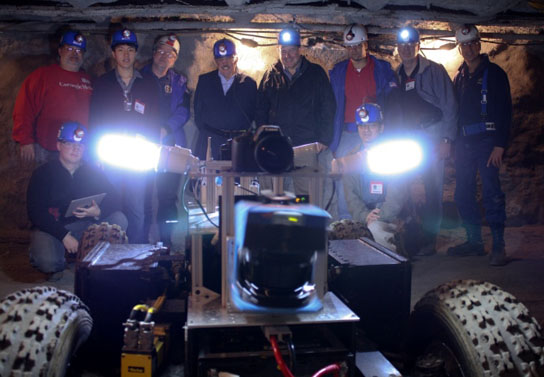
    William Whittaker’s cave-crawling robot could one day explore lunar caverns. Credit: W. Whittaker

    William Whittaker has been developing roving robots for years. By 2015, he hopes that his rover will explore some mysterious caves on the Moon.

    Three years ago, Japanese researchers discovered a hole from the published images from the satellite SELENE. However, spacecraft orbiting the Moon have been unable to peer into its shadowy depths. A robot rover might be able to go into it, and send back images of the inside. Whittaker presented his vision at the NASA Innovative Advanced Concepts (NIAC) program in Hampton, Virginia last week.

    The NIAC program will spend about $500,000 developing the rover. The prototype Whittaker tested in a coal mine could be lowered into the Moon’s pit to check for wall openings. There is also a prototype for a rover that jumps down the hole or lowers itself using a cable. The first prototype of such a robot is the four-wheeled Cave Crawler, and it can drive itself around underground. It has onboard lasers to sweep the floors, walls, and ceilings to map the tunnels and is already practicing in the mine’s tunnels.

    The hole is estimated to be about 65 meters (213 feet) wide and at least 80 meters (262 feet) deep, probably too deep to be a crater. It’s located in the Marius Hills region, suggesting that it might be an entrance to an intact horizontal tunnel beneath the surface, carved long ago by flowing lava.

    It has long been considered that lava tubes were good locations for building lunar bases. Their rocky ceilings will protect humans from micrometeorite impacts and cosmic rays.

    These kinds of protected caves could also house records of the history of the Moon and the Solar System. Rocks that were hidden from damage could look just like the surface did when it first cooled, or have textures that have been molded by hidden processes going on inside the Moon. And solar-wind particles implanted billions of years ago could provide clues about the early evolution of Sol.

    Whittaker may soon have the means to put one of his robots on the Moon. Whittaker’s company, Astrobiotic Technology in Pittsburgh, has signed a contract with SpaceX to launch a rocket that will contain their robotic tech destined for the Moon. The mission is competing for Google’s Lunar X Prize, which will award $20 million for the first privately funded team to land an autonomous vehicle on the Moon, move it 500 meters (1,650 feet) and send back data including videos.


    Engineers think that autonomous rovers could one day be used to explore caves on the Moon or Mars. Credit: Video courtesy of W. Whittaker

    Never miss a breakthrough: Join the SciTechDaily newsletter.
    Follow us on Google and Google News.

    Moon Robotics Space Exploration SpaceX
    Share. Facebook Twitter Pinterest LinkedIn Email Reddit

    Related Articles

    NASA’s Rovers Keep Getting Stuck and We Just Found Out Why

    NASA Explores Visionary Ideas That Could Transform the Future

    “Windbots” – The Future Explorers of Planetary Skies?

    New Robotic Platform Could Take Space Exploration to New Heights

    Babyloid Robot Aims to Combat Depression in the Elderly

    Qbo Robot Looks In The Mirror, Recognizes Itself

    Harvard Scientists Develop $5 Rubber Robot

    Korea Developing Robot Prison Guards

    Yaskawa Electric’s SmartPal VII Operated Using Kinect

    Leave A Reply Cancel Reply

    • Facebook
    • Twitter
    • Pinterest
    • YouTube

    Don't Miss a Discovery

    Subscribe for the Latest in Science & Tech!

    Trending News

    Monster Storms on Jupiter Unleash Lightning Beyond Anything on Earth

    Scientists Create “Liquid Gears” That Spin Without Touching

    The Simple Habit That Could Help Prevent Cancer

    Millions Take These IBS Drugs, But a New Study Finds Serious Risks

    Scientists Unlock Hidden Secrets of 2,300-Year-Old Mummies Using Cutting-Edge CT Scanner

    Bread Might Be Making You Gain Weight Even Without Eating More Calories

    Scientists Discover Massive Magma Reservoir Beneath Tuscany

    Europe’s Most Active Volcano Just Got Stranger – Here’s Why Scientists Are Rethinking It

    Follow SciTechDaily
    • Facebook
    • Twitter
    • YouTube
    • Pinterest
    • Newsletter
    • RSS
    SciTech News
    • Biology News
    • Chemistry News
    • Earth News
    • Health News
    • Physics News
    • Science News
    • Space News
    • Technology News
    Recent Posts
    • Scientists Were Wrong About This Strange “Rule-Breaking” Particle
    • Webb Space Telescope Uncovers Unexpected Ice Clouds on a Jupiter-Like World
    • 289-Million-Year-Old Reptile Mummy Reveals Origin of Human Breathing System
    • New Brain Discovery Challenges Long-Held Theory of Teenage Brain Development
    • Sharks Are Overheating as Warming Oceans Push Them to the Edge
    Copyright © 1998 - 2026 SciTechDaily. All Rights Reserved.
    • Science News
    • About
    • Contact
    • Editorial Board
    • Privacy Policy
    • Terms of Use

    Type above and press Enter to search. Press Esc to cancel.