
Close Menu
    Facebook X (Twitter) Instagram
    SciTechDaily
    • Biology
    • Chemistry
    • Earth
    • Health
    • Physics
    • Science
    • Space
    • Technology
    Facebook X (Twitter) Pinterest YouTube RSS
    SciTechDaily
    Home»Space»Spitzer Confirms Rocky Exoplanet HD 219134b, about 1.6 Times the Size of Earth
    Space

    Spitzer Confirms Rocky Exoplanet HD 219134b, about 1.6 Times the Size of Earth

    By Felicia Chou, NASAJuly 30, 2015No Comments4 Mins Read
    Facebook Twitter Pinterest Telegram LinkedIn WhatsApp Email Reddit
    Share
    Facebook Twitter LinkedIn Pinterest Telegram Email Reddit
    Spitzer Confirms Closest Rocky Exoplanet HD 219134b
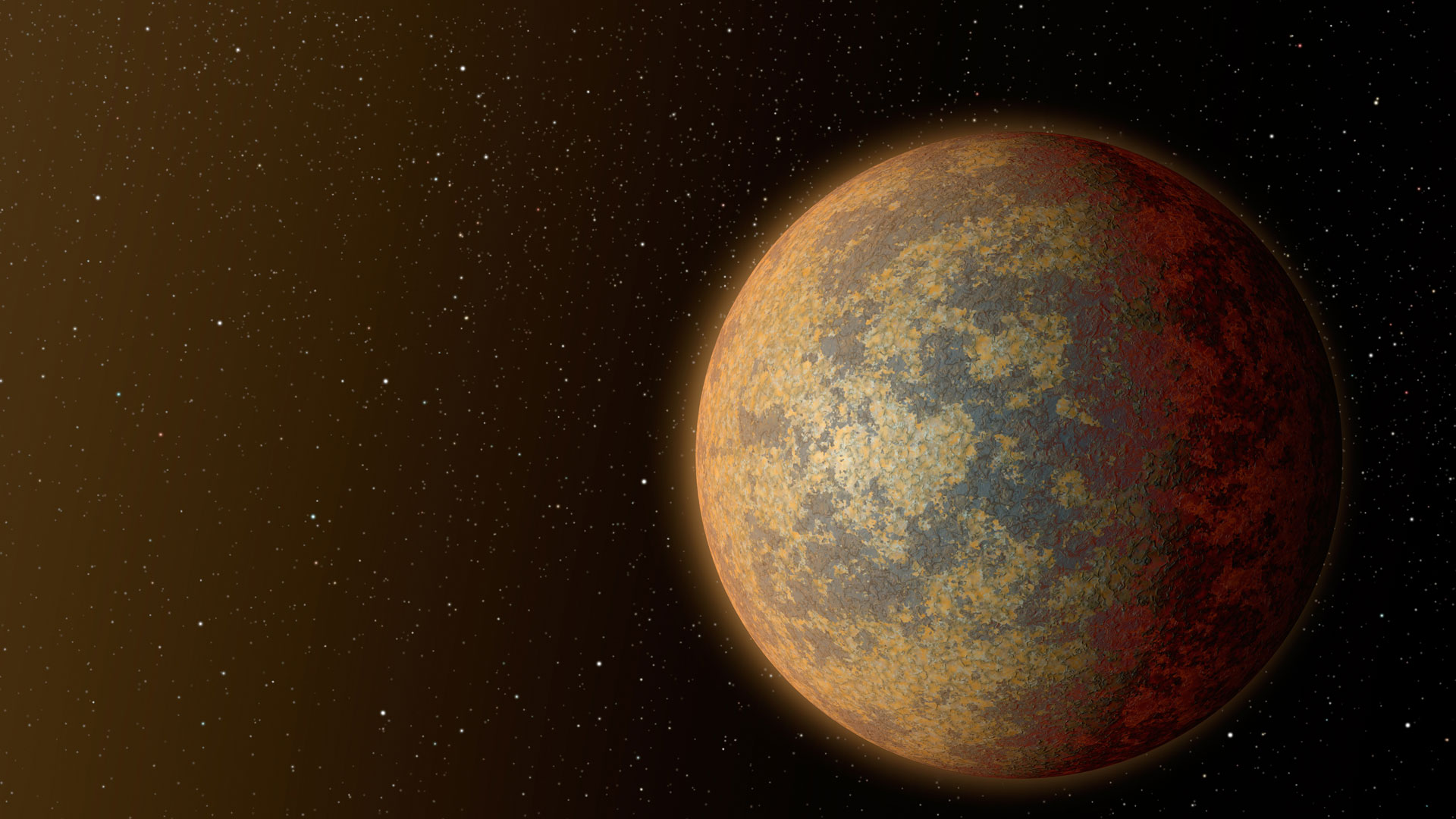
    This artist’s rendition shows one possible appearance for the planet HD 219134b, the nearest confirmed rocky exoplanet found to date outside our solar system. The planet is 1.6 times the size of Earth, and whips around its star in just three days. Scientists predict that the scorching-hot planet — known to be rocky through measurements of its mass and size — would have a rocky, partially molten surface with geological activity, including possibly volcanoes. Credit: NASA/JPL-Caltech

    Using the Spitzer Space Telescope, researchers have confirmed the discovery of the nearest rocky planet outside our solar system – exoplanet HD 219134b.

    Dubbed HD 219134b, this exoplanet, which orbits too close to its star to sustain life, is a mere 21 light-years away. While the planet itself can’t be seen directly, even by telescopes, the star it orbits is visible to the naked eye in dark skies in the Cassiopeia constellation, near the North Star.

    HD 219134b is also the closest exoplanet to Earth to be detected transiting, or crossing in front of, its star and, therefore, perfect for extensive research.

    “Transiting exoplanets are worth their weight in gold because they can be extensively characterized,” said Michael Werner, the project scientist for the Spitzer mission at NASA’s Jet Propulsion Laboratory (JPL) in Pasadena, California. “This exoplanet will be one of the most studied for decades to come.”

    The planet, initially discovered using HARPS-North instrument on the Italian 3.6-meter Galileo National Telescope in the Canary Islands, is the subject of a study accepted for publication in the journal Astronomy & Astrophysics.


    Where is Earth’s nearest rocky planet neighbor? The closest rocky exoplanet confirmed outside our solar system is located just off the “W” pattern of the Cassiopeia constellation. The planet lies 21 light-years away and can’t be seen directly, but its star is visible to the naked eye.

    Study lead author Ati Motalebi of the Geneva Observatory in Switzerland said she believes the planet is the ideal target for NASA’s James Webb Space Telescope in 2018.

    “Webb and future large, ground-based observatories are sure to point at it and examine it in detail,” Motalebi said.

    Only a small fraction of exoplanets can be detected transiting their stars due to their relative orientation to Earth. When the orientation is just right, the planet’s orbit places it between its star and Earth, dimming the detectable light of its star. It’s this dimming of the star that is actually captured by observatories such as Spitzer, and can reveal not only the size of the planet but also clues about its composition.

    “Most of the known planets are hundreds of light-years away. This one is practically a next-door neighbor,” said astronomer and study co-author Lars A. Buchhave of the Harvard-Smithsonian Center for Astrophysics in Cambridge, Massachusetts. For reference, the closest known planet is GJ674b at 14.8 light-years away; its composition is unknown.

    HD 219134b was first sighted by the HARPS-North instrument and a method called the radial velocity technique, in which a planet’s mass and orbit can be measured by the tug it exerts on its host star. The planet was determined to have a mass 4.5 times that of Earth, and a speedy three-day orbit around its star.

    Spitzer followed up on the finding, discovering the planet transits its star. Infrared measurements from Spitzer revealed the planet’s size, about 1.6 times that of Earth. Combining the size and mass gives it a density of 3.5 ounces per cubic inch (six grams per cubic centimeter) – confirming HD 219134b is a rocky planet.

    Now that astronomers know HD 219134b transits its star, scientists will be scrambling to observe it from the ground and space. The goal is to tease chemical information out of the dimming starlight as the planet passes before it. If the planet has an atmosphere, chemicals in it can imprint patterns in the observed starlight.

    Never miss a breakthrough: Join the SciTechDaily newsletter.
    Follow us on Google and Google News.

    Astronomy Astrophysics Exoplanet HARPS NASA Planetary Science Spitzer Space Telescope
    Share. Facebook Twitter Pinterest LinkedIn Email Reddit

    Related Articles

    NASA Study Reveals that Carbon Planets May be Waterless

    Astronomers Create First Cloud Map of a Planet Beyond Our Solar System

    Latest ScienceCast Video Explores the Strange Attraction of Hot Jupiters

    SEEDS Project Discovers “Second Jupiter” – Lowest-Mass Exoplanet Around a Sun-Like Star

    Spitzer Discovers a Young Stellar System That “Blinks” Every 93 Days

    How Astronomers Search for Habitable Exoplanets

    The Wild Weather of Hot Jupiters

    NASA’s Spitzer Helps Researchers Get a Closer Look at Hot Jupiters

    New Study Revives Doubted Exoplanet Fomalhaut b

    Leave A Reply Cancel Reply

    • Facebook
    • Twitter
    • Pinterest
    • YouTube

    Don't Miss a Discovery

    Subscribe for the Latest in Science & Tech!

    Trending News

    Artificial Sweeteners May Harm Future Generations, Study Suggests

    Splashdown! NASA Artemis II Returns From Record-Breaking Moon Mission

    What If Consciousness Exists Beyond Your Brain

    Scientists Finally Crack the 100-Million-Year Evolutionary Mystery of Squid and Cuttlefish

    Beyond “Safe Levels”: Study Challenges What We Know About Pesticides and Cancer

    Researchers Have Found a Dietary Compound That Increases Longevity

    Scientists Baffled by Bizarre “Living Fossil” From 275 Million Years Ago

    Your IQ at 23 Could Predict Your Wealth at 27, Study Finds

    Follow SciTechDaily
    • Facebook
    • Twitter
    • YouTube
    • Pinterest
    • Newsletter
    • RSS
    SciTech News
    • Biology News
    • Chemistry News
    • Earth News
    • Health News
    • Physics News
    • Science News
    • Space News
    • Technology News
    Recent Posts
    • What if Dark Matter Has Two Forms? Bold New Hypothesis Could Explain a Cosmic Mystery
    • Researchers Expose Hidden Chemistry of “Ore-Forming” Elements in Biology
    • Geologists Reveal the Americas Collided Earlier Than We Thought
    • 20x Difference: Study Reveals True Source of Airborne Microplastics
    • Scientists Uncover Hidden Force Powering Yellowstone’s Supervolcano
    Copyright © 1998 - 2026 SciTechDaily. All Rights Reserved.
    • Science News
    • About
    • Contact
    • Editorial Board
    • Privacy Policy
    • Terms of Use

    Type above and press Enter to search. Press Esc to cancel.