
Close Menu
    Facebook X (Twitter) Instagram
    SciTechDaily
    • Biology
    • Chemistry
    • Earth
    • Health
    • Physics
    • Science
    • Space
    • Technology
    Facebook X (Twitter) Pinterest YouTube RSS
    SciTechDaily
    Home»Space»Spitzer Reveals Clusters of Massive New Stars
    Space

    Spitzer Reveals Clusters of Massive New Stars

    By Harvard-Smithsonian Center for AstrophysicsMay 9, 2014No Comments3 Mins Read
    Facebook Twitter Pinterest Telegram LinkedIn WhatsApp Email Reddit
    Share
    Facebook Twitter LinkedIn Pinterest Telegram Email Reddit
    CfA Astronomers Study Clusters of Massive New Stars
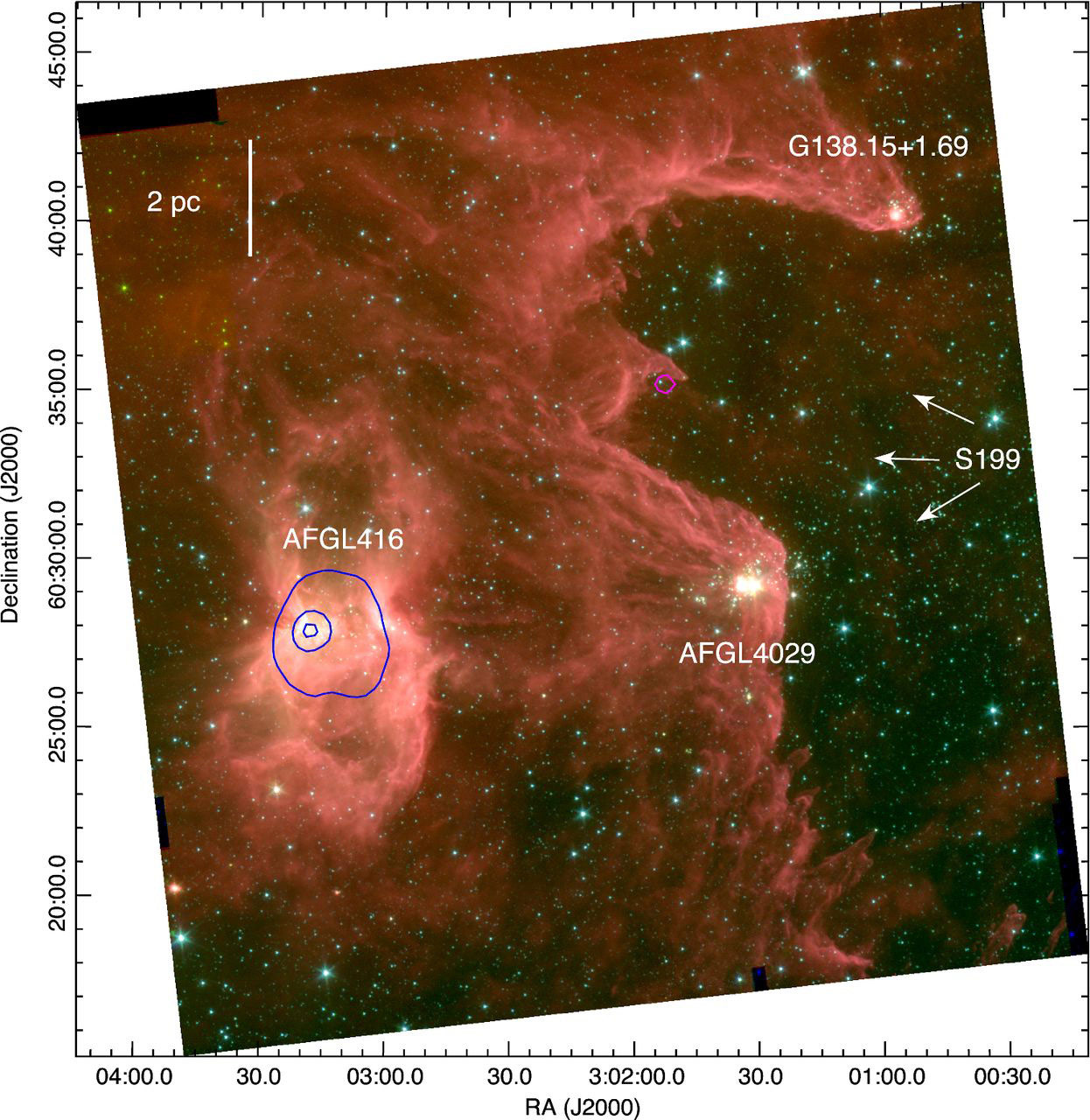
    A Spitzer three-color infrared image of the massive star-forming cluster in the W5-East molecular cloud. CfA astronomers have used the infrared images to survey the populations of embedded young stars in this and four other regions. The contours show the extent of ionizing radiation from embedded stars; white arrows show radiation from external, hot stars. The scale marker indicates a length of 6.58 light-years. Credit: NASA; Spitzer; IRAC

    Astronomers from the Harvard-Smithsonian Center for Astrophysics use Spitzer observations to study the massive star-forming regions W5-east, S235, S252, S254-S258, and NGC7538, revealing clusters of massive new stars.

    Over ninety percent of the stars in our galaxy were born in stellar nurseries, clusters of stars nestled deep within clouds of dust and molecular gas. These young natal environments are key targets for astronomers who study star formation because they retain imprints of the initial conditions that produced the stars and the dynamical environments under which they evolved. Clusters with massive stars (stars more than a few solar masses in size) are of particular interest since both the formation of massive stars and their impact on other cluster members are poorly understood, for several fundamental reasons. Massive stars begin hydrogen burning while they are still growing and hence quickly develop strong winds and ultraviolet radiation that inhibit their further growth while at the same time disrupting the nursery with shock waves and ionizing light. Moreover, because massive stars evolve quickly they do not linger in any particular stage of development long enough for easy study, and they remain obscured by the not-yet-disbursed natal dust. None of these issues applies to the formation of lower-mass stars.

    CfA astronomers Luis Chavarria, Joe Hora, Gus Muench, and Giovanni Fazio and two colleagues undertook a study of massive stellar clusters with the Spitzer Space Telescope, whose infrared camera can peer inside dusty regions. They chose five massive clusters relatively nearby (about six thousand light-years) and performed a detailed census of their populations using the infrared colors of the individual stars to characterize the clusters’ sizes and stages of development.

    The astronomers report finding 3021 young stars in their set of five clusters, a large enough sample to draw significant conclusions. The youngest group of these stars, a subset of 539, are found in regions where the cloud material is densest, supporting the general picture of cluster formation. The scientists also find that massive young stars form preferentially in filamentary (rather than spherical) structures that subsequently fragment, probably due to turbulence effects.

    Reference: “A Multiwavelength Study of Embedded Clusters in W5-east, NGC 7538, S235, S252 and S254-S258” by L. Chavarria, L. Allen, C. Brunt, J. L. Hora, A. Muench and G. Fazio, 27 February 2014, MNRAS.
    DOI: 10.1093/mnras/stu224
    arXiv: 1403.3082


    Never miss a breakthrough: Join the SciTechDaily newsletter.
    Follow us on Google and Google News.

    Astronomy Astrophysics Harvard-Smithsonian Center for Astrophysics Spitzer Space Telescope
    Share. Facebook Twitter Pinterest LinkedIn Email Reddit

    Related Articles

    Parallax Microlensing Free-Floating Stars in the Milky Way’s Bulge

    Spitzer Observations of Binary Neutron Star Merger GW170817

    Astronomers Study the Star Formation Rates of Galaxies

    Spitzer and OGLE Discover a Planet Deep Within Our Galaxy

    The Spitzer Interacting Galaxies Survey: An Infrared Atlas of Interacting Galaxies

    New Observations Confirm Variability of Young Stellar Objects

    Magnetic Winds From a Young Star in the Orion Nebula

    NGC 6334 Experiencing a “Mini-Starburst”

    Using Infrared Images from Hubble & Spitzer, Scientists Discover 25 Distant Galaxies

    Leave A Reply Cancel Reply

    • Facebook
    • Twitter
    • Pinterest
    • YouTube

    Don't Miss a Discovery

    Subscribe for the Latest in Science & Tech!

    Trending News

    Scientists Discover 132-Million-Year-Old Dinosaur Tracks on South Africa’s Coast

    Scientists Uncover the Secret Ingredient Behind the Spark That May Have Started Life on Earth

    Physicists Observe Matter in Two Places at Once in Mind-Bending Quantum Experiment

    Stanford Scientists Discover Hidden Brain Circuit That Fuels Chronic Pain

    New Study Reveals Why Ozempic Works Better for Some People Than Others

    Climate Change Is Altering a Key Greenhouse Gas in a Way Scientists Didn’t Expect

    New Study Suggests Gravitational Waves May Have Created Dark Matter

    Scientists Discover Why the Brain Gets Stuck in Schizophrenia

    Follow SciTechDaily
    • Facebook
    • Twitter
    • YouTube
    • Pinterest
    • Newsletter
    • RSS
    SciTech News
    • Biology News
    • Chemistry News
    • Earth News
    • Health News
    • Physics News
    • Science News
    • Space News
    • Technology News
    Recent Posts
    • 320 Light-Years Away, a Planet Confirms a Fundamental Cosmic Assumption
    • Astronomers Solve Decades-Long Mystery About Saturn’s Spin – “Something Strange Was Happening”
    • Scientists Uncover Strange New State of Matter Inside Uranus and Neptune
    • The Crown Jewel of Dentistry? Breakthrough Tech Could Transform Tooth Repair
    • The Surprising Non-Medical Factor That Determines Cancer Survival
    Copyright © 1998 - 2026 SciTechDaily. All Rights Reserved.
    • Science News
    • About
    • Contact
    • Editorial Board
    • Privacy Policy
    • Terms of Use

    Type above and press Enter to search. Press Esc to cancel.