
Close Menu
    Facebook X (Twitter) Instagram
    SciTechDaily
    • Biology
    • Chemistry
    • Earth
    • Health
    • Physics
    • Science
    • Space
    • Technology
    Facebook X (Twitter) Pinterest YouTube RSS
    SciTechDaily
    Home»Space»Ghost Particle From Star Shredded by Black Hole Reveals Cosmic Particle Accelerator
    Space

    Ghost Particle From Star Shredded by Black Hole Reveals Cosmic Particle Accelerator

    By New York UniversityFebruary 22, 2021No Comments5 Mins Read
    Facebook Twitter Pinterest Telegram LinkedIn WhatsApp Email Reddit
    Share
    Facebook Twitter LinkedIn Pinterest Telegram Email Reddit
    Black Hole Shreds Star
    Artist’s depiction of a black hole shreds a star. Scientists discover a high-energy neutrino after a star is consumed by a black hole, shedding light on the origins of Ultrahigh Energy Cosmic Rays. 

    A neutrino linked to a star’s destruction by a black hole supports the theory that Tidal Disruption Events produce Ultrahigh Energy Cosmic Rays.

    A team of scientists has detected the presence of a high-energy neutrino — a particularly elusive particle — in the wake of a star’s destruction as it is consumed by a black hole. This discovery, reported in the journal Nature Astronomy, sheds new light on the origins of Ultrahigh Energy Cosmic Rays — the highest energy particles in the Universe.

    The work, which included researchers from more than two dozen institutions, including New York University and Germany’s DESY research center, focused on neutrinos — subatomic particles that are produced on Earth only in powerful accelerators.

    Neutrinos — as well as the process of their creation — are hard to detect, making their discovery, along with that of Ultrahigh Energy Cosmic Rays (UHECRs), noteworthy.
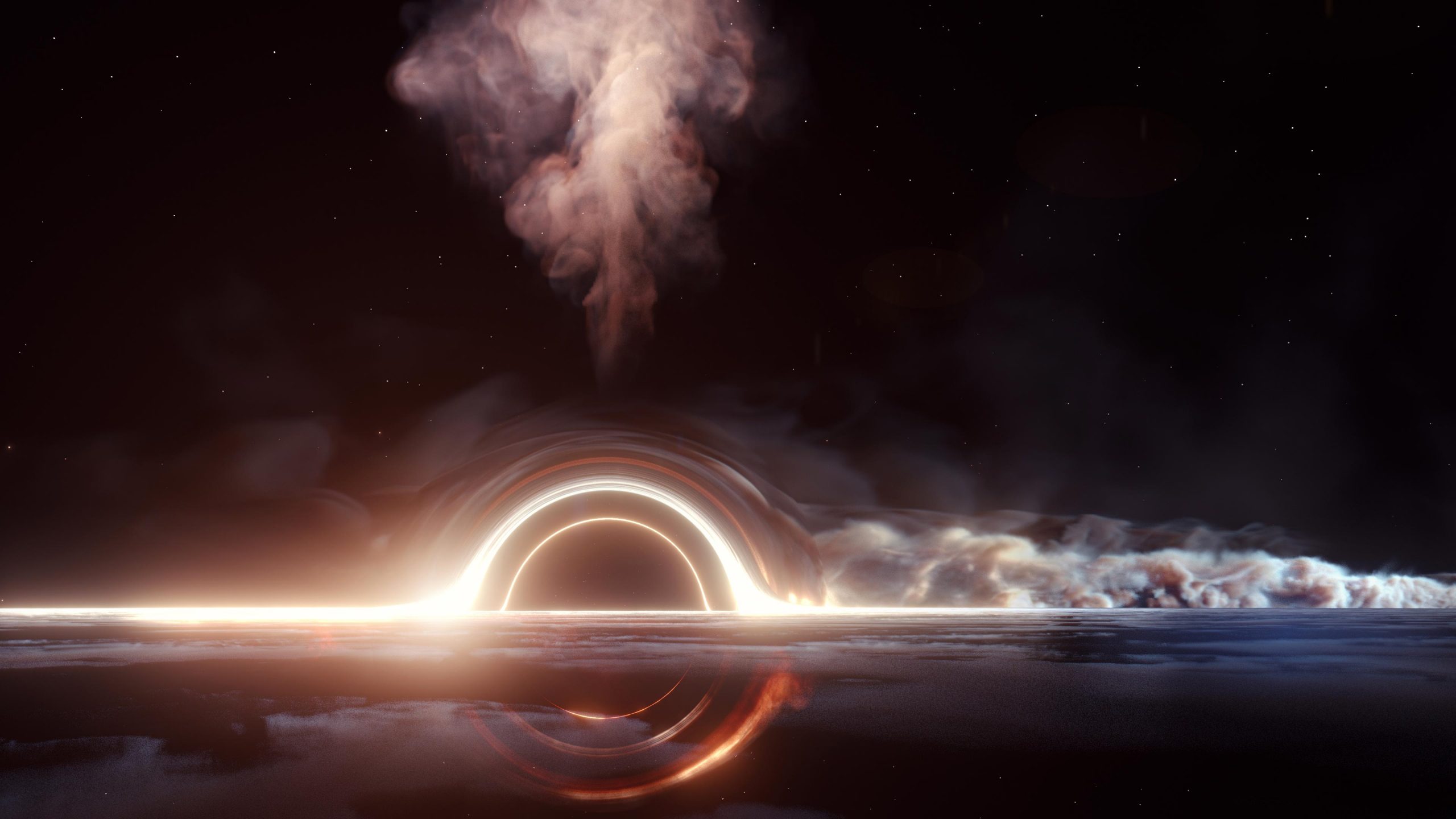
    Accretion Disc Around Supermassive Black Hole
    Heart of darkness: A view of the accretion disc around the supermassive black hole, with jet-like structures flowing away from the disc. The extreme mass of the black hole bends spacetime, allowing the far side of the accretion disc to be seen as an image above and below the black hole. Credit: DESY, Science Communication Lab

    Tracing Neutrinos Back to Their Violent Origins

    “The origin of cosmic high-energy neutrinos is unknown, primarily because they are notoriously hard to pin down,” explains Sjoert van Velzen, one of the paper’s lead authors and a postdoctoral fellow in NYU’s Department of Physics at the time of the discovery. “This result would be only the second time high-energy neutrinos have been traced back to their source.”

    Previous research by van Velzen, now at the Netherlands’ Leiden University, and NYU physicist Glennys Farrar, a co-author of the new Nature Astronomy paper, found some of the earliest evidence of black holes destroying stars in what are now known as Tidal Disruption Events (TDEs). These findings set the stage for determining if TDEs could be responsible for producing UHECRs.

    The research reported in Nature Astronomy offered support for this conclusion.
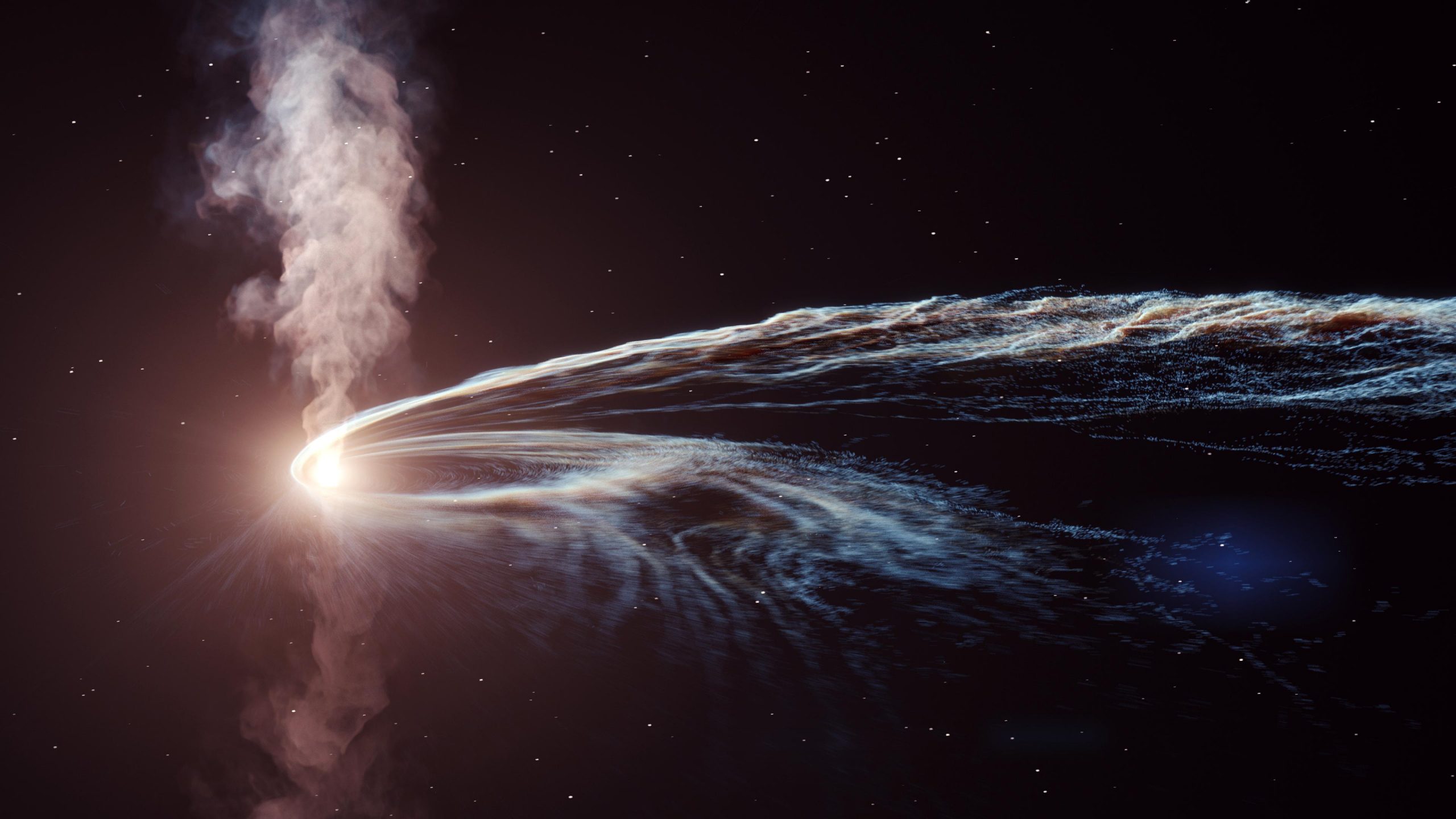
    Ghost Particle From Shredded Star
    Smoking gun: After the supermassive black hole tore the star apart, roughly half of the star debris was flung back out into space, while the remainder formed a glowing accretion disc around the black hole. The system shone brightly across many wavelengths and is thought to have produced energetic, jet-like outflows perpendicular to the accretion disc. A central, powerful engine near the accretion disc spewed out these fast subatomic particles. Credit: DESY, Science Communication Lab

    Previously, the IceCube Neutrino Observatory, a National Science Foundation-backed detector located in the South Pole, reported the detection of a neutrino, whose path was later traced by the Zwicky Transient Facility at Caltech’s Palomar Observatory.

    Specifically, its measurements showed a spatial coincidence of a high-energy neutrino and light emitted after a TDE — a star consumed by a black hole.

    “This suggests these star shredding events are powerful enough to accelerate high-energy particles,” van Velzen explains.


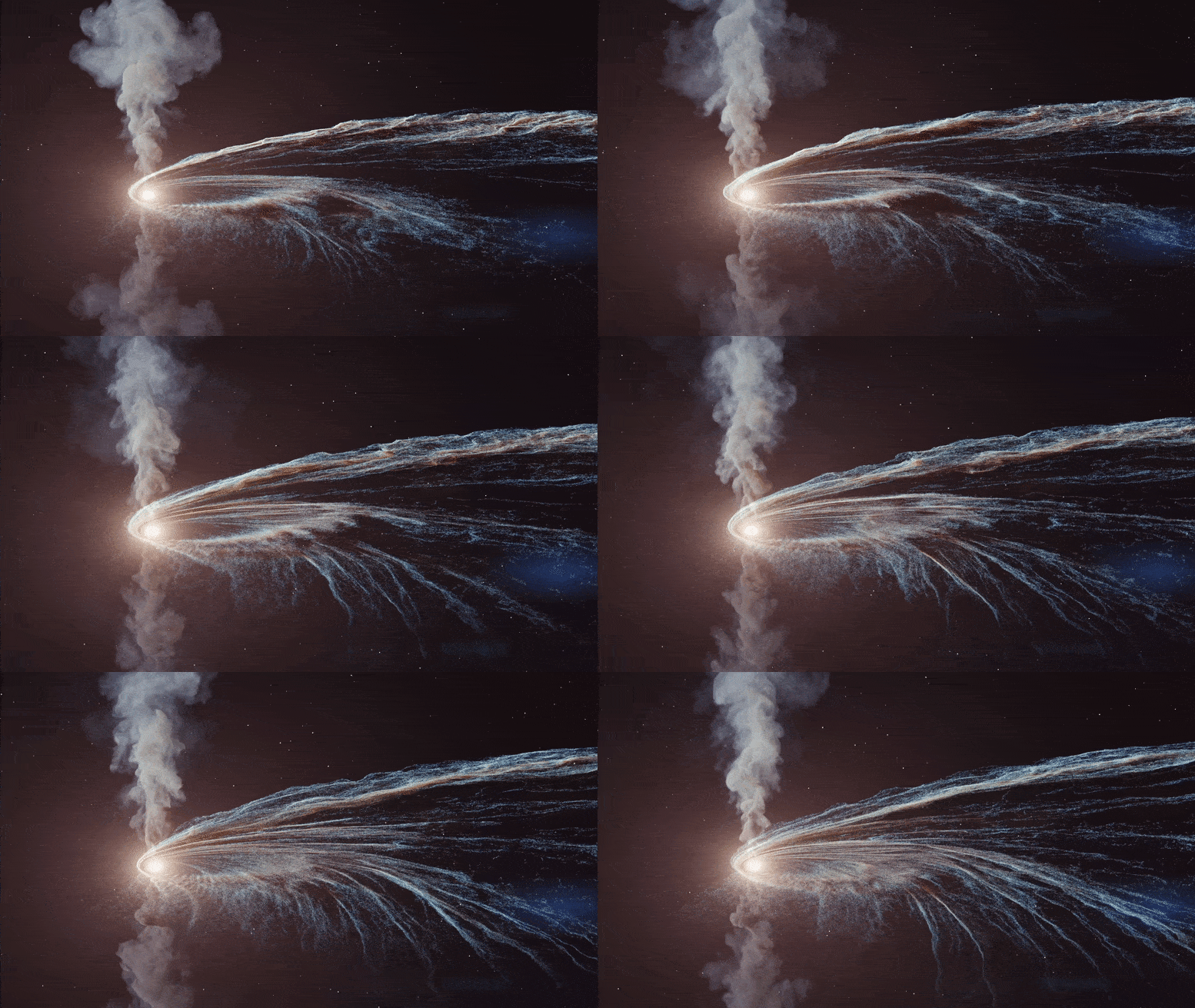
    As the star approaches the black hole, the enormous tidal forces stretch it more and more until it is finally shredded. Half of the stellar debris is flung back into space, while the remaining part forms a rotating accretion disk from which two strong outflows of matter shoot up and down. The system acts as a powerful natural particle accelerator. Credit: DESY, Science Communication Lab

    “Discovering neutrinos associated with TDEs is a breakthrough in understanding the origin of the high-energy astrophysical neutrinos identified by the IceCube detector at the South Pole whose sources have so far been elusive,” adds Farrar, who proposed in a 2009 paper that UHECRs could be accelerated in TDEs. “The neutrino-TDE coincidence also sheds light on a decades old problem: the origin of Ultrahigh Energy Cosmic Rays.”

    Reference: “A tidal disruption event coincident with a high-energy neutrino” by Robert Stein, Sjoert van Velzen, Marek Kowalski, Anna Franckowiak, Suvi Gezari, James C. A. Miller-Jones, Sara Frederick, Itai Sfaradi, Michael F. Bietenholz, Assaf Horesh, Rob Fender, Simone Garrappa, Tomás Ahumada, Igor Andreoni, Justin Belicki, Eric C. Bellm, Markus Böttcher, Valery Brinnel, Rick Burruss, S. Bradley Cenko, Michael W. Coughlin, Virginia Cunningham, Andrew Drake, Glennys R. Farrar, Michael Feeney, Ryan J. Foley, Avishay Gal-Yam, V. Zach Golkhou, Ariel Goobar, Matthew J. Graham, Erica Hammerstein, George Helou, Tiara Hung, Mansi M. Kasliwal, Charles D. Kilpatrick, Albert K. H. Kong, Thomas Kupfer, Russ R. Laher, Ashish A. Mahabal, Frank J. Masci, Jannis Necker, Jakob Nordin, Daniel A. Perley, Mickael Rigault, Simeon Reusch, Hector Rodriguez, César Rojas-Bravo, Ben Rusholme, David L. Shupe, Leo P. Singer, Jesper Sollerman, Maayane T. Soumagnac, Daniel Stern, Kirsty Taggart, Jakob van Santen, Charlotte Ward, Patrick Woudt and Yuhan Yao, 22 February 2021, Nature Astronomy.
    DOI: 10.1038/s41550-020-01295-8

    The research was supported by grants from the National Science Foundation (CAREER grant 1454816, AAG grant 1616566, PIRE Grant 1545949, NSF grant AST-1518052)

    Never miss a breakthrough: Join the SciTechDaily newsletter.
    Follow us on Google and Google News.

    Astronomy Astrophysics Neutrinos New York University Particle Physics Popular
    Share. Facebook Twitter Pinterest LinkedIn Email Reddit

    Related Articles

    Neutrino Factories in Deep Outer Space: Elementary Particles From the Depths of Our Universe

    Did a Black Hole Eating a Star Generate a Neutrino? New Research Casts Doubt

    Astrophysicists May Have Discovered the Hidden Source of Mysterious Cosmic Neutrinos Seen on Earth

    Proving the Existence of the Quark-Gluon Plasma With Gravitational Waves

    Axiogenesis: New Insight Into Fundamental Physics and the Origin of the Universe

    Extreme Solar Events and the Search for Habitable Exoplanets

    VERITAS Confirms Neutrino Emission from Vicinity of Blazar TXS 0506+056

    NASA Telescopes Reveal That Sagittarius A* May Be Producing Neutrinos

    Astronomers Accurately Measure the Mass of Neutrinos for the First Time

    Leave A Reply Cancel Reply

    • Facebook
    • Twitter
    • Pinterest
    • YouTube

    Don't Miss a Discovery

    Subscribe for the Latest in Science & Tech!

    Trending News

    Scientists Uncover Potential Brain Risks of Popular Fish Oil Supplements

    Scientists Discover a Surprising Way To Make Bread Healthier and More Nutritious

    After 60 Years, Scientists Uncover Unexpected Brain Effects of Popular Diabetes Drug Metformin

    New Research Uncovers Hidden Side Effects of Popular Weight-Loss Drugs

    Scientists Rethink Extreme Warming After Surprising Ocean Discovery

    Landmark Study Links Never Marrying to Significantly Higher Cancer Risk

    Researchers Discover Unknown Beetle Species Just Steps From Their Lab

    Largest-Ever Study Finds Medicinal Cannabis Ineffective for Anxiety, Depression, PTSD

    Follow SciTechDaily
    • Facebook
    • Twitter
    • YouTube
    • Pinterest
    • Newsletter
    • RSS
    SciTech News
    • Biology News
    • Chemistry News
    • Earth News
    • Health News
    • Physics News
    • Science News
    • Space News
    • Technology News
    Recent Posts
    • Early Warning Signals of Esophageal Cancer May Be Hiding in Plain Sight
    • Researchers Have Discovered a THC-Free Cannabis Compound That May Replace Opioids
    • Common Blood Pressure Drug Shows Surprising Power Against Deadly Antibiotic-Resistant Superbug
    • Students Build Dark Matter Detector and Set New Experimental Limits
    • Scientists Discover Caffeine Can Repair Key Memory Circuits After Sleep Loss
    Copyright © 1998 - 2026 SciTechDaily. All Rights Reserved.
    • Science News
    • About
    • Contact
    • Editorial Board
    • Privacy Policy
    • Terms of Use

    Type above and press Enter to search. Press Esc to cancel.