
Close Menu
    Facebook X (Twitter) Instagram
    SciTechDaily
    • Biology
    • Chemistry
    • Earth
    • Health
    • Physics
    • Science
    • Space
    • Technology
    Facebook X (Twitter) Pinterest YouTube RSS
    SciTechDaily
    Home»Biology»Staying Young: Scientists Discover New Enzymatic Complex That Can Stop Cells From Aging
    Biology

    Staying Young: Scientists Discover New Enzymatic Complex That Can Stop Cells From Aging

    By University of Montreal Hospital Research Centre (CRCHUM)October 2, 2021No Comments3 Mins Read
    Facebook Twitter Pinterest Telegram LinkedIn WhatsApp Email Reddit
    Share
    Facebook Twitter LinkedIn Pinterest Telegram Email Reddit
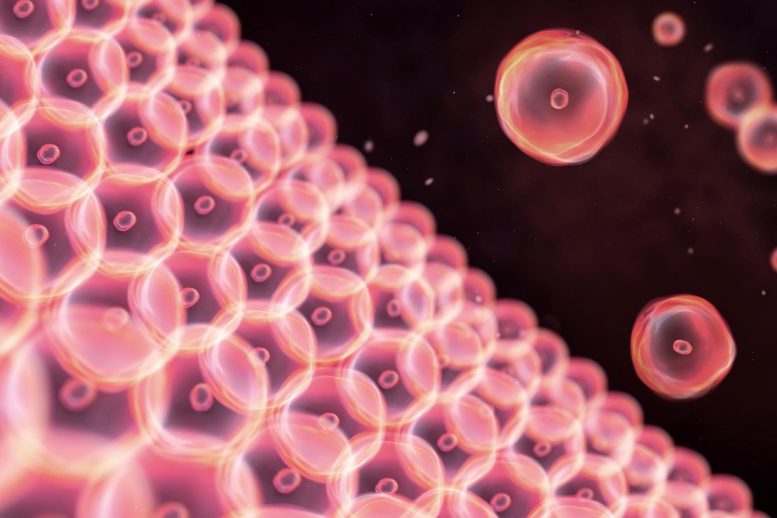
    Pink Skin Cells Illustration
    Researchers have shown that an enzyme complex named HTC (hydride transfer complex) can inhibit cell aging.

    Scientists in Montreal discover a new enzymatic complex that can stop cells from aging, opening the way to possible new cancer therapies.

    Researchers at Université de Montréal and McGill University have discovered a new multi-enzyme complex that reprograms metabolism and overcomes “cellular senescence,” when aging cells stop dividing.

    In their study published on September 16, 2021, in Molecular Cell, the researchers show that an enzyme complex named HTC (hydride transfer complex) can inhibit cells from aging. 

    “HTC protects cells from hypoxia, a lack of oxygen that normally leads to their death,” said senior author Gerardo Ferbeyre, a UdeM biochemistry professor and principal scientist at the CRCHUM, the university’s affiliated teaching hospital research center.

    “Importantly, HTC can be hijacked by certain cancer cells to improve their metabolism, resist to a hypoxic environment and proliferate,” said Ferbeyre, who made the discovery with Sebastian Igelmann, a PhD student in his lab and first author of the study.

    HTC is made up of three enzymes: pyruvate carboxylase, malate dehydrogenase 1, and malic enzyme 1. They were all highly expressed in samples from a prostate cancer mouse model generated at the University of Veterinary Medicine Vienna, in Austria, and in tissue samples from prostate cancer patients.

    Therapeutic Potential in Targeting HTC

    “Most interestingly, inhibition of these enzymes stopped the growth of prostate cancer cells, suggesting that HTC could be a key target to develop new therapeutics for a variety of cancers, including prostate cancer,” said Ferbeyre.

    Most key metabolic cycles were identified more than 50 years ago, but HTC remained hidden from researchers. “We found it by performing state-of-the-art metabolomic analysis, the study of chemical processes of cell metabolism,” said co-author Ivan Topisirovic, a McGill researcher and medical professor.

    The scientists were able to assemble the enzyme complex from purified proteins and obtain biophysical data about its composition. Their next step will be to generate a detailed high-resolution structure of the enzyme complex in order to design drugs able to modulate its functions.

    Reference: “A hydride transfer complex reprograms NAD metabolism and bypasses senescence” by Sebastian Igelmann, Frédéric Lessard, Oro Uchenunu, Jacob Bouchard, Ana Fernandez-Ruiz, Marie-Camille Rowell, Stéphane Lopes-Paciencia, David Papadopoli, Aurélien Fouillen, Katia Julissa Ponce, Geneviève Huot, Lian Mignacca, Mehdi Benfdil, Paloma Kalegari, Haytham M. Wahba, Jan Pencik, Nhung Vuong, Jordan Quenneville, Jordan Guillon, Véronique Bourdeau, Laura Hulea, Etienne Gagnon, Lukas Kenner, Richard Moriggl, Antonio Nanci, Michael N. Pollak, James G. Omichinski, Ivan Topisirovic and Gerardo Ferbeyre, 16 September 2021, Molecular Cell.
    DOI: 10.1016/j.molcel.2021.08.028

    Never miss a breakthrough: Join the SciTechDaily newsletter.
    Follow us on Google and Google News.

    Cancer Cell Biology Molecular Biology Popular University of Montreal
    Share. Facebook Twitter Pinterest LinkedIn Email Reddit

    Related Articles

    Researchers Discover New Way To Fight the Aging Process

    Solving a 100-Year-Old Paradox: Why Cancer Cells Waste So Much Energy

    New Molecular Details of Cancer Cells Could Lead to Improved Treatment

    New Discovery Reveals Fat Cells Are Sensitive to Sunlight, May Explain Winter Weight Gain

    MIT Develops a Synthetic Gene Circuit to Trigger Immune System Attack on Cancer

    Brazilian Wasp Venom Kills Cancer Cells Without Harming Normal Cells

    Scientists Discover a Gene for Brain Size

    Scientists Grow Human Brain Tissue in a 3D Culture System

    Inactivating AGPS Enzyme Reduces Tumor Growth, Cripples Cancer Cells

    Leave A Reply Cancel Reply

    • Facebook
    • Twitter
    • Pinterest
    • YouTube

    Don't Miss a Discovery

    Subscribe for the Latest in Science & Tech!

    Trending News

    Researchers Have Found a Dietary Compound That Increases Longevity

    Scientists Baffled by Bizarre “Living Fossil” From 275 Million Years Ago

    Your IQ at 23 Could Predict Your Wealth at 27, Study Finds

    320 Light-Years Away, a Planet Confirms a Fundamental Cosmic Assumption

    The Crown Jewel of Dentistry? Breakthrough Tech Could Transform Tooth Repair

    Python Blood Could Hold the Secret to Weight Loss Without Side Effects

    Naturally Occurring Bacteria Completely Eradicate Tumors in Mice With a Single Dose

    New “Nanozyme Hypothesis” Could Rewrite the Story of Life’s Origins

    Follow SciTechDaily
    • Facebook
    • Twitter
    • YouTube
    • Pinterest
    • Newsletter
    • RSS
    SciTech News
    • Biology News
    • Chemistry News
    • Earth News
    • Health News
    • Physics News
    • Science News
    • Space News
    • Technology News
    Recent Posts
    • A New Chapter in Chemistry? Scientists Uncover New Way Metals Bind Oxygen
    • New Study Reveals Earth Is Getting Brighter at Night – About 2% Each Year
    • Accidental Deep Ocean Discovery Reveals Hidden Carbon Sink
    • Cooling the Planet Could Come at a Devastating Cost
    • These New Molecules Could Change How We Treat Lupus and Arthritis
    Copyright © 1998 - 2026 SciTechDaily. All Rights Reserved.
    • Science News
    • About
    • Contact
    • Editorial Board
    • Privacy Policy
    • Terms of Use

    Type above and press Enter to search. Press Esc to cancel.