
Close Menu
    Facebook X (Twitter) Instagram
    SciTechDaily
    • Biology
    • Chemistry
    • Earth
    • Health
    • Physics
    • Science
    • Space
    • Technology
    Facebook X (Twitter) Pinterest YouTube RSS
    SciTechDaily
    Home»Space»Stellar “Ashfall” Could Help Distant Planets Grow – 3D Simulation Provides Insights on Protoplanetary Mystery
    Space

    Stellar “Ashfall” Could Help Distant Planets Grow – 3D Simulation Provides Insights on Protoplanetary Mystery

    By Center for Computational Astrophysics, NAOJDecember 14, 2021No Comments4 Mins Read
    Facebook Twitter Pinterest Telegram LinkedIn WhatsApp Email Reddit
    Share
    Facebook Twitter LinkedIn Pinterest Telegram Email Reddit
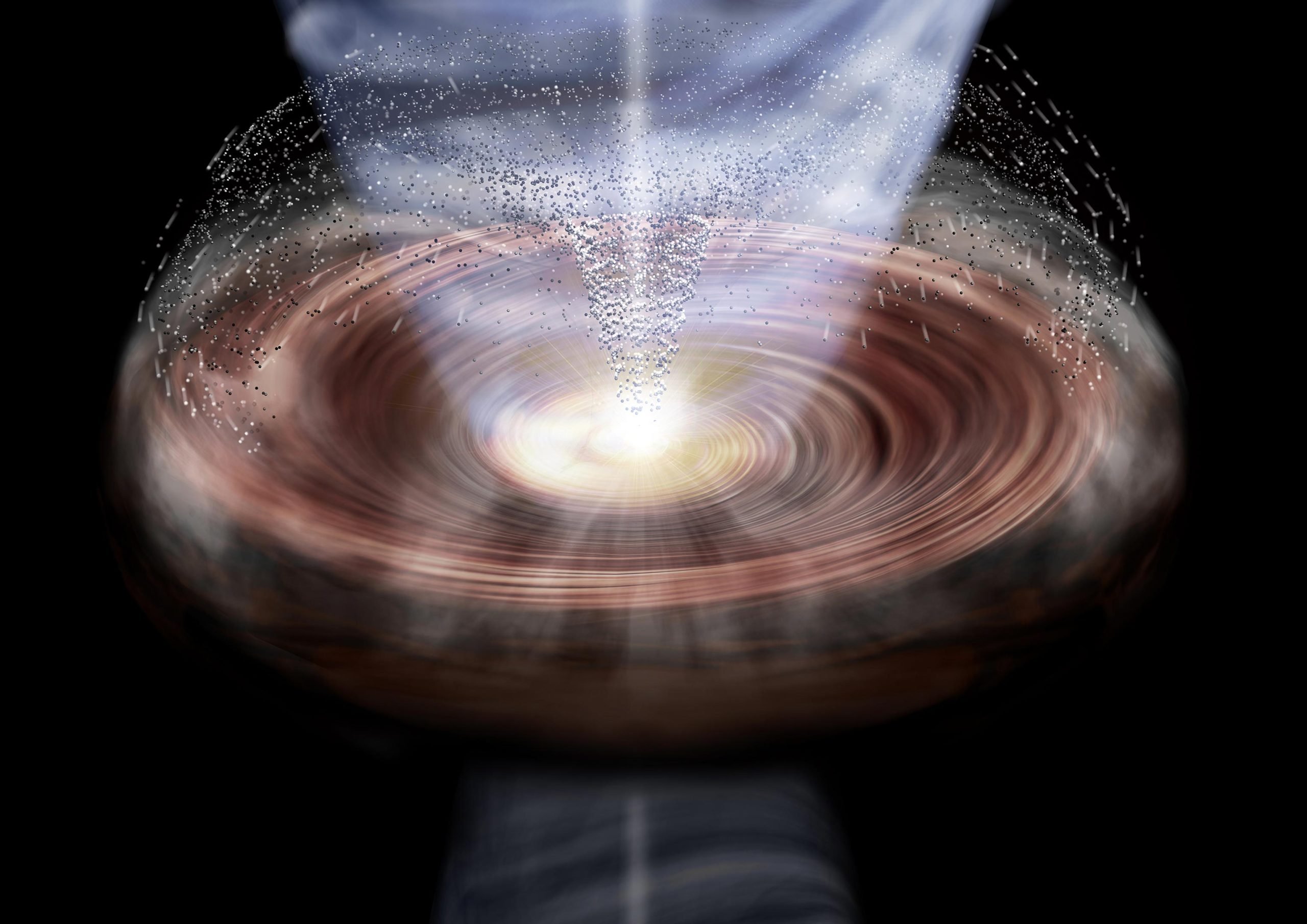
    Stellar Ashfall
    Artist’s impression of the “Ashfall” in a protoplanetary disk. The dust particles swept up by the bipolar outflow from the center of the protoplanetary disk are piled up on the outer edge of the disk. Credit: Kagoshima University

    Simulations reveal “stellar ashfall,” where dust ejected by gas outflows falls back to enrich outer disks, solving the mystery of distant dust rings.

    The world’s first 3D simulation simultaneously considering dust motion and growth in a disk around a young star has shown that large dust from the central region can be entrained by and then ejected by gas outflows, and eventually fall back onto the outer regions of the disk where it may enable planetesimal formation. This process can be likened to volcanic “ashfall” where ash carried up by gas during an eruption falls back on the area around the volcano. These results help to explain observed dust structures around young protostars.
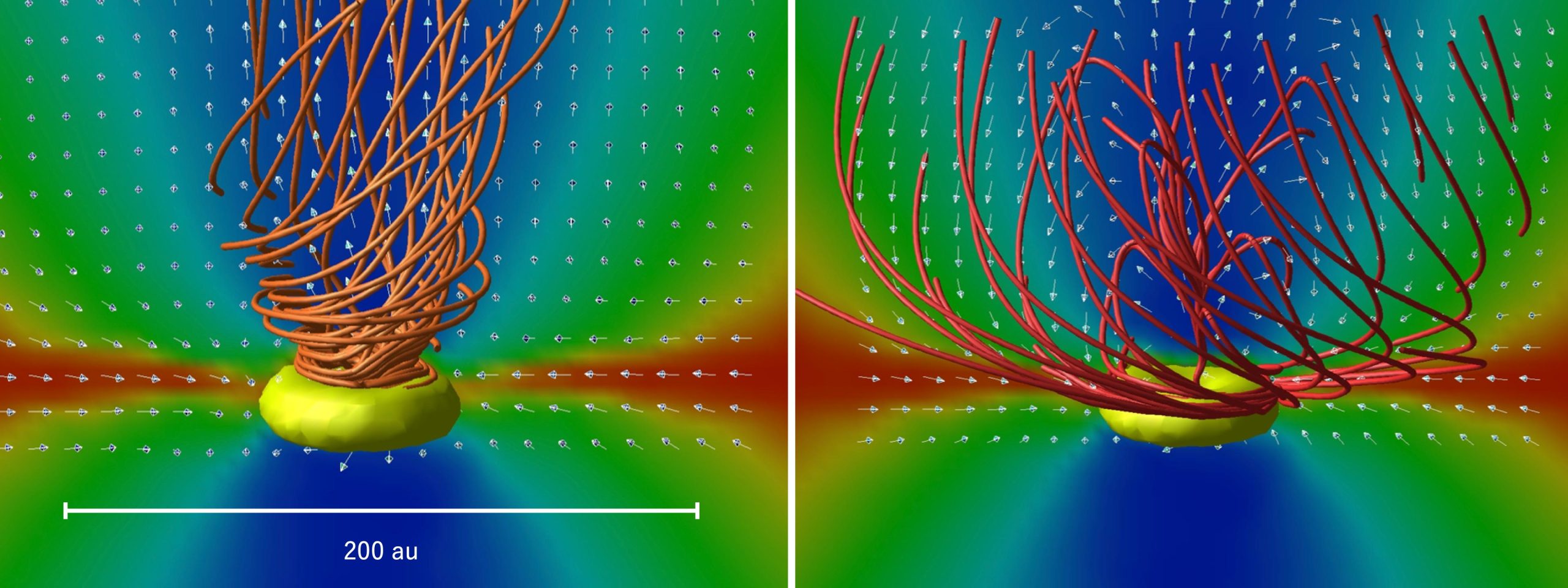
    Flows of Gas and Dust
    The flows of gas (left panel) and dust (right panel). The orange and red lines indicate the gas and dust paths (streamlines), respectively, and the white arrows indicate the flow direction. The yellow region represents the protoplanetary disk formed in the simulation. Credit: Yusuke Tsukamoto

    Observations by ALMA (Atacama Large Millimeter/submillimeter Array) have revealed gaps in protoplanetary disks of gas and dust around young stars. The gravitational effects of planets are thought to be one of the reasons for the formation of these rings. However, some rings are seen even further out than the position of Neptune in the Solar System. At these distances, dust, a vital component to planet formation, should be scarce. Furthermore, the dust is expected to move in towards the central region of the disk as it grows. So how planets can form in the outer regions has been a mystery.
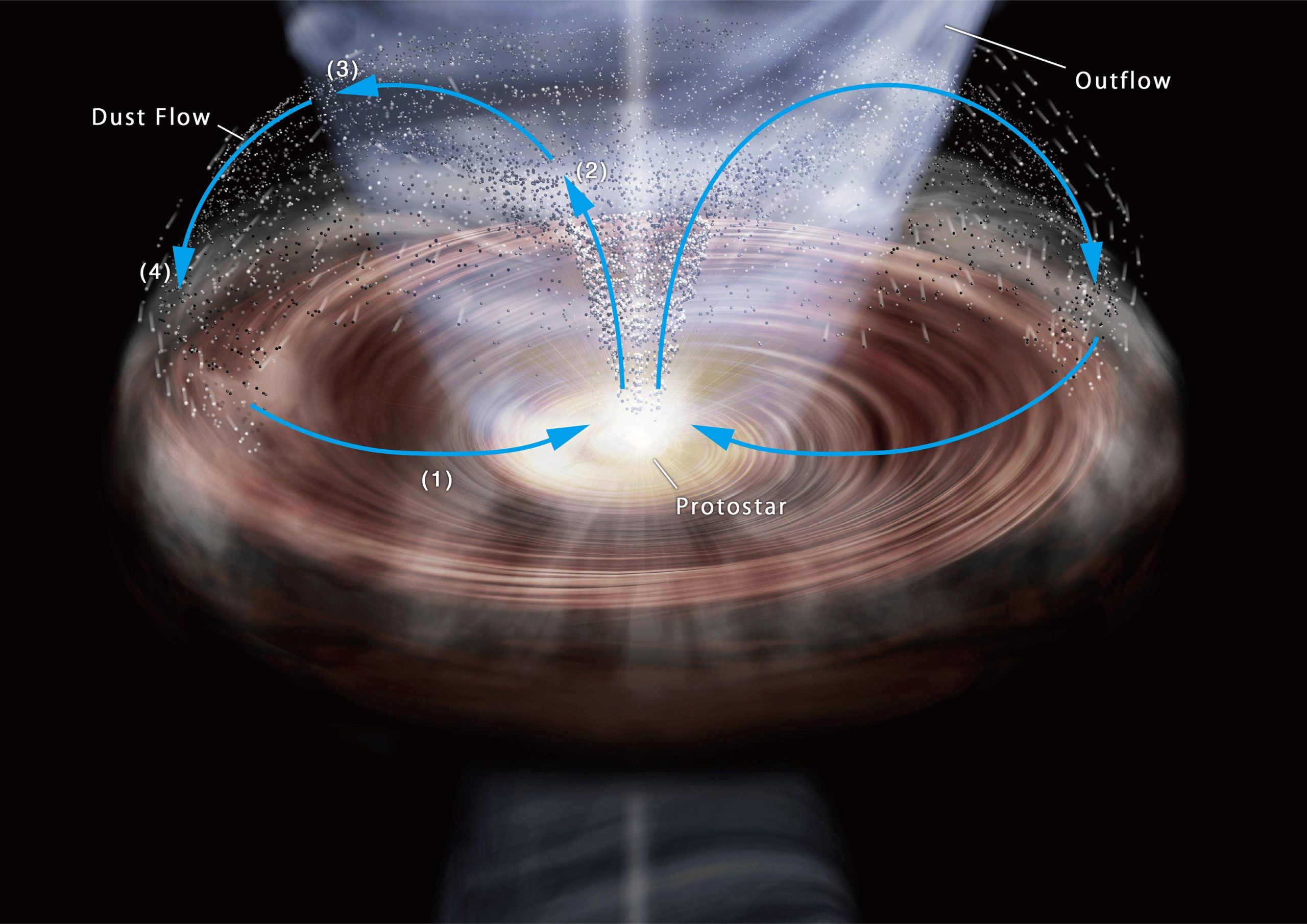
    Stellar Ashfall Annotated
    Artist’s impression of the “Ashfall” in a protoplanetary disk. (1)The dust grows in the disk and migrates to the center of the protoplanetary disk near the protostar. (2)When the dust reaches the vicinity of the protostar, the dust particles are lifted vertically by the gas outflow. (3)Dust particles are separated from the outflow by centrifugal force. (4)The dust that leaves the outflow falls on the outer edge of the protoplanetary disk. Credit: Kagoshima University

    A research team led by Yusuke Tsukamoto at Kagoshima University used ATERUI II, the world’s most powerful supercomputer dedicated to astronomy calculations at the National Astronomical Observatory of Japan, to perform the world’s first 3D simulation of dust motion and growth in a protoplanetary disk. The team found that large dust particles grown in the central region can be carried out perpendicular to the disk by streams of gas, called bipolar outflow, erupting out from the disk. This dust then drifts out from the outflow and gravity pulls it back down to the outer part of the disk. Tsukamoto comments, “Living in Kagoshima, in the shadow of the active volcano Mt. Sakurajima, I naturally thought of volcanic ashfall when I saw the simulation results.”

    The simulation shows that this “stellar ashfall” can enrich large dust in the outer region of the protoplanetary disk and facilitate planetesimal formation, which may eventually cause planet formation.
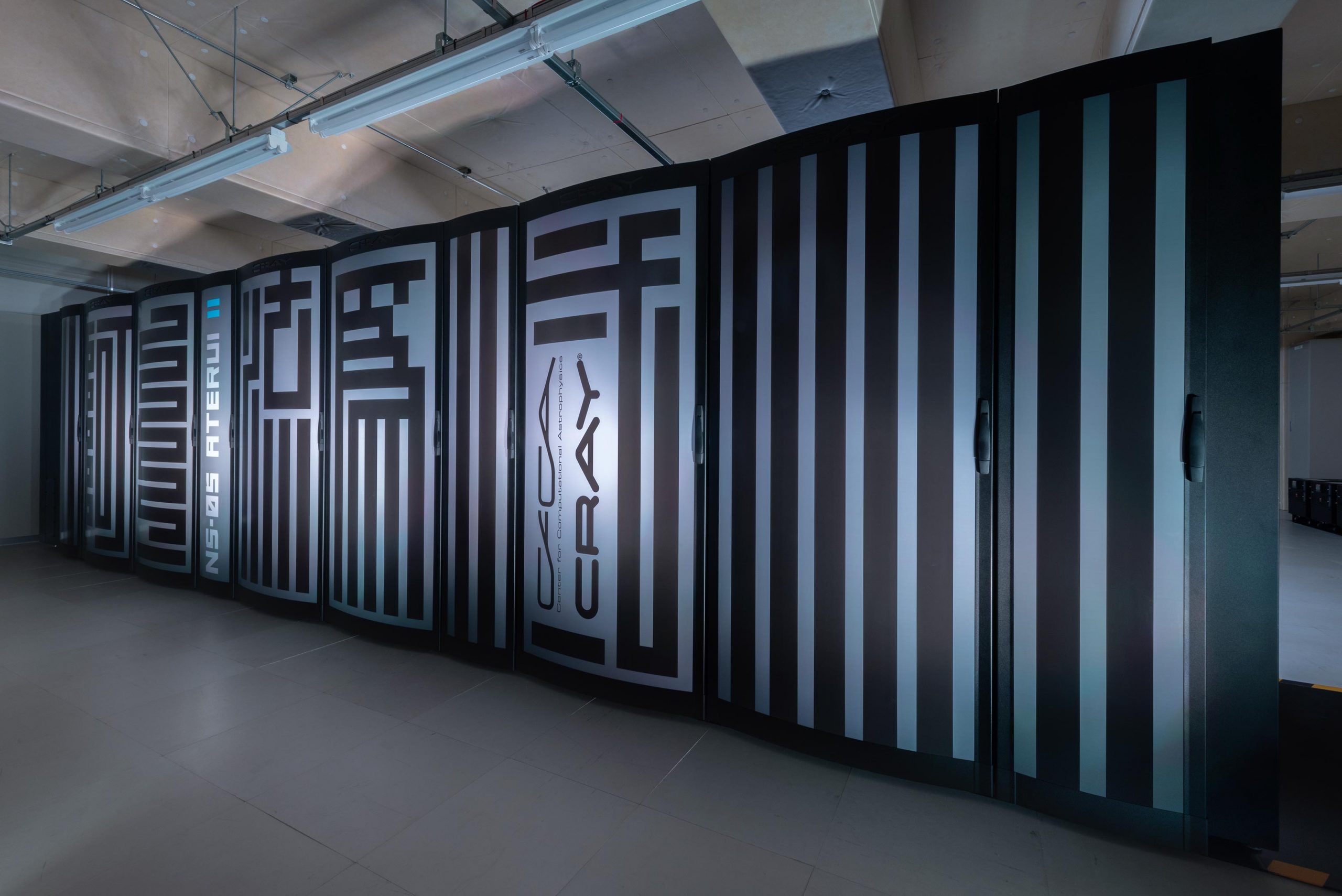
    NAOJ Supercomputer ATERUI II Cray XC50
    NAOJ supercomputer ATERUI II (Cray XC50). Credit: NAOJ

    This research utilized the NAOJ supercomputer ATERUI II (Cray XC50) for the simulations of protoplanetary disks. ATERUI II is operated at NAOJ Mizusawa Campus (Oshu, Iwate) with a theoretical peak performance of 3.087 Pflops.

    Reference: “”Ashfall” induced by molecular outflow in protostar evolution” by Yusuke Tsukamoto, Masahiro N. Machida and Shu-ichiro Inutsuka, 15 October 2021, The Astrophysical Journal Letters.
    DOI: 10.3847/2041-8213/ac2b2f

    Never miss a breakthrough: Join the SciTechDaily newsletter.
    Follow us on Google and Google News.

    Astronomy Astrophysics NAOJ Planets
    Share. Facebook Twitter Pinterest LinkedIn Email Reddit

    Related Articles

    Growing up Stardust: Astronomers Discover That Stars and Planets May Be Siblings

    Vaporized Crusts of Earth-Like Planets Discovered in Dying Stars

    “Farfarout” Indeed: Planetoid Confirmed to Be Solar System’s Most Distant Known Object

    Two Scientists Have Figured Out What Caused Saturn’s Tilt

    Solar System Formation in Two Steps – Explains Composition and Features of Planets, Asteroids and Meteorites

    A Tale of Planetary Resurrection in a Triple-Star System With a Skewed Configuration

    Striped or Spotted? Planetary Scientists Solve a Brown Dwarf Mystery

    AB Aur: A Rosetta Stone for Planet Formation

    Astronomers Discover Pair of Lonely Exotic Planet-Like Objects Born Like Stars

    Leave A Reply Cancel Reply

    • Facebook
    • Twitter
    • Pinterest
    • YouTube

    Don't Miss a Discovery

    Subscribe for the Latest in Science & Tech!

    Trending News

    Scientists May Have Found the Key to Jupiter and Saturn’s Moon Mystery

    Scientists Uncover Brain Changes That Link Pain to Depression

    Saunas May Do More Than Raise Body Temperature – They Activate Your Immune System

    Exercise in a Pill? Metformin Shows Surprising Effects in Cancer Patients

    Hidden Oceans of Magma Could Be Protecting Alien Life

    New Study Challenges Alzheimer’s Theories: It’s Not Just About Plaques

    Artificial Sweeteners May Harm Future Generations, Study Suggests

    Splashdown! NASA Artemis II Returns From Record-Breaking Moon Mission

    Follow SciTechDaily
    • Facebook
    • Twitter
    • YouTube
    • Pinterest
    • Newsletter
    • RSS
    SciTech News
    • Biology News
    • Chemistry News
    • Earth News
    • Health News
    • Physics News
    • Science News
    • Space News
    • Technology News
    Recent Posts
    • Ancient DNA Reveals Irish Goats Have a 3,000-Year-Old Lineage Still Alive Today
    • Historians Reveal Secrets of the Strange Hat Wars That Shook Early Modern England
    • “A Plague Is Upon Us”: The Mass Death That Changed an Ancient City Forever
    • This Strange Material Can Turn Superconductivity on and off Like a Switch
    • Scientists Discover Game-Changing New Way To Treat High Cholesterol
    Copyright © 1998 - 2026 SciTechDaily. All Rights Reserved.
    • Science News
    • About
    • Contact
    • Editorial Board
    • Privacy Policy
    • Terms of Use

    Type above and press Enter to search. Press Esc to cancel.