
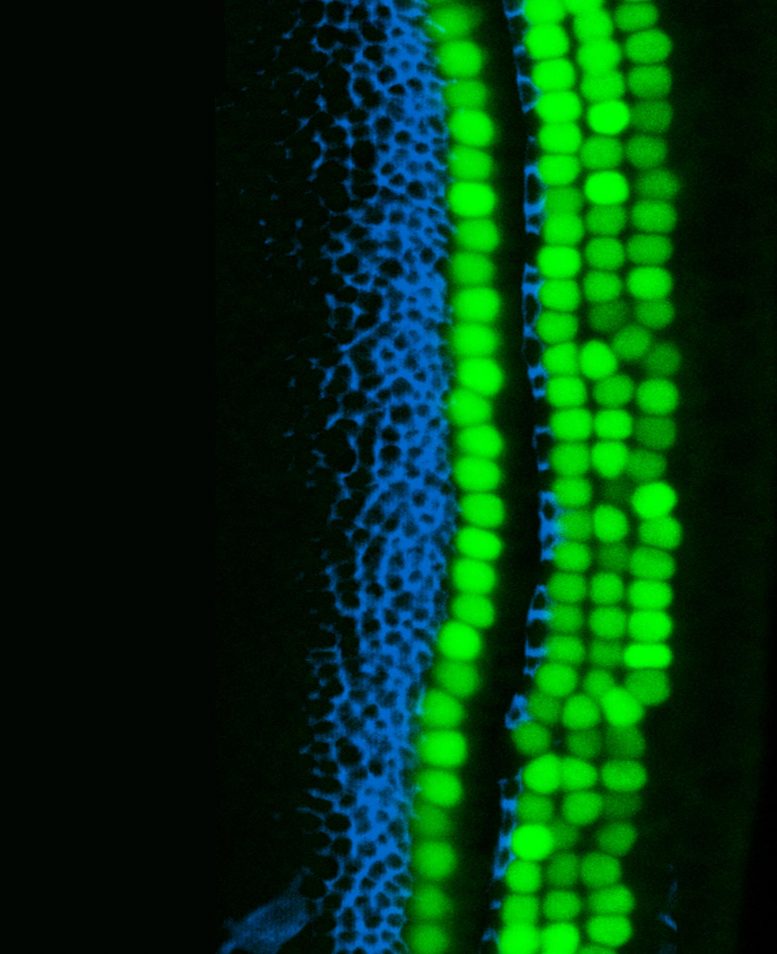
Researchers found that loss of a specific histone marker limits inner ear cell regeneration. Restoring this marker could lead to treatments for age-related hearing loss.
Scientists from the USC Stem Cell laboratory of Neil Segil have identified a natural barrier to the regeneration of the inner ear’s sensory cells, which are lost in hearing and balance disorders. Overcoming this barrier may be a first step in returning inner ear cells to a newborn-like state that’s primed for regeneration, as described in a new study published in Developmental Cell.
“Permanent hearing loss affects more than 60 percent of the population that reaches retirement age,” said Segil, who is a Professor in the Department of Stem Cell Biology and Regenerative Medicine, and the USC Tina and Rick Caruso Department of Otolaryngology – Head and Neck Surgery. “Our study suggests new gene engineering approaches that could be used to channel some of the same regenerative capability present in embryonic inner ear cells.”
In the inner ear, the hearing organ, which is the cochlea, contains two major types of sensory cells: “hair cells” that have hair-like cellular projections that receive sound vibrations; and so-called “supporting cells” that play important structural and functional roles.
When the delicate hair cells incur damage from loud noises, certain prescription drugs, or other harmful agents, the resulting hearing loss is permanent in older mammals. However, for the first few days of life, lab mice retain an ability for supporting cells to transform into hair cells through a process known as “transdifferentiation,” allowing recovery from hearing loss. By one week of age, mice lose this regenerative capacity—also lost in humans, probably before birth.
Based on these observations, postdoctoral scholar Litao Tao, PhD, graduate student Haoze (Vincent) Yu, and their colleagues took a closer look at neonatal changes that cause supporting cells to lose their potential for transdifferentiation.
Epigenetic Modifications Control Gene Activity
In supporting cells, the hundreds of genes that instruct transdifferentiation into hair cells are normally turned off. To turn genes on and off, the body relies on activating and repressive molecules that decorate the proteins known as histones. In response to these decorations known as “epigenetic modifications,” the histone proteins wrap the DNA into each cell nucleus, controlling which genes are turned “on” by being loosely wrapped and accessible, and which are turned “off” by being tightly wrapped and inaccessible. In this way, epigenetic modifications regulate gene activity and control the emergent properties of the genome.
In the supporting cells of the newborn mouse cochlea, the scientists found that hair cell genes were suppressed by both the lack of an activating molecule, H3K27ac, and the presence of the repressive molecule, H3K27me3. However, at the same time, in the newborn mouse supporting cells, the hair cell genes were kept “primed” to activate by the presence of yet a different histone decoration, H3K4me1. During transdifferentiation of a supporting cell to a hair cell, the presence of H3K4me1 is crucial to activate the correct genes for hair cell development.
Loss of Priming Molecule Limits Regeneration
Unfortunately with age, the supporting cells of the cochlea gradually lost H3K4me1, causing them to exit the primed state. However, if the scientists added a drug to prevent the loss of H3K4me1, the supporting cells remained temporarily primed for transdifferentiation. Likewise, supporting cells from the vestibular system, which naturally maintained H3K4me1, were still primed for transdifferentiation into adulthood.
“Our study raises the possibility of using therapeutic drugs, gene editing, or other strategies to make epigenetic modifications that tap into the latent regenerative capacity of inner ear cells as a way to restore hearing,” said Segil. “Similar epigenetic modifications may also prove useful in other non-regenerating tissues, such as the retina, kidney, lung, and heart.”
Reference: “Enhancer decommissioning imposes an epigenetic barrier to sensory hair cell regeneration” by Litao Tao, Haoze V. Yu, Juan Llamas, Talon Trecek, Xizi Wang, Zlatka Stojanova, Andrew K. Groves and Neil Segil, 30 July 2021, Developmental Cell.
DOI: 10.1016/j.devcel.2021.07.003
Additional co-authors of the study include Juan Llamas, Talon Trecek, Xizi Wang, and Zlatka Stojanova in the Segil Lab at USC, and Andrew K. Groves at Baylor College of Medicine.
Sixty percent of this project was supported by federal funding from the National Institute on Deafness and Other Communication Disorders (R01DC015829, R01DC014832, T32DC009975, F31DC017376). Additional funding came from the Hearing Restoration Project at the Hearing Health Foundation.
Never miss a breakthrough: Join the SciTechDaily newsletter.
Follow us on Google and Google News.