
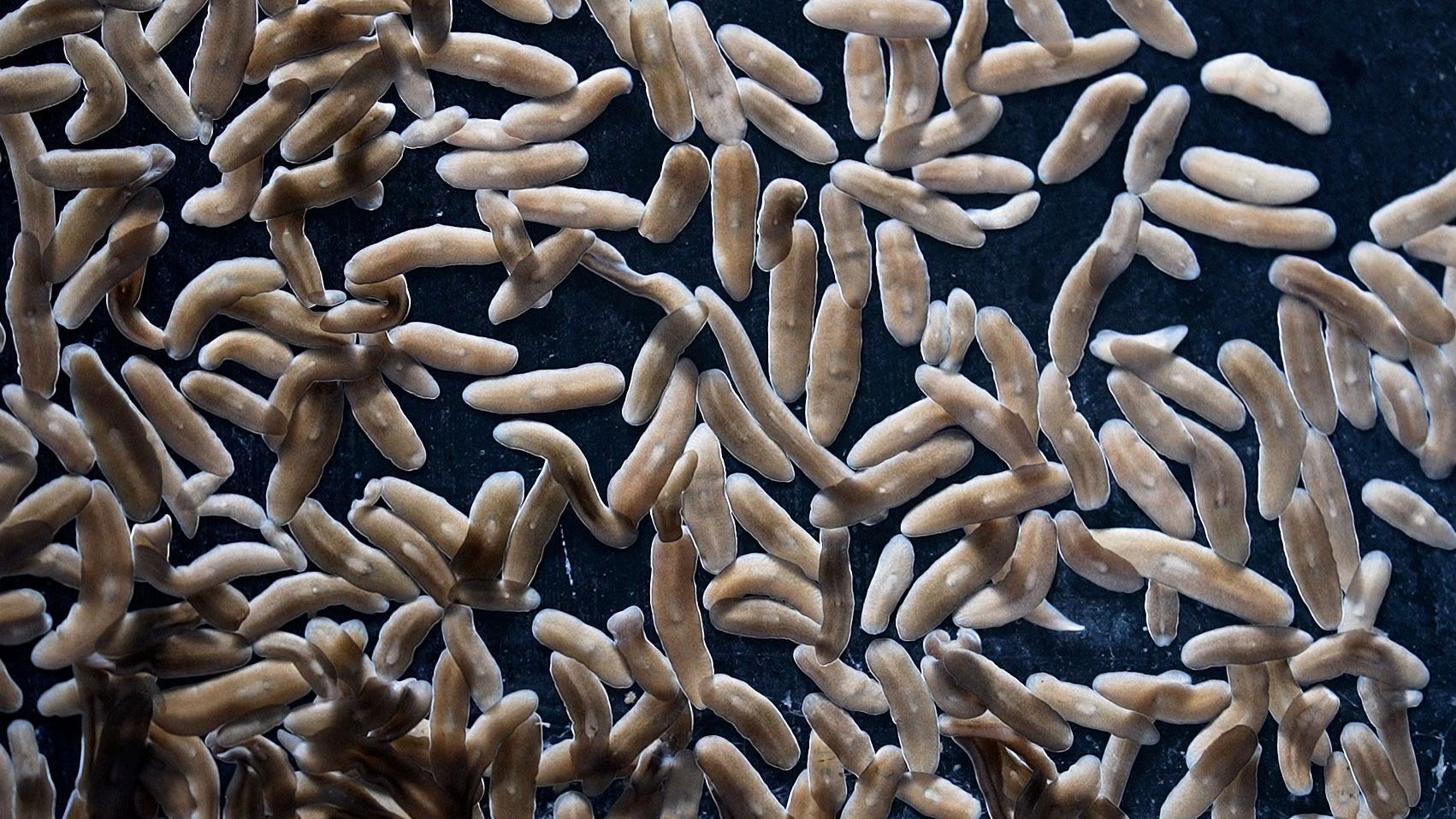
Stowers scientists uncover new principles guiding how flatworm stem cells regenerate body parts, revealing clues that could advance tissue repair and regenerative medicine in humans.
Stem cells in most living organisms usually take their instructions from nearby cells. However, scientists at the Stowers Institute for Medical Research have discovered that planarian stem cells behave differently. Instead of listening to signals from adjacent cells, these stem cells respond to cues coming from distant areas within the flatworm’s body.
This surprising behavior may be the key to understanding how planarians can regrow entire body parts, and it could provide valuable insights into how human tissues might one day be repaired or replaced.
The research, published in Cell Reports on October 15, 2025, was led by Postdoctoral Research Associate Frederick “Biff” Mann, Ph.D., from the laboratory of Stowers President and Chief Scientific Officer Alejandro Sánchez Alvarado, Ph.D. The study challenges the long-held idea that most stem cells occupy a fixed location known as a niche, where neighboring cells direct their division, renewal, and specialization.
“For instance, human blood-forming stem cells reside in niches within bone marrow where they divide to self-renew and make new blood cells,” said Mann.
Three-dimensional rendering of a planarian stem cell (gray, center) with its neighbors. The stem cells reside in complex niches and have a diverse set of neighbors. Neoblast (gray). Phagocytic (blue). Muscle (orange). Hecatonoblast (pink). Credit: Stowers Institute for Medical Research
The team, however, revealed that the planarian’s remarkable ability to regrow body parts, for example, rebuilding an amputated head or even an entire body from just a tiny fragment, is linked to stem cells that act more independently from their surroundings than those in most other animals.
“Understanding how stem cells are regulated in living organisms is one of the great challenges in the fields of stem cell biology and regenerative medicine,” said Sánchez Alvarado. “This finding challenges our concept of a stem cell ‘niche’ and may significantly advance our understanding of how to control stem cells’ abilities to restore damaged tissues.”
Limitless Potential and the Risk of Going Rogue
Adult planarian stem cells have unlimited potential to become any type of cell, in contrast to most other organisms including humans whose stem cells are tightly regulated to enable them to produce just a few specialized cell types. Part of this control system is in place to help prevent unchecked cell growth, which is a hallmark of cancer.
“Our hope is to uncover the basic rules that guide stem cells to become specific tissues as opposed to going rogue, as most tumors in humans begin when stem cells stop following these rules,” said Sánchez Alvarado.
“The role of a traditional niche may be more in line with a micromanager — instructing cells, ‘You can be a stem cell, but only one particular type’,” said Mann. “However, we’ve now shown having a normal niche may not be essential for stem cells to work. Some stem cells, like those in the planarian flatworm, have figured out a way to be independent and can turn into any type of cell without needing a nearby niche.”
Armed with the emerging technology of spatial transcriptomics, the researchers could determine which genes are turned on not just within one cell but also within surrounding cells in a tissue. This revealed surprising neighbors — notable varieties of cell types that surround stem cells. The most prominent was one not previously characterized — a very large cell with a multitude of projections, or fingerlike extensions of its cell membrane. The team named these cells “hecatonoblasts” after Hecatoncheires, a Greek mythological monster with many arms.
“Because they were located so close to stem cells, we were surprised to find that hecatonoblasts were not controlling their fate nor function, which is counterintuitive to a typical stem cell-niche connection,” said Mann.
Distant Signals Drive Regeneration
Instead, the team discovered the strongest instructions came from intestinal cells — the next most prominent cell type in their dataset. They found these cells were indeed providing planarian stem cells with instructions regarding their position and function during regeneration, despite being a considerable distance away.
“I tend to think about this as local versus global communication networks,” said co-corresponding author Blair Benham-Pyle, Ph.D., an Assistant Professor at the Baylor College of Medicine in Houston, Texas, and former Stowers Postdoctoral Research Associate. “While interactions between stem cells and their neighboring cells influence how a stem cell reacts immediately, distant interactions may control how that same stem cell responds to big changes in an organism.”
A team of researchers from the Stowers Institute for Medical Research discusses findings from their latest study surrounding the regenerative capabilities of planarians, offering insights into potential tissue repair and regenerative medicine in humans. Credit: Stowers Institute for Medical Research
The team discovered that planarian stem cells seem to be uncoupled from traditional contact-based niches and “found that there isn’t a specific cell type or factor right next to stem cells that is controlling their identity,” said Benham-Pyle. Thus, they hypothesize that this may be the key underlying planarian stem cell potency, and the incredible regenerative feats flatworms can perform.
“The big discovery is a property of the whole planarian permitting both subtle local interactions and global signaling events that allow stem cells to achieve these remarkable feats of regeneration,” said Benham-Pyle.
“The most surprising finding is that, at least in planarians, the environment in which the stem cells reside is not fixed. Instead, it’s dynamic — where stem cells reside is essentially made up by ‘friends’ that the stem cells and their progeny make along the way to differentiation,” said Sánchez Alvarado. “The more we understand how nearby cells and overall signals in the body work together to boost the ability and power of our stem cells, the better we’ll be at creating ways to improve the body’s natural healing. This knowledge could help develop new treatments and regenerative therapies for humans in the future.”
Reference: “Molecular and cellular characterization of planarian stem cell microenvironments” by Frederick G. Mann, Carolyn E. Brewster, Dung M. Vuu, Mol Mir, Riley Galton, Shao-Fu Nien, Enya R. Dewars, Carlos Guerrero-Hernández, Jason A. Morrison, Mary C. McKinney, Lucinda E. Maddera, Melainia L. McClain, Kate E. Hall, Seth Malloy, Shiyuan Chen, Brian D. Slaughter, Sean A. McKinney, Stephanie H. Nowotarski, Anoja Perera, Blair W. Benham-Pyle and Alejandro Sánchez Alvarado, 15 October 2025, Cell Reports.
DOI: 10.1016/j.celrep.2025.116401
This work was funded by the National Institute for General Medical Sciences of the National Institutes of Health (NIH) (award: R37GM057260) and by institutional support from the Stowers Institute for Medical Research. The content is solely the responsibility of the authors and does not necessarily represent the official views of the NIH.
Never miss a breakthrough: Join the SciTechDaily newsletter.
Follow us on Google and Google News.