
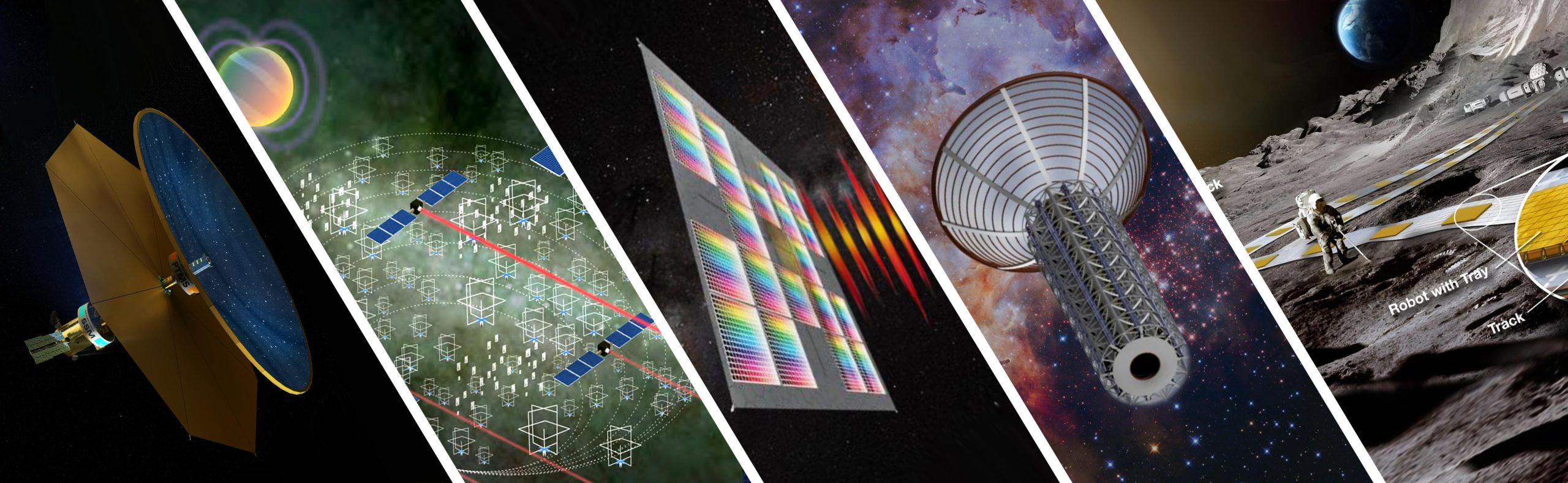
NASA’s Innovative Advanced Concepts program is advancing six “‘science fiction-like” space technology projects, including a lunar railway and a fluid telescope.
Six visionary concept studies have been selected by NASA’s Innovative Advanced Concepts program for additional funding and development. Each study has already completed the initial NIAC phase, showing their futuristic ideas — like a lunar railway system and fluid-based telescopes — may provide fresh perspectives and approaches as NASA explores the unknown in space.
The NIAC Phase II conceptual studies will receive up to $600,000 to continue working over the next two years to address key remaining technical and budget hurdles and pave their development path forward. When Phase II is complete, these studies could advance to the final NIAC phase, earning additional funding and development consideration toward becoming a future aerospace mission.
“These diverse, science fiction-like concepts represent a fantastic class of Phase II studies,” said John Nelson, NIAC program executive at NASA Headquarters in Washington. “Our NIAC fellows never cease to amaze and inspire, and this class definitely gives NASA a lot to think about in terms of what’s possible in the future.”
The six concepts chosen for 2024 NIAC Phase II awards are:
- Fluidic Telescope (FLUTE): Enabling the Next Generation of Large Space Observatories would create a large optical observatory in space using fluidic shaping of ionic liquids. These in-space observatories could potentially help investigate NASA’s highest-priority astrophysics targets, including Earth-like exoplanets, first-generation stars, and young galaxies. The FLUTE study is led by Edward Balaban from NASA’s Ames Research Center in California’s Silicon Valley.
- Pulsed Plasma Rocket: Shielded, Fast Transits for Humans to Mars is an innovative propulsion system that relies on using fission-generated packets of plasma for thrust. This innovative system could significantly reduce travel times between Earth and any destination in the solar system. This study is led by Brianna Clements with Howe Industries in Scottsdale, Arizona.
- The Great Observatory for Long Wavelengths (GO-LoW) could change the way NASA conducts astronomy. This mega-constellation low-frequency radio telescope uses thousands of autonomous SmallSats capable of measuring the magnetic fields emitted from exoplanets and the cosmic dark ages. GO-LoW is led by Mary Knapp with MIT in Cambridge, Massachusetts.
- Radioisotope Thermoradiative Cell Power Generator is investigating new in-space power sources, potentially operating at higher efficiencies than NASA legacy power generators. This technology could enable small exploration and science spacecraft in the future that are unable to carry bulky solar or nuclear power systems. This power generation concept study is from Stephen Polly at the Rochester Institute of Technology in New York.
- FLOAT: Flexible Levitation on a Track would be a lunar railway system, providing reliable, autonomous, and efficient payload transport on the Moon. This rail system could support daily operations of a sustainable lunar base as soon as the 2030s. Ethan Schaler leads FLOAT at NASA’s Jet Propulsion Laboratory in Southern California.
- ScienceCraft for Outer Planet Exploration distributes Quantum Dot-based sensors throughout the surface of a solar sail, enabling it to become an innovative imager. Quantum physics would allow NASA to take scientific measurements by studying how the dots absorb light. By leveraging the solar sail’s area, it allows lighter, more cost-effective spacecraft to carry imagers across the solar system. ScienceCraft is led by NASA’s Mahmooda Sultana at the agency’s Goddard Space Flight Center in Greenbelt, Maryland.
NASA’s Space Technology Mission Directorate funds the NIAC program, as it is responsible for developing the agency’s new cross-cutting technologies and capabilities to achieve its current and future missions.
To learn more about NIAC and the 2024 Phase II studies, visit:
https://www.nasa.gov/stmd-the-nasa-innovative-advanced-concepts-niac/
Never miss a breakthrough: Join the SciTechDaily newsletter.
Follow us on Google and Google News.
2 Comments
Consider there are still people who doubt mankind had ever made it to the moon and therefore will be extremely skeptical of any claims made by NASA representatives.
People who do not believe that we landed on the Moon do not matter. Fortunately, their numbers are low, and their low education and intelligence will further reduce their impact.