
Close Menu
    Facebook X (Twitter) Instagram
    SciTechDaily
    • Biology
    • Chemistry
    • Earth
    • Health
    • Physics
    • Science
    • Space
    • Technology
    Facebook X (Twitter) Pinterest YouTube RSS
    SciTechDaily
    Home»Science»Strengths & Weaknesses of Super Material – Soft, Light, yet Strong Enough to Stop a Bullet
    Science

    Strengths & Weaknesses of Super Material – Soft, Light, yet Strong Enough to Stop a Bullet

    By Jesper Bruun, Aarhus UniversityOctober 1, 20191 Comment3 Mins Read
    Facebook Twitter Pinterest Telegram LinkedIn WhatsApp Email Reddit
    Share
    Facebook Twitter LinkedIn Pinterest Telegram Email Reddit
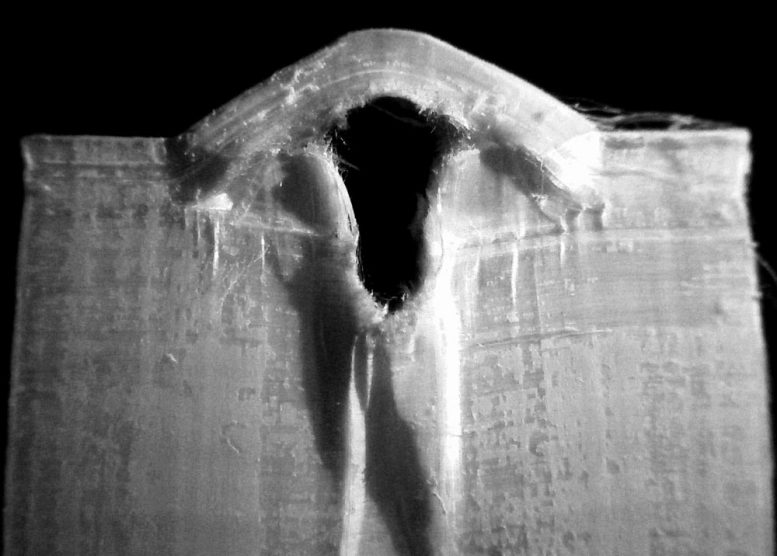
    Test of UHMWPE Fiber Strength
    This is an optical image of a UHMWPE test subject. In the test in question, the plate was deformed to a very high degree in an attempt to break the UHMWPE fibers. The fibers failed to break due to their incredible strength. Credit: Simon Skovsgård

    Scientists from Aarhus University and the University of Cambridge are the first to measure and set guidelines for bolted joints using the upcoming replacement for Kevlar: the ultra-strong material with the catchy name ultra-high molecular weight polyethylene.

    Imagine a velvety, soft material that is extremely light, but also strong enough to stop a bullet. This is close to a description of ultra-high molecular weight polyethylene (UHMWPE), a super-plastic material commercially known as Dyneema or Spectra, which is already taking over from the para-aramid fibrous material, Kevlar, in, for example, bullet-proof jackets.

    There is also much need for the super material in many other applications than body armor, and therefore researchers have now set up guidelines and failure maps for use of the material in joints with steel bolts. The research team is being led by Simon Skovsgård, Ph.D. and MSc in engineering at the Department of Engineering, Aarhus University, and Professor Norman Fleck at the University of Cambridge.

    The results have just been published in the International Journal of Solids and Structures.

    Simon Skovsgård, Aarhus University
    Ultra-high molecular weight polyethylene is already taking over from the para-aramid fibrous material, Kevlar, in e.g. bullet-proof jackets, which PhD Simon Skovsgård is wearing here. Credit: Lars Kruse / AU Foto

    “The tests we’ve done showed that the material began to deform at the joints, but the fibers weren’t broken. This is interesting in relation to other popular composite materials, such as carbon fiber composites, which snap suddenly. Here, although we can tear the material, it’s really difficult to actually break the fibers,” says Simon Skovsgård.

    UHMWPE consists of extremely long chains of polyethylene (PE). And these long chains strengthen the intermolecular interactions of the substance and enable the material to transfer stress loads effectively to the polymer skeleton.

    This means that UHMWPE fibers have an incredibly high tensile strength compared to many other thermoplastics, and this also means that the material is much stronger than steel in the fiber direction. The tensile strength of high-strength steel is approx. 900 MPa, but in order to break the fibers in UHMWPE, you need approximately 3000 MPa.

    “UHMWPE fiber plates are a collection of these incredibly strong fibers. It’s almost impossible to extend and break the fibers, but if you twist or shear the material, it is soft. This combination makes it easy for the material to absorb energy,” says Simon Skovsgård.

    The new research results are good news for the commercial use of UHMWPE, which is increasingly being introduced in the shipping industry in containers, ropes, and nets, as well as armor for vehicles and personnel and in the textile industry. So far, there has been no experience with using the material combined with other materials.

    Reference: “Load transfer within the bolted joint of a laminate made from ultra-high molecular weight polyethylene fibres” by S. P. H. Skovsgaard, H. M. Jensen and N. A. Fleck, 16 August 2019, International Journal of Solids and Structures.
    DOI: 10.1016/j.ijsolstr.2019.08.014

    Never miss a breakthrough: Join the SciTechDaily newsletter.
    Follow us on Google and Google News.

    Aarhus University Materials Science University of Cambridge
    Share. Facebook Twitter Pinterest LinkedIn Email Reddit

    Related Articles

    Triplex Origami: A Game-Changer in Gene Therapy and DNA Nanotechnology

    Sustainable, Biodegradable, Vegan Glitter That’s Just As Sparkly – From Your Fruit Bowl

    Cambridge Research Shows Cricket Bats Should Be Made From Bamboo Not Willow

    Nanostructure of Wood Revealed – Strength Gains Could Lead to Wooden Skyscrapers

    Researchers Uncover Why Lithium Iron Phosphate Works So Well

    Self-Healing Polymer Mechanism Rediscovered After 60 Years

    Scientists Make 3D Objects Invisible to Microwave Wavelengths

    Graphene is Transparent to Water

    Research for High Pressure Materials for DoD Underway

    1 Comment

    1. Brett Blaikie on October 1, 2019 3:39 pm

      perhaps we can come up with a catchier name?

      I dunno… StarSilk perhaps.

      Reply
    Leave A Reply Cancel Reply

    • Facebook
    • Twitter
    • Pinterest
    • YouTube

    Don't Miss a Discovery

    Subscribe for the Latest in Science & Tech!

    Trending News

    Millions Take These IBS Drugs, But a New Study Finds Serious Risks

    Scientists Unlock Hidden Secrets of 2,300-Year-Old Mummies Using Cutting-Edge CT Scanner

    Bread Might Be Making You Gain Weight Even Without Eating More Calories

    Scientists Discover Massive Magma Reservoir Beneath Tuscany

    Europe’s Most Active Volcano Just Got Stranger – Here’s Why Scientists Are Rethinking It

    Alzheimer’s Symptoms May Start Outside the Brain, Study Finds

    Millions Take This Popular Supplement – Scientists Discover a Concerning Link to Heart Failure

    The Universe Is Expanding Too Fast and Scientists Can’t Explain Why

    Follow SciTechDaily
    • Facebook
    • Twitter
    • YouTube
    • Pinterest
    • Newsletter
    • RSS
    SciTech News
    • Biology News
    • Chemistry News
    • Earth News
    • Health News
    • Physics News
    • Science News
    • Space News
    • Technology News
    Recent Posts
    • Scientists Say a Hidden Structure May Exist Inside Earth’s Core
    • Doctors Surprised by the Power of a Simple Drug Against Colon Cancer
    • Why Popular Diabetes Drugs Like Ozempic Don’t Work for Everyone: The “Genetic Glitch”
    • Scientists Create Improved Insulin Cells That Reverse Diabetes in Mice
    • Scientists Stunned After Finding Plant Thought Extinct for 60 Years
    Copyright © 1998 - 2026 SciTechDaily. All Rights Reserved.
    • Science News
    • About
    • Contact
    • Editorial Board
    • Privacy Policy
    • Terms of Use

    Type above and press Enter to search. Press Esc to cancel.