
Gregory Laughlin and Malena Rice weren’t exactly surprised a few weeks ago when they learned that a second interstellar object had made its way into our solar system.
The Yale University astronomers had just put the finishing touches on a new study suggesting that these strange, icy visitors from other planets are going to keep right on coming. We can expect a few large objects showing up every year, they say; smaller objects entering the solar system could reach into the hundreds each year.
The study has been accepted for publication in The Astrophysical Journal Letters.
“There should be a lot of this material floating around,” said Rice, a graduate student at Yale and the first author of the study. “So much more data will be coming out soon, thanks to new telescopes coming online. We won’t have to speculate.”
The first interstellar object known to pass through our solar system was ‘Oumuamua, first spotted in October 2017. Its arrival generated intense debate over its origins and how to classify it. Laughlin, an astronomy professor at Yale, has contributed valuable research indicating ‘Oumuamua likely has properties similar to a comet, despite the fact that it doesn’t have a comet’s telltale tail, called a coma.

The new object, recently dubbed 2I/Borisov, came on the scene this summer. Amateur astronomer Gennady Borisov first noticed 2I/Borisov in August, and researchers will have about a year to observe the object with telescopes — a considerably longer time than the few weeks they had to observe ‘Oumuamua. The new object is also larger than ‘Oumuamua and has a pronounced coma.
Of course, for scientists, one of the big questions arising from the appearance of interstellar objects is: “Where did they come from?” An easy answer would be that they are ejected planetary building blocks — planetesimals — from other solar systems. But upon first look, there’s a problem with that theory, say researchers: A close study of the roughly 4,000 confirmed planets outside of our solar system shows that most of them are located too close to their parent stars to readily eject a planetesimal. Planetesimals stirred up by most currently known planets would remain stuck in orbits in the systems where they formed.
So where do the interstellar objects originate?
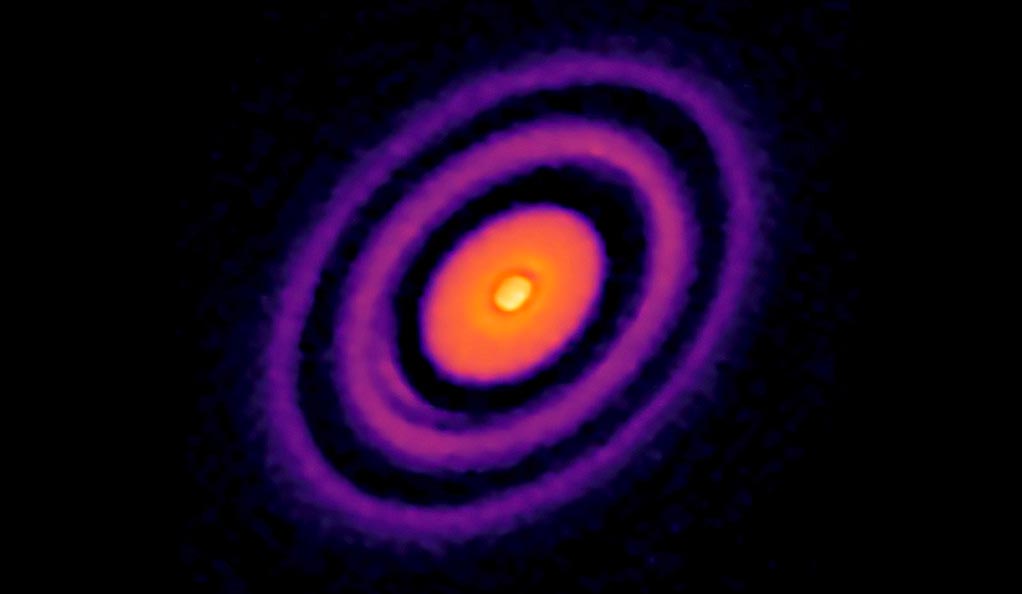
Rice and Laughlin’s work proposes for the first time that interstellar objects could be material ejected from large, newborn planets, orbiting farther away from their sun, which have carved out pronounced gaps in the cosmic platters of gas and dust that astronomers call protoplanetary disks.
When a star is newly formed, it is surrounded by a thin, rotating “protoplanetary” disk of dense gas and dust. The disk is a volatile environment in which gas and dust are heated up by the young star, as well as the star’s gravitational energy, leading to movement, collisions, and eventually, the formation of planets.
“[This is] a completely unprecedented way to study extrasolar systems up close — and this field is going to start exploding with data, very soon.”
— Malena Rice
Although most known planets form close to their sun, there are some that develop much farther away and create large gaps in the protoplanetary disk. According to Rice and Laughlin, those more distant planets are able to fling out material that could leave their home solar systems. However, they are also much more difficult to directly observe than their closer-in counterparts, which is why not many of these planets have been confirmed, the researchers said.
To test their theory, the researchers looked at three protoplanetary disks from the Disk Substructures at High Angular Resolution Project (DSHARP), a survey conducted by a large consortium of astronomers. DSHARP focuses on images of 20 nearby, bright and large protoplanetary disks taken by the Atacama Large Millimeter/submillimeter Array telescope in Chile.
“We were looking for disks in which it was pretty clear a planet was there,” Rice said. “If a disk has clear gaps in it, like several of the DSHARP disks do, it’s possible to extrapolate what type of planet would be there. Then, we can simulate the systems to see how much material should be ejected over time.”
“This idea nicely explains the high density of these objects drifting in interstellar space, and it shows that we should be finding up to hundreds of these objects with upcoming surveys coming online next year,” Laughlin said.
Beyond the mere novelty of noticing interstellar objects passing through our solar system, the idea of observing such objects offers major possibilities for advancing our knowledge of the cosmos, the researchers added.
Unlike many astronomical discoveries, in which data is observed and interpreted from tremendous distances, interstellar objects are an up-close look at another part of the galaxy, they said.
“You’re not looking at a distant star through a telescope,” Rice said. “This is the actual material that makes up planets in other solar systems, being flung at us. It’s a completely unprecedented way to study extrasolar systems up close — and this field is going to start exploding with data, very soon.”
The research was supported by the NASA Astrobiology Institute through a cooperative agreement between Yale University and the NASA Ames Research Center, and by the National Science Foundation Graduate Research Fellowship Program.
Reference: “Hidden Planets: Implications from ‘Oumuamua and DSHARP” by Malena Rice and Gregory Laughlin, 10 October 2019, The Astrophysical Journal Letters.
DOI: 10.3847/2041-8213/ab4422
Never miss a breakthrough: Join the SciTechDaily newsletter.
Follow us on Google and Google News.
2 Comments
Anything to worry about?
I recently took a photo of a comet looking object