
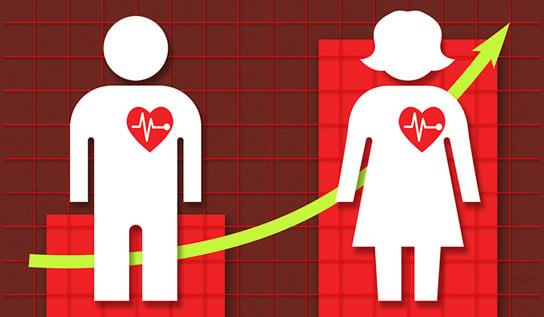
A new study from Yale University shows that stress plays a role in the sex-based differences in recovery after acute myocardial infarction.
Young and middle-aged women experience more stress than their male counterparts, which could contribute to worse recovery from acute myocardial infarction (AMI), according to new findings by Yale School of Medicine researchers and their colleagues.
The findings appear in the current issue of Circulation.
“Women tend to report greater stress and more stressful life events than men, potentially because of their different roles in family life and work, as compared to men,” said first author Xiao Xu, assistant professor in the Department of Obstetrics, Gynecology & Reproductive Sciences at Yale School of Medicine. “This difference in the level of stress may be an important reason for sex-based differences in recovery after acute myocardial infarction.”
Xu and colleagues used data from the Variation in Recovery: Role of Gender Outcomes on Young AMI Patients (VIRGO) study, which is the largest prospective observational study of young and middle-aged women and men with AMI. VIRGO studied AMI patients 18 to 55 years old from a large, diverse network of 103 hospitals in the United States, 24 in Spain, and 3 in Australia from 2008 to 2012.
Xu and the team measured each patient’s self-perceived psychological stress during the initial hospital stay for AMI using 14 questions, which asked participants about the degree to which their life situations during the last month were unpredictable, uncontrollable, and overloaded. One sample question asked, “In the last month, how often have you been upset because of something that happened unexpectedly?” Response to each item was scored as never (0), almost never (1), sometimes (2), fairly often (3), and very often (4). The team measured each patient’s recovery based on changes in their angina-specific and overall health status between initial hospitalization for AMI and one month after AMI.
Compared with men, women had significantly higher rates of diabetes, chronic lung disease, chronic renal dysfunction, depression, and cancer, as well as previous stents, congestive heart failure, and stroke. Women were also more likely to have children or grandchildren living in their household, while experiencing greater financial strain.
“This study is distinctive in focusing particularly on young women and going beyond traditional predictors of risk to reveal how the context of these people’s lives influences their prognosis,” said senior author Dr. Harlan M. Krumholz, principal investigator of the VIRGO study.
Xu added, “Helping patients develop positive attitudes and coping skills for stressful situations may not only improve their psychological well-being, but also help recovery after AMI. Stress management interventions that recognize and address different sources of stress for men and women would be beneficial.
Other authors on the study include Haikun Bao, Kelly Strait, Dr. John A. Spertus, Judith H. Lichtman, Dr. Gail D’Onofrio, Dr. Erica Spatz, Emily M. Bucholz, Mary Geda, Nancy P. Lorenze, Dr. Héctor Bueno, and John F. Beltrame.
The study was funded by the National Heart, Lung, and Blood Institute, National Institutes of Health, Department of Health and Human Services. IMJOVEN (VIRGO in Spain) was supported by the Fondo de Investigaciones Sanitarias del Instituto Carlos III, Ministry of Science and Technology, and additional funds from the Centro Nacional de Investigaciones Cardiovasculares. VIRGO Australia was supported in part by the Hospital Research Foundation Program Grant for the Vascular Disease Therapeutic Research Group. Xu and Krumholz were supported by the Center for Cardiovascular Outcomes Research at Yale University. Bueno was supported in part by the Fondo de Investigación Sanitaria del Instituto de Salud Carlos III, Spain.
Reference: “Sex Differences in Perceived Stress and Early Recovery in Young and Middle-Aged Patients with Acute Myocardial Infarction” by Xiao Xu, Haikun Bao, Kelly Strait, John A. Spertus, Judith H. Lichtman, Gail D’Onofrio, Erica Spatz, Emily M. Bucholz, Mary Geda, Nancy P. Lorenze, Héctor Bueno, John F. Beltrame and Harlan M. Krumholz, 9 February 2015, Circulation.
DOI: 10.1161/CIRCULATIONAHA.114.012826
Never miss a breakthrough: Join the SciTechDaily newsletter.
Follow us on Google and Google News.