
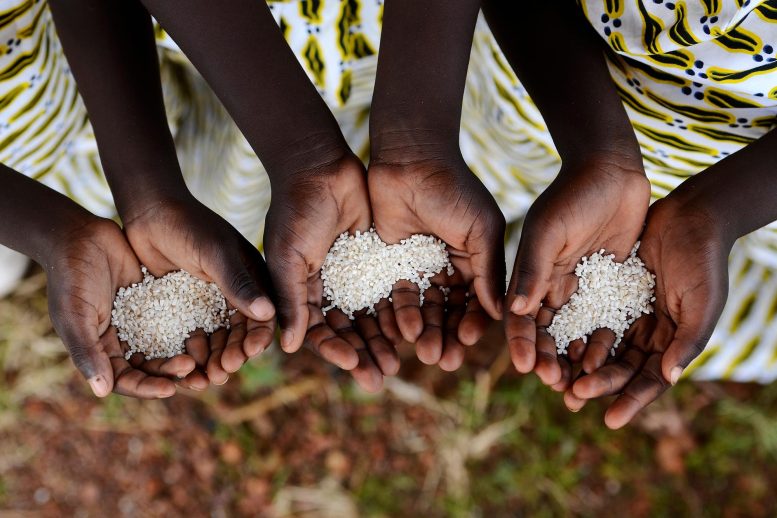
Up to 3 times more children suffer severe hunger with each El Niño than from COVID-19. El Niño events provide a snapshot of the future under climate change and chronicle the lack of proactive policy action even when climate events are predictable.
Over the last year and a half, the 1-in-100-year COVID-19 pandemic drove millions of children into hunger. But every four to seven years, an El Niño causes weather patterns to shift across the tropics, leading to warmer temperatures and precipitation changes and widespread impacts on agriculture, infectious diseases, conflicts and more. During a single bad El Niño, nearly 6 million children are driven into undernutrition as a result, according to a study in Nature Communications. That’s at least 70 percent and perhaps up to three times the number of children who have gone hungry because of the pandemic.
“It would have been very difficult to prepare the world for a pandemic that few saw coming, but we can’t say the same about El Niño events that have a potentially much greater impact on the long-term growth and health of children,” says Amir Jina, an author of the paper and assistant professor at the Harris School of Public Policy. “Scientists can forecast an approaching El Niño up to 6 months in advance, allowing the international community to intervene to prevent the worst impacts. Our study helps to quantify those impacts on child nutrition to guide global public investments in food insecure areas.”
First Global Estimate of El Niño’s Nutritional Toll
Jina and his coauthors, Jesse Anttila-Hughes and Gordon McCord, provide the first estimate of El Niño’s impacts on child nutrition throughout the global tropics. They do so by assembling data on more than a million children spanning four decades and all developing country regions, a dataset that represents about half of the more than 600 million-strong under-five population globally. Their analysis finds that warmer, drier El Niño conditions increase undernutrition in children across most of the tropics, where 20 percent of children are already deemed severely underweight by the World Health Organization (WHO). That percentage ticks up by 2.9 percent during El Niño years, affecting millions of children.
In the case of the severe 2015 El Niño, the number of children at or below the WHO threshold for severely underweight jumped by nearly 6 percent—or an additional nearly 6 million children driven into hunger. While the children’s weight appears to recuperate with time, the shock on their nutrition at such a young age stunts their growth in later years.
As part of the Sustainable Development Goals, the international community is working to eliminate all forms of undernutrition by 2030, meaning each year about 6 million children would need to rise out of severe hunger. With less than 10 years remaining to meet that goal, the 2015 El Niño erased one year of progress. To offset the impacts of the 2015 El Niño would require providing 134 million children with micronutrient supplements or 72 million food insecure children with food, the study finds.
Predictable Yet Preventable Hunger Crises
“Since scientists can point to which places are going to have drought and which places are going to flood months ahead of time, the international community could act proactively to prevent millions of children from falling into undernutrition,” says Gordon McCord from the UC San Diego School of Global Policy and Strategy. “It’s a real tragedy that even in the 21st century so much of the human population is pushed to desperation by predictable climate processes.”
While it is unclear whether climate change will increase the frequency and intensity of El Niño, climate change will cause hot areas to become hotter and dry areas to become drier. When El Niño is layered on top of these overall shifts, there is no doubt that the impacts during El Niño years will be worse than they are now. For example, as areas expect to lose crops with climate change, those same areas will likely lose even more crops during El Niño years.
“These are routine events in the climate that lead to real tragedy around the world,” says Jesse Anttila-Hughes from the University of San Francisco. “Studying El Niño can teach us about the impacts that come from a hotter, drier climate—important lessons as these changes become more global in scale with climate change. But the fact that we live through an El Niño every few years, we know they’re coming, and we still don’t act is a bad sign since many of these climate shifts—from isolated heat waves to hurricanes—will be a lot less predictable as the climate changes.”
Reference: “ENSO impacts child undernutrition in the global tropics” by Jesse K. Anttila-Hughes, Amir S. Jina and Gordon C. McCord, 12 October 2021, Nature Communications.
DOI: 10.1038/s41467-021-26048-7
Never miss a breakthrough: Join the SciTechDaily newsletter.
Follow us on Google and Google News.
1 Comment
El Nino and La Nina seem to get the headlines for all the bad they do. Yet in Australia, the mainly desert, island continent, the constant switching cycle is essential for survival. While one half the country is in drought with one, the other half receives rain and vice versa when it switches. Both our flora and fauna seem designed for this three to five year cycle. We do however have issues when the cycle locks one way or the other for extended periods.