
Close Menu
    Facebook X (Twitter) Instagram
    SciTechDaily
    • Biology
    • Chemistry
    • Earth
    • Health
    • Physics
    • Science
    • Space
    • Technology
    Facebook X (Twitter) Pinterest YouTube RSS
    SciTechDaily
    Home»Chemistry»Strong Isotope Effects Revealed in Water Photochemistry by Dalian Coherent Light Source
    Chemistry

    Strong Isotope Effects Revealed in Water Photochemistry by Dalian Coherent Light Source

    By Dalian Institute of Chemical PhysicsJuly 23, 2021No Comments2 Mins Read
    Facebook Twitter Pinterest Telegram LinkedIn WhatsApp Email Reddit
    Share
    Facebook Twitter LinkedIn Pinterest Telegram Email Reddit
    Strong Isotope Effects Revealed in Water Photochemistry
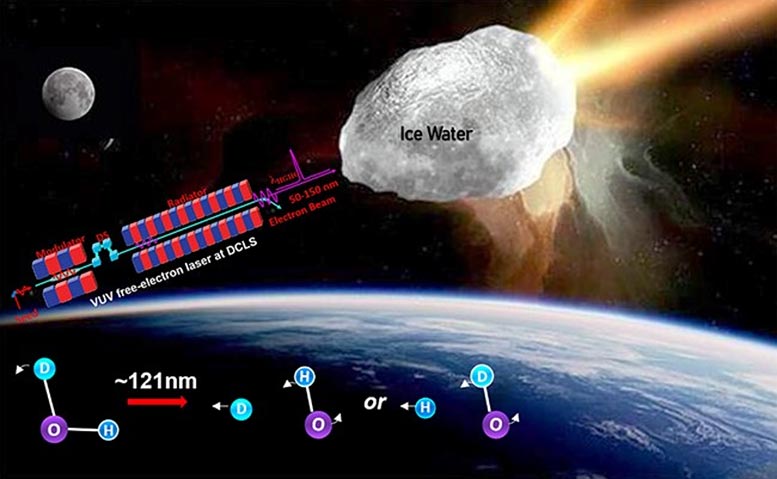
    Dalian Coherent Light Source revealing strong isotope effects in water photochemistry. Credit: DICP

    Researchers found that when a hydrogen-deuterium water molecule is broken apart by light, it doesn’t always break the same way. These differences might help explain why the ratio of hydrogen to deuterium varies across the solar system.

    Recently, a research group led by Prof. YUAN Kaijun and Prof. YANG Xueming from the Dalian Institute of Chemical Physics (DICP) of the Chinese Academy of Sciences revealed strong isotope effects in photodissociation of the water isotopologue (HOD) using the Dalian Coherent Light Source.

    Their findings were published in Science Advances on July 21, 2021.

    “Our experimental results illustrate dramatically different quantum state population distributions of OH and OD fragments from HOD photodissociation. The branching ratios of the H+OD and D+OH channels display large wavelength-dependent isotopic fractionation,” said Prof. YUAN.

    Because water is one of the most abundant species in the solar nebula, photodissociation of water and its isotopologue by solar vacuum ultraviolet photons may be an alternative source of the D/H isotope heterogeneity, and this effect must be considered in photochemical models.

    The photochemical processes identified in this work may vary the D/H isotopic ratios in the inner and outer regions, and/or in different periods of the solar nebula, which may cause the D/H isotope heterogeneity in the solar system.

    Reference: “Strong isotope effect in the VUV photodissociation of HOD: A possible origin of D/H isotope heterogeneity in the solar nebula” by Zijie Luo, Yarui Zhao, Zhichao Chen, Yao Chang, Su-e Zhang, Yucheng Wu, Jiayue Yang, Yi Cheng, Li Che, Guorong Wu, Daiqian Xie, Xueming Yang and Kaijun Yuan, 21 July 2021, Science Advances.
    DOI: 10.1126/sciadv.abg7775

    This research was supported by the Strategic Priority Research Program of the Chinese Academy of Sciences, Chemical Dynamics Research Center, and the National Natural Science Foundation of China.

    Never miss a breakthrough: Join the SciTechDaily newsletter.
    Follow us on Google and Google News.

    Astrophysics Chinese Academy of Sciences
    Share. Facebook Twitter Pinterest LinkedIn Email Reddit

    Related Articles

    Oxygen Production From Three-Body Photodissociation of Water Revealed by Dalian Coherent Light Source

    Dalian Coherent Light Source Reveals the Origin of S2 Fragments in the Interstellar Medium

    Surprise Discovery of Black Hole in Our Galaxy That “Should Not Even Exist”

    New Results on Black Hole and Neutron Star X-Ray Binaries From Insight-HXMT

    Simulations Reveal How Acids Behave in Ultracold Interstellar Space

    Evidence of How a Dwarf Galaxy Contributes to Growth of the Milky Way

    Astronomers Reveal a Warped and Twisted Milky Way

    Lab Experiments Reveal Pathway to Forming Life’s Building Blocks in Space

    Understanding the Evolution of Organic Molecules in Our Solar System

    Leave A Reply Cancel Reply

    • Facebook
    • Twitter
    • Pinterest
    • YouTube

    Don't Miss a Discovery

    Subscribe for the Latest in Science & Tech!

    Trending News

    Why Popular Diabetes Drugs Like Ozempic Don’t Work for Everyone: The “Genetic Glitch”

    Scientists Stunned After Finding Plant Thought Extinct for 60 Years

    Scientists Discover Tiny New Spider That Hunts Prey 6x Its Size

    Natural Component From Licorice Shows Promise for Treating Inflammatory Bowel Disease

    Scientists Warn: Popular Sweetener Linked to Dangerous Metabolic Effects

    Monster Storms on Jupiter Unleash Lightning Beyond Anything on Earth

    Scientists Create “Liquid Gears” That Spin Without Touching

    The Simple Habit That Could Help Prevent Cancer

    Follow SciTechDaily
    • Facebook
    • Twitter
    • YouTube
    • Pinterest
    • Newsletter
    • RSS
    SciTech News
    • Biology News
    • Chemistry News
    • Earth News
    • Health News
    • Physics News
    • Science News
    • Space News
    • Technology News
    Recent Posts
    • Hidden Ocean Currents Revealed in Stunning Detail by AI
    • Trees Emit Tiny Lightning Flashes During Storms and Scientists Finally Prove It
    • Forget Chemicals. This Plant Removes Microplastics From Water
    • Breakthrough Crystal Lets Scientists “Write” Nanoscale Patterns With Light
    • Pomegranate Compound Could Help Protect Against Heart Disease
    Copyright © 1998 - 2026 SciTechDaily. All Rights Reserved.
    • Science News
    • About
    • Contact
    • Editorial Board
    • Privacy Policy
    • Terms of Use

    Type above and press Enter to search. Press Esc to cancel.