

Divya Tyagi reworked a century-old aerodynamic problem, creating a simpler approach to optimize wind turbine efficiency.
Her solution, overlooked in past research, accounts for crucial forces affecting turbine blades. Her award-winning work could shape the future of wind energy, increasing power output and lowering costs.
Revisiting a Century-Old Math Problem
A Penn State engineering student has simplified a century-old math problem, making it more accessible and practical for modern applications. Divya Tyagi’s research refines the work of British aerodynamicist Hermann Glauert, opening new possibilities for wind turbine design that were previously unexplored.
Tyagi, now a graduate student pursuing her master’s in aerospace engineering, first tackled this problem as an undergraduate for her Schreyer Honors College thesis. Her findings were later published in Wind Energy Science.
Optimizing Wind Turbine Performance
“I created an addendum to Glauert’s problem which determines the optimal aerodynamic performance of a wind turbine by solving for the ideal flow conditions for a turbine in order to maximize its power output,” said Tyagi, who earned her bachelor’s degree in aerospace engineering.
Her adviser, Sven Schmitz, the Boeing/A.D. Welliver Professor in the Department of Aerospace Engineering and co-author on the paper, noted that Glauert’s original work focused solely on the maximum attainable power coefficient—how efficiently a turbine converts wind energy into electricity. However, it did not account for the total force and moment coefficients acting on the rotor, nor how turbine blades flex under wind pressure.
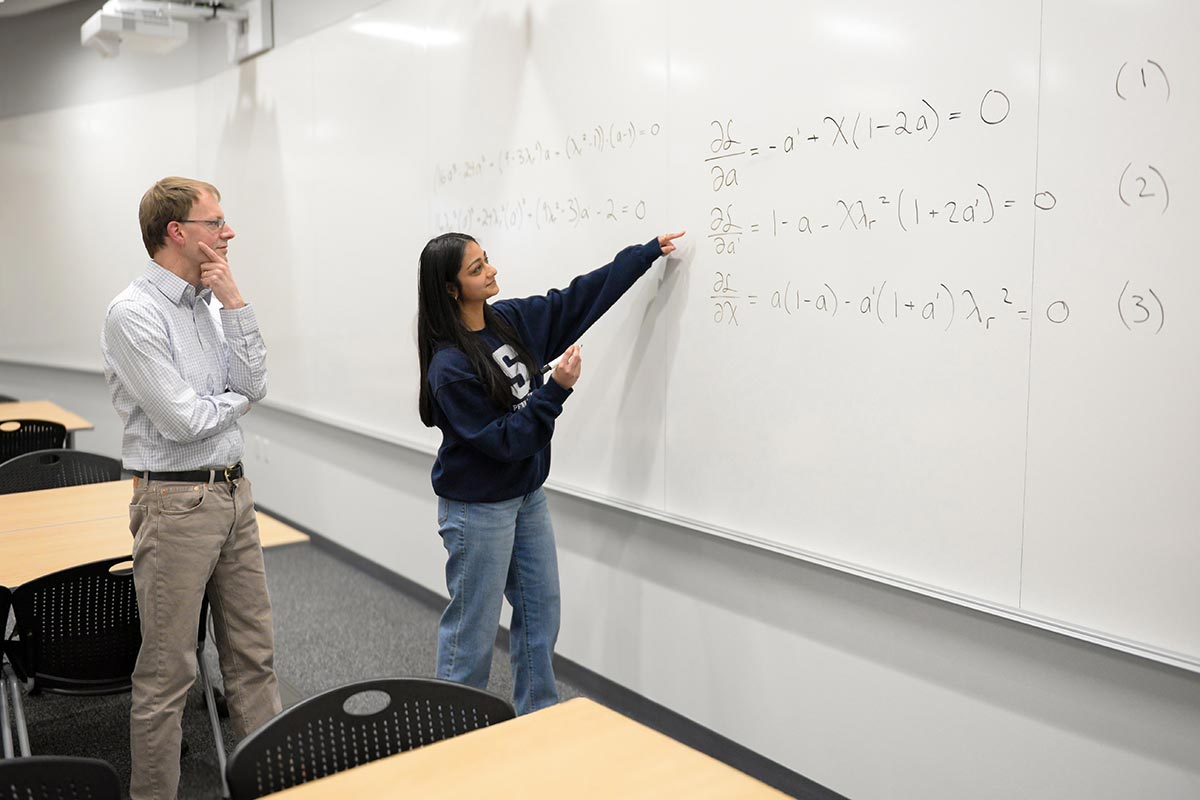
“If you have your arms spread out and someone presses on your palm, you have to resist that movement,” said Schmitz, a faculty member in the Institute of Energy and the Environment. “We call that the downwind thrust force and the root bending moment, and wind turbines must withstand that, too. You need to understand how large the total load is, which Glauert did not do.”
A Simple Yet Powerful Solution
Schmitz said the simplicity of Tyagi’s addendum based on calculus of variations, a mathematical method used for constrained optimization problems, will allow people to explore new facets of wind turbine design.
“The real impact will be on the next generation of wind turbines using the new knowledge that has been unveiled,” Schmitz said. “As for Divya’s elegant solution, I think it will find its way into the classrooms, across the country and around the world.”
Boosting Wind Energy Efficiency
Tyagi said she sees her work as a step toward improving wind energy production and reducing costs.
“Improving the power coefficient of a large wind turbine by just 1% has significant impacts on the energy production of a turbine, and that translates towards the other coefficients that we derived relations for,” she said. “A 1% improvement in power coefficient could notably increase a turbine’s energy output, potentially powering an entire neighborhood.”
During her senior year, Tyagi won the Anthony E. Wolk Award for her thesis on the addendum to Glauert’s work. The Wolk Award is presented to a senior in aerospace engineering who has developed the best thesis among aerospace engineering students.
Advancing Computational Fluid Dynamics
Now pursuing her master’s degree, Tyagi is studying computational fluid dynamics simulations, analyzing airflow around a helicopter rotor.
“The goal is to integrate that with the complex flow around a ship to see how the ship airwake interacts with a helicopter trying to land on its deck,” she said.
Her U.S. Navy-supported research aims to improve flight simulation and pilot safety by better understanding these dynamic interactions.
The Persistence Behind the Breakthrough
Reflecting on her undergraduate research, Tyagi said proving her solution on paper was challenging.
“I would spend about 10 to 15 hours a week between the problem, writing the thesis and on research. It took a long time because it was so math intensive,” she said. “But I feel really proud now, seeing all the work I’ve done.”
Schmitz, who has contemplated Glauert’s problem for decades, credited Tyagi’s persistence in tackling it.
“When I thought about the Glauert problem, I thought steps were missing and it was very complicated,” Schmitz said. “There had to be an easier way to do it. That’s when Divya came in. She was the fourth student I challenged with looking at it, and she was the only one who took it on. Her work is truly impressive.”
Reference: “Glauert’s optimum rotor disk revisited – a calculus of variations solution and exact integrals for thrust and bending moment coefficients” by Divya Tyagi and Sven Schmitz, 21 February 2025, Wind Energy Science.
DOI: 10.5194/wes-10-451-2025
Never miss a breakthrough: Join the SciTechDaily newsletter.
Follow us on Google and Google News.
3 Comments
That’s some Good Will Hunting stuff right there. I don’t buy it.
When we do research on the ‘airwave characteristics of a moving ship’ , the variation of air movement on the sides of bow and hind are very different . Air movement on staboard and portside are similar to a large extent. The air movement caused by the wakewash on the hind side of a sailing ship calls a challenging feat in our calculation.
When we do research on the ‘airwave characteristics of a moving ship’ , the variation of air movement on the sides of bow and hind are very different . Air movement on staboard and portside are similar to a large extent. The air movement caused by the wakewash on the hind side of a sailing ship calls a challenging feat in our calculation.