
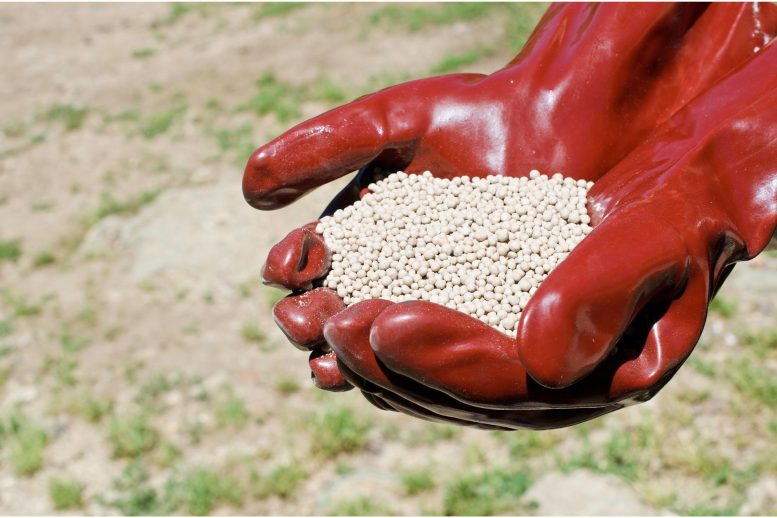
An experiment has reinforced the connection between contaminants.
Eight years ago, the data was robust but only suggestive, and the evidence was strong but circumstantial.
Recently, Karrie Weber and her team at the University of Nebraska–Lincoln have experimentally confirmed that nitrate, a compound found in both fertilizers and animal waste, can facilitate the movement of naturally occurring uranium from underground to groundwater.
Their new research backs a 2015 Weber-led study showing that aquifers contaminated with high levels of nitrate — including the High Plains Aquifer residing beneath Nebraska — also contain uranium concentrations far exceeding a threshold set by the Environmental Protection Agency. Uranium concentrations above the EPA threshold have been shown to cause kidney damage in humans, especially when regularly consumed via drinking water.
“Most Nebraskans do rely on groundwater as drinking water,” said Weber, associate professor in the School of Biological Sciences and Department of Earth and Atmospheric Sciences. “In Lincoln, we rely on it. A lot of rural communities, they’re relying on groundwater. So when you have high concentrations (of uranium), that becomes a potential concern.”
Research had already established that dissolved inorganic carbon could chemically detach traces of natural, non-radioactive uranium from underground sediment, ultimately priming it for transport into groundwater. But the 2015 study, which found that certain areas of the High Plains Aquifer contained uranium levels up to 89 times the EPA threshold, had convinced Weber that nitrate was contributing, too.
Groundbreaking Experiments with Aquifer Sediments
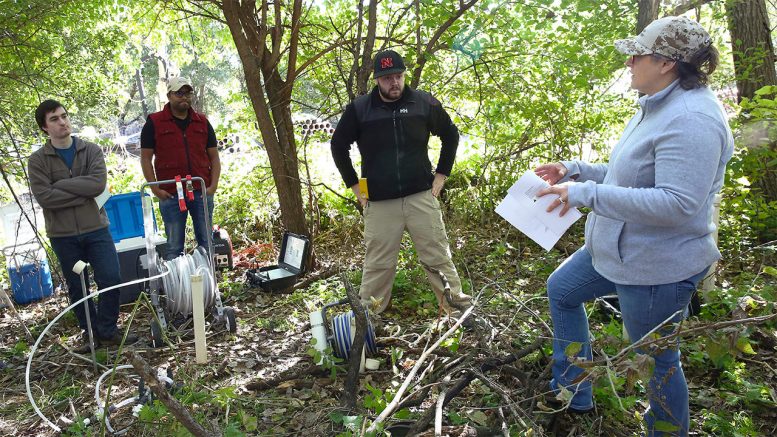
So, with the help of 12 colleagues, Weber set out to test the hypothesis. To do it, the team extracted two cylindrical cores of sediment — each roughly 2 inches (6 centimeters) wide and running 60 feet (18 meters) deep — from an aquifer site near Alda, Nebraska. That site not only contains natural traces of uranium, the researchers knew, but also allows groundwater to flow east into the adjacent Platte River.
Their goal? Recreate that flow in the samples of sediment, then determine whether adding some nitrate to the water would increase the amount of uranium that got carried away with it.
“One of the things we wanted to make sure of was that we did not alter the state of the uranium or the sediments or the (microbial) community when we collected the samples,” Weber said. “We did everything we could to preserve natural conditions.”
“Everything” meant immediately capping and wax-sealing the extracted cores, sliding them into airtight tubes, flushing those tubes with argon gas to dispel any oxygen, and putting them on ice. Back at the lab, Weber and her colleagues would eventually remove 15-inch segments from each of the two cores. Those segments consisted of sand and also silt that contained relatively high levels of uranium.
Later, the team would fill multiple columns with that silt before pumping simulated groundwater through them at roughly the same rate it would have traveled underground. In some cases, that water contained nothing extra. In others, the researchers added nitrate. And in still other cases, they added both nitrate and an inhibitor designed to halt the biochemical activity of microorganisms living in the sediment.
Microbes in Uranium Mobilization
The water containing nitrate, but lacking the microbial inhibitor, managed to carry away roughly 85% of the uranium — compared with just 55% when the water lacked nitrate and 60% when it contained nitrate but also the inhibitor. Those results implicated both the nitrate and the microbes in further mobilizing the uranium.
They also supported the hypothesis that a series of biochemical events, kicked off by the microbes, was transforming the otherwise-solid uranium into a form that could be easily dissolved in water. First, bacteria living in the sediment donate electrons to the nitrate, catalyzing its transformation into a compound called nitrite. That nitrite then oxidizes — steals electrons from — the neighboring uranium, ultimately turning it from a solid mineral into an aqueous one ready to surf the trickle of water seeping through the silt.
After analyzing DNA sequences present in its sediment samples, the team identified multiple microbial species capable of metabolizing nitrate to nitrite. Though that uranium-mobilizing biochemistry had been known to unfold in highly contaminated areas — uranium mines, sites where nuclear waste is processed — Weber said the new study is the first to establish that the same mobilization process also takes place in natural sediment.
Practical Implications for Groundwater Safety
“When we first got this project funded, and we were thinking about this, it was as a primary contaminant leading to secondary contamination,” she said of the nitrate and uranium. “This research supports that, yes, that can happen.”
Still, as Weber said, “Nitrate isn’t always a bad thing.” Both her previous research and some forthcoming studies suggest that nitrate mobilizes uranium only when the compound approaches its own EPA threshold of 10 parts per million.
“If we reflect upon what we published prior, that data suggests there’s a tipping point. The important thing,” she said, “is not to have too much.”
Reference: “Nitrate-Stimulated Release of Naturally Occurring Sedimentary Uranium” by Jeffrey P. Westrop, Pooja Yadav, PJ Nolan, Kate M. Campbell, Rajesh Singh, Sharon E. Bone, Alicia H. Chan, Anthony J. Kohtz, Donald Pan, Olivia Healy, John R. Bargar, Daniel D. Snow and Karrie A. Weber, 27 February 2023, Environmental Science & Technology.
DOI: 10.1021/acs.est.2c07683
Never miss a breakthrough: Join the SciTechDaily newsletter.
Follow us on Google and Google News.
4 Comments
“Research had already established that dissolved inorganic carbon could chemically detach traces of natural, non-radioactive uranium from underground sediment, ultimately priming it for transport into groundwater.” Except all uranium is radioactive, so I’m not sure what you’re trying to say here.
what is the recommendation to substitute,agricultural fertilizer, specifically Urea?
Thanks for your groundbreaking study, here is my point;
First of all, Nitrate is a naturally occurring chemical form of nitrogen found in most soils. It may be formed from the decomposition of plant residues, animal manures and human wastes. Secondly, Bacteria species that play a role in metabolizing nitrates also are natural environmental bacteria as well as dissolved inorganic carbon that chemically detach traces of natural, non-radioactive uranium from underground sediment, priming it for transport into groundwater. Yes, we can control the use of nitrogen-based fertilizers but still traces of uranium will find ways into ground waters. I suggest that the long-lasting solution may be to adapt our water treatment systems with technologies that are capable of eliminating those traces of aluminum for example, reverse osmosis.
Thanks for your groundbreaking study, here is my point;
First of all, Nitrate is a naturally occurring chemical form of nitrogen found in most soils. It may be formed from the decomposition of plant residues, animal manures and human wastes. Secondly, Bacteria species that play a role in metabolizing nitrates also are natural environmental bacteria as well as dissolved inorganic carbon that chemically detach traces of natural, non-radioactive uranium from underground sediment, priming it for transport into groundwater. Yes, we can control the use of nitrogen-based fertilizers but still traces of uranium will find ways into ground waters. I suggest that the long-lasting solution may be to adapt our water treatment systems with technologies that are capable of eliminating those traces of Uranium for example, reverse osmosis.