
Close Menu
    Facebook X (Twitter) Instagram
    SciTechDaily
    • Biology
    • Chemistry
    • Earth
    • Health
    • Physics
    • Science
    • Space
    • Technology
    Facebook X (Twitter) Pinterest YouTube RSS
    SciTechDaily
    Home»Biology»Study Shows 300,000-Year-Old South African Hominin Ate a Lot of Dust
    Biology

    Study Shows 300,000-Year-Old South African Hominin Ate a Lot of Dust

    By Dr. Michael Berthaume, Max Planck Institute for Evolutionary AnthropologyMarch 7, 2018No Comments3 Mins Read
    Facebook Twitter Pinterest Telegram LinkedIn WhatsApp Email Reddit
    Share
    Facebook Twitter LinkedIn Pinterest Telegram Email Reddit
    Homo Naledi Had Wear-Resistant Molars
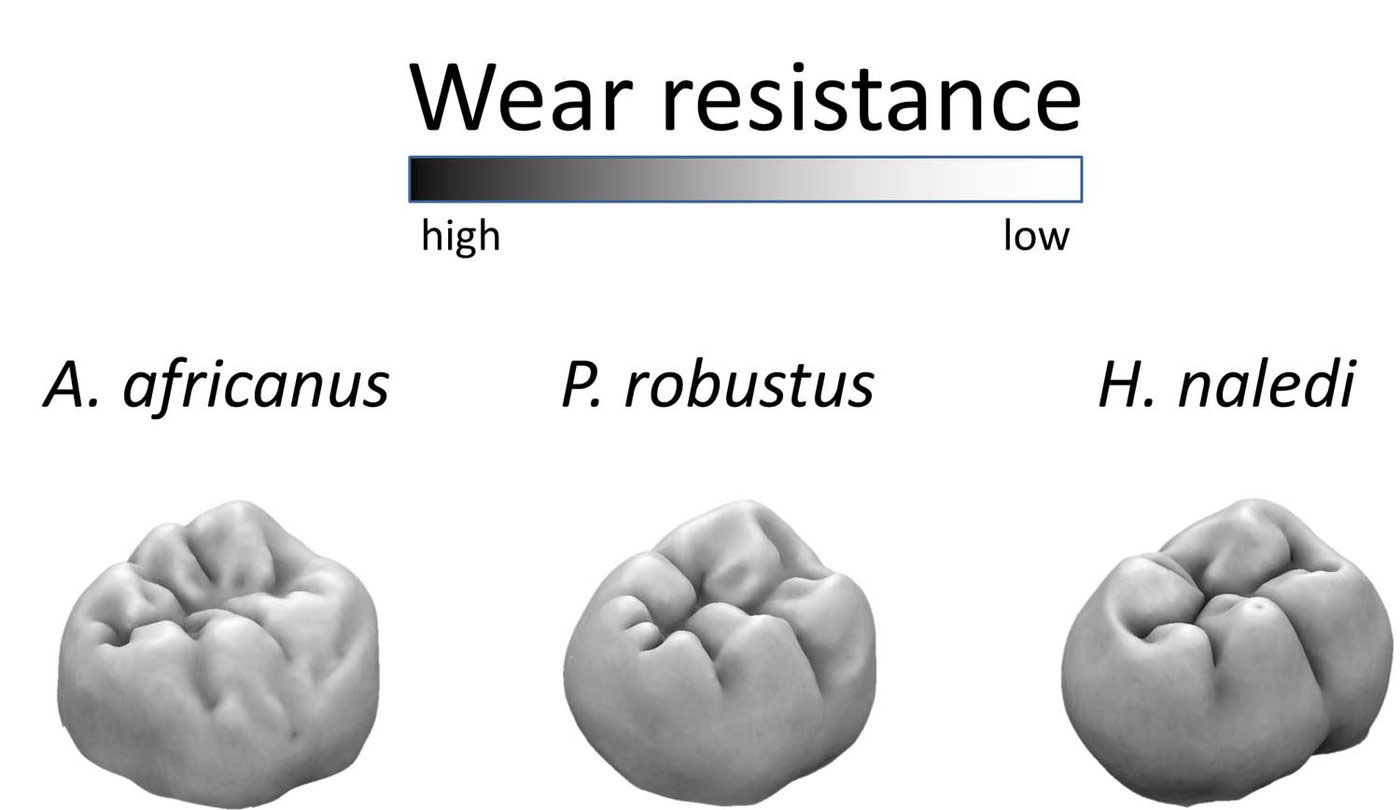
    Molar wear resistance of two older South African hominins (Australopithecus africanus and Paranthropus robustus) and Homo naledi: Darker colors indicate more wear resistant areas of the tooth, and lighter colors indicate less wear resistant areas. © MPI f. Evolutionary Anthropology

    Homo naledi’s relatively taller and more wear-resistant molars enabled it to have a much more abrasive diet than other South African hominins. This is the result of a recent study by researchers from the Max Planck Institute for Evolutionary Anthropology in Leipzig, the University of Durham in the United Kingdom, and the University of Arkansas in the United States. The researchers conclude that Homo naledi may have eaten a much grittier diet than other South African hominins.

    Mammals that eat foods that need to be cut, like leaves and grasses, have sharper, more complex molars (i.e. more cusps and crests) , while mammals that eat foods that need to be crushed, like fruits and nuts, have duller, less complex molars. The researchers used a technique known as dental topography to measure molar sharpness, complexity, and other aspects of tooth shape in South African hominins to reconstruct the diet of Homo naledi.

    The researchers found no difference in sharpness or complexity between the molars of Homo naledi and other South African hominins, implying they ate foods with similar mechanical properties. However, Homo naledi did have relatively taller, more wear resistant molars than other South African hominins, suggesting its teeth were adapted to consume foods that wore its teeth faster. “We think that Homo naledi must have been eating foods covered in dust or grit, or possibly ate plants containing lots of defensive silica particles, known as phytoliths,” said Michael Berthaume of the Max Planck Institute of Evolutionary Anthropology and Durham University, one of the authors of the study.

    Protection from gritty diets

    Plants produce phytoliths or ‘plant stones’ to try and prevent animals from eating too much of them. Animals such as grass-eating antelopes living in dry, and hence gritty, environments have high crowned molars to enable them to eat diets heavy in plant stones and grit without wearing their teeth away too much.

    The findings of the present study suggest that Homo naledi may have evolved a similar strategy, and hence was eating a different diet to that of other South African hominins. “This lends support to the idea that Homo naledi, with its mixture of traits from earlier and later hominins, was ecologically distinct to other South African hominins,” Berthaume added.

    Reference: “Dental topography and the diet of Homo naledi” by Michael A. Berthaume, Lucas K. Delezene and Kornelius Kupczik, 5 March 2018, Journal of Human Evolution.
    DOI: 10.1016/j.jhevol.2018.02.006

    Never miss a breakthrough: Join the SciTechDaily newsletter.
    Follow us on Google and Google News.

    Evolutionary Anthropology Evolutionary Biology Hominin Max Planck Institute
    Share. Facebook Twitter Pinterest LinkedIn Email Reddit

    Related Articles

    Scientists Reveal Homo Sapiens’ Secret of Success

    New Dating Techniques Show Germany Was Covered by Glaciers 450,000 Years Ago

    Scientists Reveal the Evolution of Modern Human Brain Shape

    Biologists Show Food Odor Enhances Male Flies’ Attractiveness

    New Study Shows Neanderthals Boosted Our Immune System

    Modern Humans Triggered the Demise of Neanderthals

    Biomechanics of Dental Features and Tooth Wear

    Ancient Genome Reveals Relationships Between Denisovans and Present-Day Humans

    Bonobo Genome Completed, Differs from Humans by 1.3 Percent

    Leave A Reply Cancel Reply

    • Facebook
    • Twitter
    • Pinterest
    • YouTube

    Don't Miss a Discovery

    Subscribe for the Latest in Science & Tech!

    Trending News

    The Universe Is Expanding Too Fast and Scientists Can’t Explain Why

    “Like Liquid Metal”: Scientists Create Strange Shape-Shifting Material

    Early Warning Signals of Esophageal Cancer May Be Hiding in Plain Sight

    Common Blood Pressure Drug Shows Surprising Power Against Deadly Antibiotic-Resistant Superbug

    Scientists Uncover Dangerous Connection Between Serotonin and Heart Valve Disease

    Scientists Discover a “Protector” Protein That Could Help Reverse Hair Loss

    Bone-Strengthening Discovery Could Reverse Osteoporosis

    Scientists Uncover Hidden Trigger Behind Stem Cell Aging

    Follow SciTechDaily
    • Facebook
    • Twitter
    • YouTube
    • Pinterest
    • Newsletter
    • RSS
    SciTech News
    • Biology News
    • Chemistry News
    • Earth News
    • Health News
    • Physics News
    • Science News
    • Space News
    • Technology News
    Recent Posts
    • Scientists Overcome Major Quantum Bottleneck, Potentially Transforming Teleportation and Computing
    • Quantum Physics’ Strangest Problem May Hold the Key to Time Itself
    • Scientists Create “Liquid Gears” That Spin Without Touching
    • The Simple Habit That Could Help Prevent Cancer
    • Forgotten Medicinal Plant Shows Promise in Fighting Dangerous Superbugs
    Copyright © 1998 - 2026 SciTechDaily. All Rights Reserved.
    • Science News
    • About
    • Contact
    • Editorial Board
    • Privacy Policy
    • Terms of Use

    Type above and press Enter to search. Press Esc to cancel.