
Close Menu
    Facebook X (Twitter) Instagram
    SciTechDaily
    • Biology
    • Chemistry
    • Earth
    • Health
    • Physics
    • Science
    • Space
    • Technology
    Facebook X (Twitter) Pinterest YouTube RSS
    SciTechDaily
    Home»Health»Study Shows Arthritis Drug Restores Skin Color for Vitiligo Patients
    Health

    Study Shows Arthritis Drug Restores Skin Color for Vitiligo Patients

    By Ziba Kashef, Yale UniversityJune 26, 2015No Comments3 Mins Read
    Facebook Twitter Pinterest Telegram LinkedIn WhatsApp Email Reddit
    Share
    Facebook Twitter LinkedIn Pinterest Telegram Email Reddit
    Arthritis Drug Restores Skin Color in Vitiligo Patients
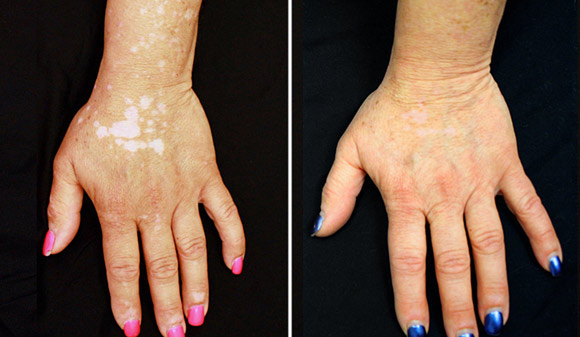
    Left hand of vitiligo patient before and after treatment with tofacitinib. Credit: Dr. Brett King

    New research from Yale University demonstrates the effectiveness of tofacitinib for treating vitiligo. After five months of treatment, the white spots on the patients face and hands were nearly gone and tofacitinib caused no adverse side effects during the course of treatment.

    Within two months of treatment, the patient experienced partial repigmentation on her face, arms, and hands — the areas that concerned her most. After five months, the white spots on her face and hands were nearly gone, with only a few spots remaining on other parts of her body.

    A medication for treating rheumatoid arthritis has restored skin color in a patient suffering from vitiligo, according to dermatologists at Yale School of Medicine. The disfiguring condition is best known as the disease that plagued late pop star Michael Jackson.

    The finding was published June 24 in JAMA Dermatology.

    Vitiligo is a common, psychologically devastating condition that causes skin to lose its pigmentation or color. Current treatments, such as steroid creams and light therapy, are not reliably effective in reversing the disease. Recent advances in vitiligo research led Yale investigators to consider an existing class of FDA-approved medications known as Janus kinase (JAK) inhibitors, as a possible treatment.

    Last year, Dr. Brett King, assistant professor of dermatology and principal investigator of the research, broke new ground when he published a paper demonstrating the effectiveness of the JAK inhibitor tofacitinib citrate in treating hair loss caused by alopecia areata. King and co-author Dr. Brittany Craiglow, believed the same medicine might be effective for vitiligo.

    To test the hypothesis, King and Craiglow administered tofacitinib to a 53-year-old patient with prominent white spots covering her face, hands, and body. For more than a year prior to taking tofacitinib, the numbers of these white spots had been increasing.

    Within two months of treatment, the patient experienced partial repigmentation on her face, arms, and hands — the areas that concerned her most. After five months, the white spots on her face and hands were nearly gone, with only a few spots remaining on other parts of her body. Notably, tofacitinib caused no adverse side effects during the course of treatment.

    The results could represent a breakthrough in vitiligo treatment, say the researchers.

    “While it’s one case, we anticipated the successful treatment of this patient based on our current understanding of the disease and how the drug works,” said King.

    King said further research would be necessary to confirm the drug’s safety and efficacy and cited work by University of Massachusetts Medical Center dermatologist and scientist John Harris as the inspiration for Dr. Brett King trying tofacitinib in this patient.

    “It’s a first, and it could revolutionize the treatment of an awful disease,” said King. “This may be a huge step forward in the treatment of patients with this condition.” King hopes to conduct a clinical trial using tofacitinib, or a similar medicine, ruxolitinib, for the treatment of vitiligo.


    Never miss a breakthrough: Join the SciTechDaily newsletter.
    Follow us on Google and Google News.

    Dermatology Medicine Yale University
    Share. Facebook Twitter Pinterest LinkedIn Email Reddit

    Related Articles

    Yale Researchers Successfully Treat Eczema with Rheumatoid Arthritis Drug

    Potential Over-Treatment of Diabetes in Older Adults

    Researchers May Have Pinpointed a Strategy for Eliminating Latent HIV

    Yale Study Shows Metformin May be Safe for Patients with Kidney Disease

    Antifreeze Protein in Ticks Could Lead to New Antibiotics for Humans

    Study Finds Stimulant Use Increases by 30% During the School Year

    Yale Researchers Discover New Cancer Cell Vulnerability

    Yale Study Shows No Link between Hospital Readmissions and Death Rates

    Intensive Glycemic Control Does Not Definitively Reduce the Risk of Impaired Kidney Function

    Leave A Reply Cancel Reply

    • Facebook
    • Twitter
    • Pinterest
    • YouTube

    Don't Miss a Discovery

    Subscribe for the Latest in Science & Tech!

    Trending News

    Millions Take These IBS Drugs, But a New Study Finds Serious Risks

    Scientists Unlock Hidden Secrets of 2,300-Year-Old Mummies Using Cutting-Edge CT Scanner

    Bread Might Be Making You Gain Weight Even Without Eating More Calories

    Scientists Discover Massive Magma Reservoir Beneath Tuscany

    Europe’s Most Active Volcano Just Got Stranger – Here’s Why Scientists Are Rethinking It

    Alzheimer’s Symptoms May Start Outside the Brain, Study Finds

    Millions Take This Popular Supplement – Scientists Discover a Concerning Link to Heart Failure

    The Universe Is Expanding Too Fast and Scientists Can’t Explain Why

    Follow SciTechDaily
    • Facebook
    • Twitter
    • YouTube
    • Pinterest
    • Newsletter
    • RSS
    SciTech News
    • Biology News
    • Chemistry News
    • Earth News
    • Health News
    • Physics News
    • Science News
    • Space News
    • Technology News
    Recent Posts
    • Simple Blood Test May Predict Alzheimer’s Years Before Brain Scans Show Signs
    • Scientists Say Adding This Unusual Seafood to Your Diet Could Reverse Signs of Aging
    • U.S. Waste Holds $5.7 Billion Worth of Crop Nutrients
    • Scientists Say a Hidden Structure May Exist Inside Earth’s Core
    • Doctors Surprised by the Power of a Simple Drug Against Colon Cancer
    Copyright © 1998 - 2026 SciTechDaily. All Rights Reserved.
    • Science News
    • About
    • Contact
    • Editorial Board
    • Privacy Policy
    • Terms of Use

    Type above and press Enter to search. Press Esc to cancel.