
Close Menu
    Facebook X (Twitter) Instagram
    SciTechDaily
    • Biology
    • Chemistry
    • Earth
    • Health
    • Physics
    • Science
    • Space
    • Technology
    Facebook X (Twitter) Pinterest YouTube RSS
    SciTechDaily
    Home»Health»Yale Researchers Successfully Treat Eczema with Rheumatoid Arthritis Drug
    Health

    Yale Researchers Successfully Treat Eczema with Rheumatoid Arthritis Drug

    By Ziba Kashef, Yale UniversityJuly 20, 2015No Comments3 Mins Read
    Facebook Twitter Pinterest Telegram LinkedIn WhatsApp Email Reddit
    Share
    Facebook Twitter LinkedIn Pinterest Telegram Email Reddit
    Yale Researchers Successfully Treat Eczema with Arthritis Drug
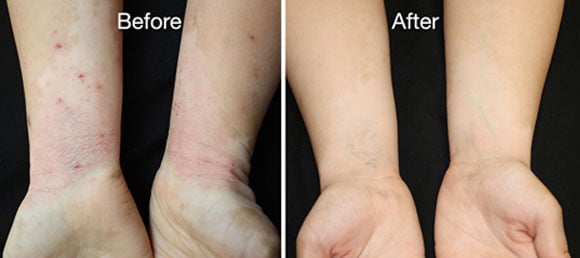
    Forearms of eczema patient before and after treatment with arthritis medication. (Photos by Dr. Brett King)

    A team of scientists at Yale University used a rheumatoid arthritis drug to successfully treated patients with moderate to severe eczema. The same rheumatoid arthritis drug (tofacitinib citrate) has recently shown to reverse two other disfiguring skin conditions, vitiligo and alopecia areata.

    The research findings are published early online in the Journal of the American Academy of Dermatology.

    Eczema (atopic dermatitis) is a chronic condition that causes severe itching and leaves the skin red and thickened. It can adversely affect sleep and quality of life. Standard treatments, such as steroid creams and oral medicines, commonly fail to relieve symptoms in patients with moderate to severe eczema.

    Based on current scientific models of eczema biology, assistant professor of dermatology Dr. Brett King. hypothesized that a drug approved for rheumatoid arthritis, tofacitinib citrate, would interrupt the immune response that causes eczema.

    In the new study, King and his colleagues report that treatment with the drug led to a dramatic improvement in six patients with moderate to severe eczema who had previously tried conventional therapies without success.

    During treatment, all six patients reported a significant reduction in itch as well as improved sleep. The redness and thickening of the skin diminished, also.

    “These individuals were not only very happy with the results, they also expressed a tremendous sense of relief at being comfortable in their skin for the first time in many years,” King said.

    King and fellow Yale dermatologist Dr. Brittany Craiglow had previously shown that tofacitinib citrate regrows hair in patients with an autoimmune-related form of hair loss called alopecia areata. They also published findings reporting the successful treatment of a patient with vitiligo, which can leave widespread irregular white patches all over the body.

    The new study suggests that a change in the standard of care for eczema — a condition for which there is no targeted therapy — may be on the horizon, say the researchers.

    “Eczema affects millions of children and adults in the United States,” said King. “I’m hopeful we are entering a whole new era in treatment.”

    The researchers note that further research is needed to confirm the treatment’s long-term efficacy and safety for eczema patients.

    Other Yale authors include Dr. Lauren L. Levy and Dr. Jennifer Urban.

    Reference: “Treatment of recalcitrant atopic dermatitis with the oral Janus kinase inhibitor tofacitinib citrate” by Lauren L. Levy, MD; Jennifer Urban, MD and Brett A. King, MD, Ph.D., 17 July 2015, Journal of the American Academy of Dermatology.
    DOI: 10.1016/j.jaad.2015.06.045

    Never miss a breakthrough: Join the SciTechDaily newsletter.
    Follow us on Google and Google News.

    Dermatology Medicine Yale University
    Share. Facebook Twitter Pinterest LinkedIn Email Reddit

    Related Articles

    Study Shows Arthritis Drug Restores Skin Color for Vitiligo Patients

    Potential Over-Treatment of Diabetes in Older Adults

    Researchers May Have Pinpointed a Strategy for Eliminating Latent HIV

    Yale Study Shows Metformin May be Safe for Patients with Kidney Disease

    Antifreeze Protein in Ticks Could Lead to New Antibiotics for Humans

    Study Finds Stimulant Use Increases by 30% During the School Year

    Yale Researchers Discover New Cancer Cell Vulnerability

    Yale Study Shows No Link between Hospital Readmissions and Death Rates

    Intensive Glycemic Control Does Not Definitively Reduce the Risk of Impaired Kidney Function

    Leave A Reply Cancel Reply

    • Facebook
    • Twitter
    • Pinterest
    • YouTube

    Don't Miss a Discovery

    Subscribe for the Latest in Science & Tech!

    Trending News

    Popular Vitamin B3 Supplements May Help Cancer Cells Survive, Scientists Warn

    Scientists Discover Strange Property of Rice and Turn It Into a Smart Material

    NASA Artemis II Skips Burn As Astronaut Captures Stunning View of Earth

    NASA’s Artemis II: Humans Just Left Earth Orbit for the First Time Since 1972

    What Causes Chronic Pain? Scientists Identify Key Culprit in the Brain

    Semaglutide Shows Surprising Mental Health Benefits in Massive 100,000-Person Study

    This Liquid Snapped Instead of Flowing and Scientists Were Shocked

    Breakthrough Alzheimer’s Drug Rewires the Brain Instead of Just Clearing Plaques

    Follow SciTechDaily
    • Facebook
    • Twitter
    • YouTube
    • Pinterest
    • Newsletter
    • RSS
    SciTech News
    • Biology News
    • Chemistry News
    • Earth News
    • Health News
    • Physics News
    • Science News
    • Space News
    • Technology News
    Recent Posts
    • Astronomers Discover the Most Pristine Star Ever Found
    • New Study Suggests Gravitational Waves May Have Created Dark Matter
    • Scientists Solve 60-Year-Old Mystery of Strange Magnetic Surges Above the Moon
    • Scientists Discover How Multiple Sclerosis Kills Brain Cells
    • Scientists Discover Why the Brain Gets Stuck in Schizophrenia
    Copyright © 1998 - 2026 SciTechDaily. All Rights Reserved.
    • Science News
    • About
    • Contact
    • Editorial Board
    • Privacy Policy
    • Terms of Use

    Type above and press Enter to search. Press Esc to cancel.