
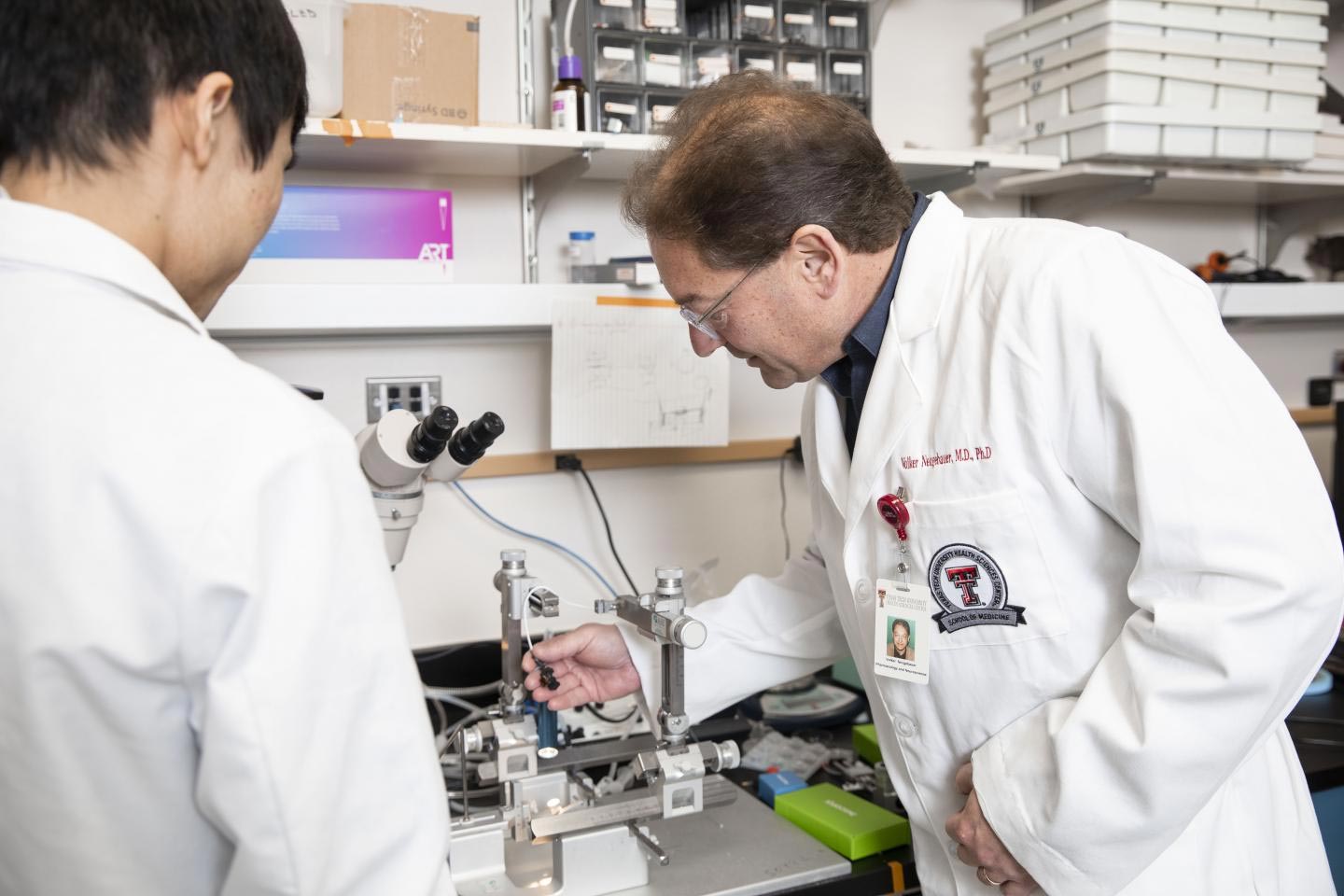
Texas Tech University Health Sciences Center study shows brain mechanisms have potential to block arthritis pain. Existing compound produces pain-relieving effects and relieves anxiety.
Millions of people around the world are affected by pain, a multidimensional experience characterized by interactions between our emotional, cognitive, sensory, and motor functions. Because pain is a complex condition, treating it efficiently continues to pose challenges for physicians.
Past pain research typically has focused on the spinal cord or the peripheral areas of the nervous system located outside the spinal cord and brain. However, a research team headed by Volker E. Neugebauer, M.D., Ph.D., at the Texas Tech University Health Sciences Center (TTUHSC) School of Medicine recently investigated how some mechanisms in the brain contribute to pain. His study, “Amygdala group II mGluRs Mediate the Inhibitory Effects of Systemic Group II mGluR Activation on Behavior and Spinal Neurons in a Rat Model of Arthritis Pain,” was published recently by the journal Neuropharmacology. Mariacristina Mazzitelli, a TTUHSC research assistant and Ph.D. candidate, is the study’s lead author.

“Our group has been interested in understanding pain mechanisms, and our unique area of expertise is really understanding that changes in the brain contribute to the persistence, intensity, and other side effects of pain,” Neugebauer said. “It is not just a sensation that lets you know where it hurts and how intense the pain feels. It also causes anxiety, impairs quality of life, and causes depression. We’re studying the brain because all of those things reside there.”
To better understand what pain-related changes may occur in the brain, and how to normalize those changes, Neugebauer’s study applied an arthritis pain model and focused on the amygdala, which are almond-shaped clusters located deep inside each of the brain’s temporal lobes. The amygdala is part of what is known as the limbic brain, a complex arrangement of nerve cells and networks that control basic survival functions, motivations, and emotions like fear and play a central role in disorders like anxiety, addiction, and pain.
The study specifically looked at activating what are known as group II metabotropic glutamate receptors, or II mGluRs, within the amygdala. There are three groups of mGluRs that serve opposing functions, and activating these receptors can trigger an excitatory response between cells, which increases pain-related activity, or they can trigger an inhibitory response between cells that decreases pain-related activity.
“The idea is that if we can activate the inhibitory receptor, we could decrease brain activity, which also would decrease pain,” Neugebauer said.
To attempt the activation of an inhibitory response, Neugebauer used a previously developed compound called LY379268. Though not commercially available, LY379268 has been explored by the industry and demonstrates the ability to decrease anxiety while producing very few relatively minor side effects.
“We wanted to see if the compound had pain-relieving effects and determine the site of action,” Neugebauer said. “In pain research, the spinal cord has traditionally been the target for interventions because it’s more easily accessible for drug applications than the brain and it’s the first line of processing information from the body before it gets to the brain.”

In the past, Neugebauer said LY379268 and other similar compounds have been thought of as acting in the spinal cord, though the evidence is not completely clear and remains somewhat controversial. For this study, the Neugebauer team injected the drug systemically so it could circulate and act anywhere in the body or nervous system and then observed what, if any effects it produced. Then they blocked the II mGluR receptors in the amygdala to see if that would eliminate any analgesic, or pain-relieving effects.
“And it did actually,” Neugebauer said. “So, imagine you inject this drug systemically, you block the receptors only in the amygdala, and the analgesic, or pain-relieving effect of the drug is gone. That means the effect of the compound has not really been through an action in the spinal cord, but through an action in the area of interest in the brain, which is the amygdala. I think that’s really a fascinating key, and it was surprising that basically the entire pain-relieving effect of the drug can be explained by an action in the brain, not in the spinal cord. This compound does have effects on the spinal cord, but not through an action in the spinal cord. That means this brain area somehow communicates with the spinal cord and regulates spinal cord activity. Our team showed this by measuring the activity of nerve cells in the spinal cord that were inhibited by LY379268, whether it was administered systemically or injected directly into the amygdala.”
Though he and his team did not develop the LY379268 compound, Neugebauer said their study has provided the rationale for exploring it further, which Mazzitelli will do as part of her dissertation.
“When it’s given systemically it works, and now we know it works in the brain,” he said. “It produces pain-relieving effects and also relieves anxiety, so it could prove to be a very good pain medication.”
Neugebauer, also director of TTUHSC’s Garrison Institute on Aging, said because current mechanistic pain research typically studies young rather than older adult animals, his team wants to investigate whether or not managing pain for conditions like arthritis is age-dependent. Some compounds like LY379268 may or may not work in the older population, but that can’t be known until basic research is conducted on those subjects.
“Changes can happen quickly in the nervous system, maybe even in hours, so when we look at years and decades, there could be a lot of significant changes,” he said. “Maybe some targets get lost because that part of the nervous system is just not involved anymore. It’s fascinating, but it’s also amazing how little we know about normal aging disorders like pain and arthritis. In the context of aging, there is really a big knowledge gap, so that’s a direction I think we’re going to go.”
Reference: “Amygdala group II mGluRs mediate the inhibitory effects of systemic group II mGluR activation on behavior and spinal neurons in a rat model of arthritis pain” by Mariacristina Mazzitellia and Volker Neugebauer, 1 November 2019, Neuropharmacology.
DOI: 10.1016/j.neuropharm.2019.107706
Never miss a breakthrough: Join the SciTechDaily newsletter.
Follow us on Google and Google News.
1 Comment
Physical pain consists of sensation and the emotion of fear it evokes: We do not possess peripheral “pain-receptors” or “nociceptors.”
If we accept a definition of a “pain-receptor” as being “a sensory nerve ending which is sensitive to tissue-damaging or potentially tissue damaging stimuli,” and realize that any physical stimulus is potentially tissue-damaging, we can see that currently accepted theories of pain based on “nociception” from peripheral nerve endings are fundamentally flawed.
“There is nothing either good or bad, but thinking makes it so,” Hamlet told us in 1603.
Pinch your own (intact, healthy, unpierced) ear lobe as hard as you can between finger and thumb: I doubt you will experience any pain, and for the same reason that you (probably) cannot tickle yourself to laughter.
Phantom pain may be real, but it obviously lacks appropriate “pain-receptors.”
Locally active agents such as local anesthetics, ice or a thump can reduce or abolish pain but do so by affecting not just pain in that area, but sensation
Agents which act centrally on pain, be it general anesthetics such as alcohol, nitrous oxide, chloroform, ether and opioids, or stimulants such as catecholamines, xanthines or amphetamines….these all raise our fear/anxiety thresholds.
A minor ache which we think may last indefinitely may be more intolerable than a much more severe one which we believe will be over soon.
As the sensation from, say a deep, bruising kick or blow to a muscle, grows in intensity, the pain may seem overwhelming but, once that sensation has climaxed, as it declines, the same sensation which hurt so much – which frightened is so much – on the up, say at 80-90%, hardly bothers us when we feel that the trajectory is now downwards, instead.
A midge bite can produce a histamine-mediated allergic response in the skin. It can prove humiliating to try to practice “mind-over-matter” control of our aggravation from the irritation until we realize that the sensation is not the result of a tiny bite but that it is being amplified moment by moment by the growing release of histamine in the skin!
Those such as the self-immolating Vietnamese monks who could expire in flames without screaming were surely demonstrating not so much “mind-over-matter” self control, as mind control – controlling their thinking minds with their higher awareness.
Once medicine acknowledges that, as Professor Howard Schubiner has put it, “The reign of pain is mainly in the brain,” or entirely in the mind, I anticipate a paradigm shift may be possible, or inevitable.
I hope so!
Tom Kelly, veterinarian.
References:
1: Thích Quảng Đức – Wikipedia:
https://share.google/eVi0qtaeCSqYMUAP8
2: Professor Howard Schubiner:
https://youtu.be/0VyH1laOd2M?si=CJiamrYendhM-Ytz