
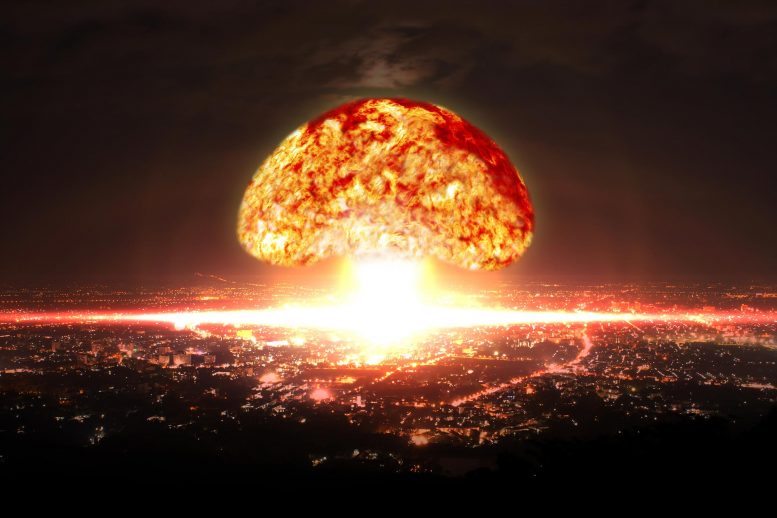
Nuclear war between India and Pakistan could kill millions worldwide. Mass starvation may occur with less sunlight reaching Earth’s surface.
More than 100 million people could die immediately if India and Pakistan wage a nuclear war, followed by global mass starvation, according to a Rutgers co-authored study.
“Such a war would threaten not only the locations where bombs might be targeted but the entire world,” said Alan Robock, a Distinguished Professor in the Department of Environmental Sciences at Rutgers University–New Brunswick.
Robock, who co-authored the study in the journal Science Advances, and other scientists, looked at a war scenario that could occur between India and Pakistan in 2025. The neighboring countries, which both place claim and have waged several wars over the Kashmir territory, could have a combined 400 to 500 nuclear weapons by then. Skirmishes continue to this day.
The research found that fires ignited by exploding nuclear weapons could release 16 million to 36 million tons of soot (black carbon) in smoke that would rise into the upper atmosphere, spreading around the world within weeks.
The soot would absorb solar radiation, heating the air and boosting the smoke’s swift rise. Sunlight reaching the Earth would decline by 20 to 35 percent, cooling the surface by 3.6 to 9 degrees Fahrenheit (2 to 5 degrees Celsius) and reducing precipitation by 15 to 30 percent, with larger regional impacts.
Vegetation growth would decline by 15 to 30 percent on land and ocean productivity would decline by 5 to 15 percent. Recovery from all these impacts would take more than 10 years because the smoke would linger in the upper atmosphere.
“Nine countries have nuclear weapons, but Pakistan and India are the only ones rapidly increasing their arsenals,” Robock said. “Because of the continuing unrest between these two nuclear-armed countries, particularly over Kashmir, it is important to understand the consequences of a nuclear war.”
Researchers say the weapons in 2025 could range from 15 kilotons in explosive power – equivalent to 15,000 tons of TNT, the same size as the U.S. bomb dropped on Hiroshima in 1945 – to a few hundred kilotons.
If India used 100 strategic weapons and Pakistan used 150, an estimated 50 to 125 million people could die from the direct effects, with additional deaths from mass starvation possible worldwide.
“Nuclear weapons cannot be used in any rational scenario but could be used by accident or as a result of hacking, panic or deranged world leaders,” Robock said. “The only way to prevent this is to eliminate them.”
The results provide more evidence to support the 2017 UN Treaty on the Prohibition of Nuclear Weapons, which led to the 2017 Nobel Peace Prize awarded to the International Campaign to Abolish Nuclear Weapons, Robock added.
For more on this study, read India-Pakistan Nuclear War Could Kill 125 Million, Threaten Global Starvation and Global Climate Disaster If Nuclear War Between India and Pakistan.
Reference: “Rapidly expanding nuclear arsenals in Pakistan and India portend regional and global catastrophe” by Owen B. Toon, Charles G. Bardeen, Alan Robock, Lili Xia, Hans Kristensen, Matthew McKinzie, R. J. Peterson, Cheryl S. Harrison, Nicole S. Lovenduski and Richard P. Turco, 2 October 2019, Science Advances.
DOI: 10.1126/sciadv.aay5478
Scientists at the University of Colorado, Boulder, led the study, and Rutgers research associate Lili Xia contributed to it. Other contributors work at the U.S. National Center for Atmospheric Research; Federation of American Scientists; Natural Resources Defense Council; University of Texas Rio Grande; and University of California at Los Angeles.
Never miss a breakthrough: Join the SciTechDaily newsletter.
Follow us on Google and Google News.