
Close Menu
    Facebook X (Twitter) Instagram
    SciTechDaily
    • Biology
    • Chemistry
    • Earth
    • Health
    • Physics
    • Science
    • Space
    • Technology
    Facebook X (Twitter) Pinterest YouTube RSS
    SciTechDaily
    Home»Science»Study Suggests Life on Land Began 65 Million Years Earlier Than Current Estimate
    Science

    Study Suggests Life on Land Began 65 Million Years Earlier Than Current Estimate

    By SciTechDailyDecember 13, 2012No Comments2 Mins Read
    Facebook Twitter Pinterest Telegram LinkedIn WhatsApp Email Reddit
    Share
    Facebook Twitter LinkedIn Pinterest Telegram Email Reddit
    dickinsonia-parvancorina-terrestrial
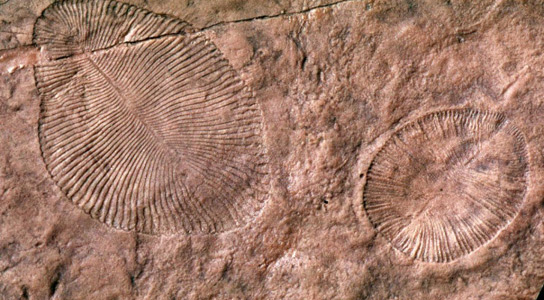
    Are these fossils traces of Ediacaran worms or lichen? Credit: Greg Retallack

    A new study shows that fossils that have been regarded as ancient sea creatures may have actually been land-dwelling lichen, suggesting life on land began 65 million years earlier than current estimates.

    The scientists published their findings in the journal Nature. However, other paleontologists flatly reject the hypothesis made by Gregory Retallack, a geologist from the University of Oregon, in Eugene. His paper marks a dramatic reinterpretation of the fossils and suggests that life on land began 65 million years earlier than researchers had estimated.

    The exact nature of the fossils from the Ediacaran period, 635 to 542 million years ago, has been controversial among paleontologists. Some think that the fossils represent some of the earliest complex marine organisms that evolved over 10 million years before the Cambrian explosion, which saw the rapid emergence of major complex animal groups.

    Retallack thinks that the fossils are lichens, traces of slime molds, and soil structures. He believes that rock in the Ediacara Member in South Australia, where paleontologist Reginald Sprigg first discovered Ediacaran fossils in 1947, represents new geological data. The rock’s red color and weathering pattern indicate that the deposits were formed in terrestrial environments, not marine ones, and the trails attributed to Ediacaran worms could actually be slime-mold growth.

    Some paleontologists dismiss this paper as a summary of the views that Retallack’s has had for the last decade and believe that Retallack hasn’t presented any evidence that would contradict the interpretation that the sedimentary layers involved are marine. Multiple independent laboratories worldwide have nearly universally converged on a marine origin for the Ediacara biota.

    Reference: “Ediacaran life on land” by Gregory J. Retallack, 12 December 2012, Nature.
    DOI: 10.1038/nature11777

    Never miss a breakthrough: Join the SciTechDaily newsletter.
    Follow us on Google and Google News.

    Ediacaran Period Fossils Lichens Paleontology
    Share. Facebook Twitter Pinterest LinkedIn Email Reddit

    Related Articles

    Prehistoric Fossilized Eocene Epoch Turtles Died Locked In Coitus

    27-Foot Long Crocodylus Thorbjarnarsoni Roamed Kenya

    Carbonemys Was a Giant Turtle From Late Paleocene

    Mysterious “Godzillus” Fossil Discovered by Amateur Paleontologist

    Cretaceous Period Sankofa Pyrenaica Fossilized Eggs Are Unusually Shaped

    Burtele Foot Points to Other Past Hominins

    Microraptor Feathers Were Black With Iridescent Sheen

    Jurassic Period Super-Sized Fleas Had Armored Mouthparts to Attack the Thick Hide of Dinosaurs

    Hundreds of Lost Fossils From the Darwin Collection Rediscovered by the British Geological Survey

    Leave A Reply Cancel Reply

    • Facebook
    • Twitter
    • Pinterest
    • YouTube

    Don't Miss a Discovery

    Subscribe for the Latest in Science & Tech!

    Trending News

    The Strange “Spacetime Crystal” That Can Suddenly Turn Into a Black Hole

    The Surprising Way Asteroids May Have Helped Life Begin on Earth

    Vast Hidden Structure Discovered Under Miles of Ice in East Antarctica

    A Surprising Discovery Suggests Autism Is Not One Condition

    New Alzheimer’s Discovery Could Change How Scientists Fight the Disease

    Yale Discovery Overturns Long-Held “Evolutionary Dead End” Theory

    UCLA Scientists Uncover a “Hidden Weakness” in Some of the World’s Deadliest Cancers

    Humpback Whale Stuns Scientists With 15,000 Kilometer Journey Across Oceans

    Follow SciTechDaily
    • Facebook
    • Twitter
    • YouTube
    • Pinterest
    • Newsletter
    • RSS
    SciTech News
    • Biology News
    • Chemistry News
    • Earth News
    • Health News
    • Physics News
    • Science News
    • Space News
    • Technology News
    Recent Posts
    • James Webb Spots Something Strange Between Day and Night on an Alien Planet
    • Food Waste Becomes a Powerful Carbon Trap in Climate Breakthrough
    • Battery-Free Artificial Photosynthesis Turns Sunlight, Water, and CO2 Into Fuel
    • How Ancient People Moved a 6-Ton Stone 700 Kilometers to Stonehenge
    • Scientists Finally See How Antibodies Really Attack Viruses
    Copyright © 1998 - 2026 SciTechDaily. All Rights Reserved.
    • Science News
    • About
    • Contact
    • Editorial Board
    • Privacy Policy
    • Terms of Use

    Type above and press Enter to search. Press Esc to cancel.