
Close Menu
    Facebook X (Twitter) Instagram
    SciTechDaily
    • Biology
    • Chemistry
    • Earth
    • Health
    • Physics
    • Science
    • Space
    • Technology
    Facebook X (Twitter) Pinterest YouTube RSS
    SciTechDaily
    Home»Space»Stunning Shimmering Space Butterfly Captured by Very Large Telescope
    Space

    Stunning Shimmering Space Butterfly Captured by Very Large Telescope

    By European Southern ObservatoryAugust 2, 20202 Comments4 Mins Read
    Facebook Twitter Pinterest Telegram LinkedIn WhatsApp Email Reddit
    Share
    Facebook Twitter LinkedIn Pinterest Telegram Email Reddit
    VLT NGC 2899 Planetary Nebula
    This highly detailed image of the fantastic NGC 2899 planetary nebula was captured using the FORS instrument on ESO’s Very Large Telescope in northern Chile. This object has never before been imaged in such striking detail, with even the faint outer edges of the planetary nebula glowing over the background stars. Credit: ESO

    Resembling a butterfly with its symmetrical structure, beautiful colors, and intricate patterns, this striking bubble of gas — known as NGC 2899 — appears to float and flutter across the sky in this new picture from ESO’s Very Large Telescope (VLT). This object has never before been imaged in such striking detail, with even the faint outer edges of the planetary nebula glowing over the background stars.


    Astronomers using ESO’s Very Large Telescope have imaged a ‘space butterfly,’ a planetary nebula known as NGC 2899. This video offers stunning views of this object and the science behind it. Credit: ESO

    NGC 2899’s vast swathes of gas extend up to a maximum of two light-years from its center, glowing brightly in front of the stars of the Milky Way as the gas reaches temperatures upwards of ten thousand degrees. The high temperatures are due to the large amount of radiation from the nebula’s parent star, which causes the hydrogen gas in the nebula to glow in a reddish halo around the oxygen gas, in blue.
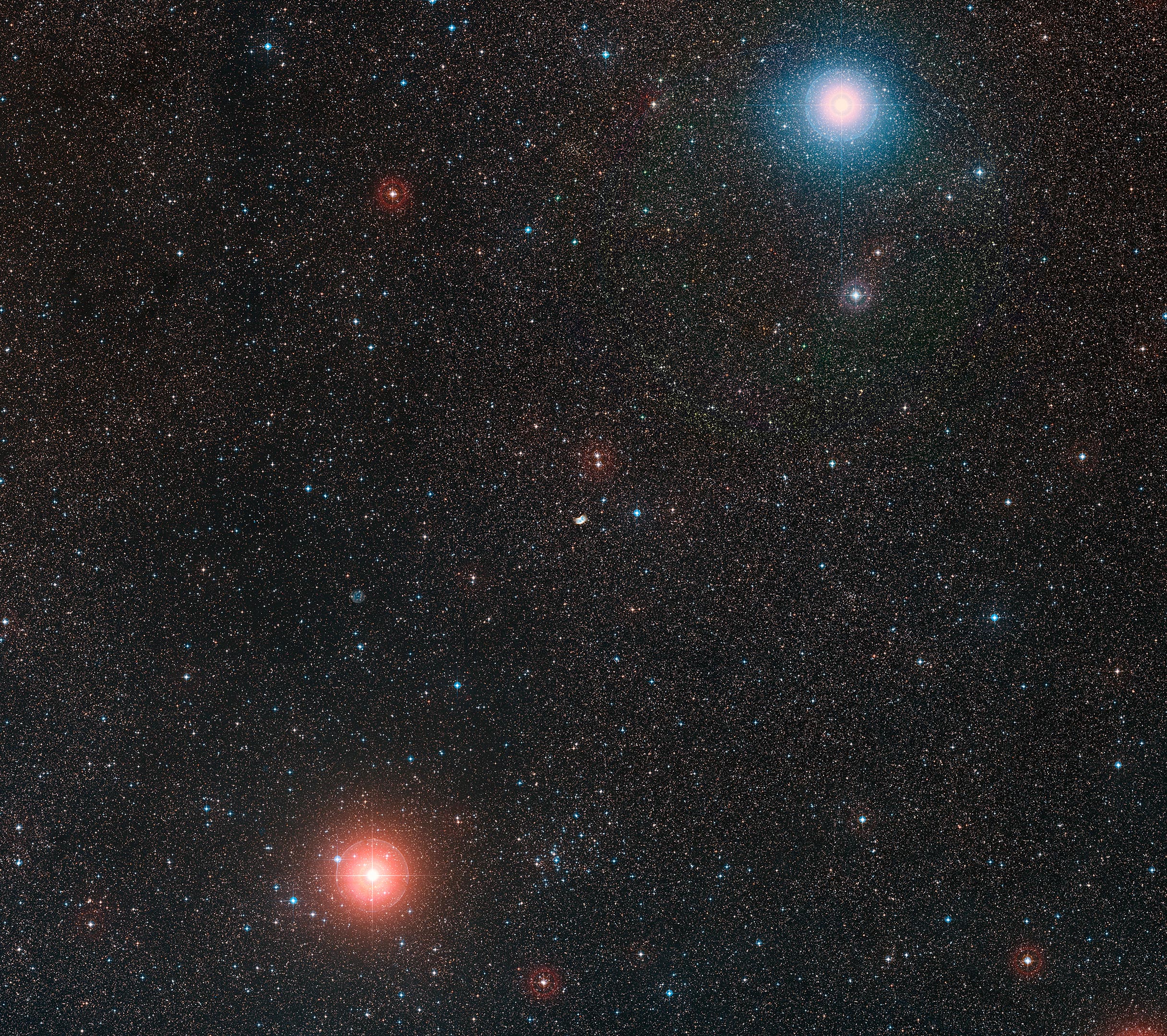
    NGC 2899 Sky
    This image shows the sky around the location of NGC 2899, which is visible at the very center of the frame. This picture was created from images in the Digitized Sky Survey 2. Credit: ESO/Digitized Sky Survey 2. Acknowledgment: Davide De Martin

    This object, located between 3000 and 6500 light-years away in the Southern constellation of Vela (The Sails), has two central stars, which are believed to give it its nearly symmetric appearance. After one star reached the end of its life and cast off its outer layers, the other star now interferes with the flow of gas, forming the two-lobed shape seen here. Only about 10–20% of planetary nebulae[1] display this type of bipolar shape.

    Astronomers were able to capture this highly detailed image of NGC 2899 using the FORS instrument installed on UT1 (Antu), one of the four 8.2-meter telescopes that make up ESO’s VLT in Chile. Standing for FOcal Reducer and low dispersion Spectrograph, this high-resolution instrument was one of the first to be installed on ESO’s VLT and is behind numerous beautiful images and discoveries from ESO. FORS has contributed to observations of light from a gravitational wave source, has researched the first known interstellar asteroid, and has been used to study in depth the physics behind the formation of complex planetary nebulae.
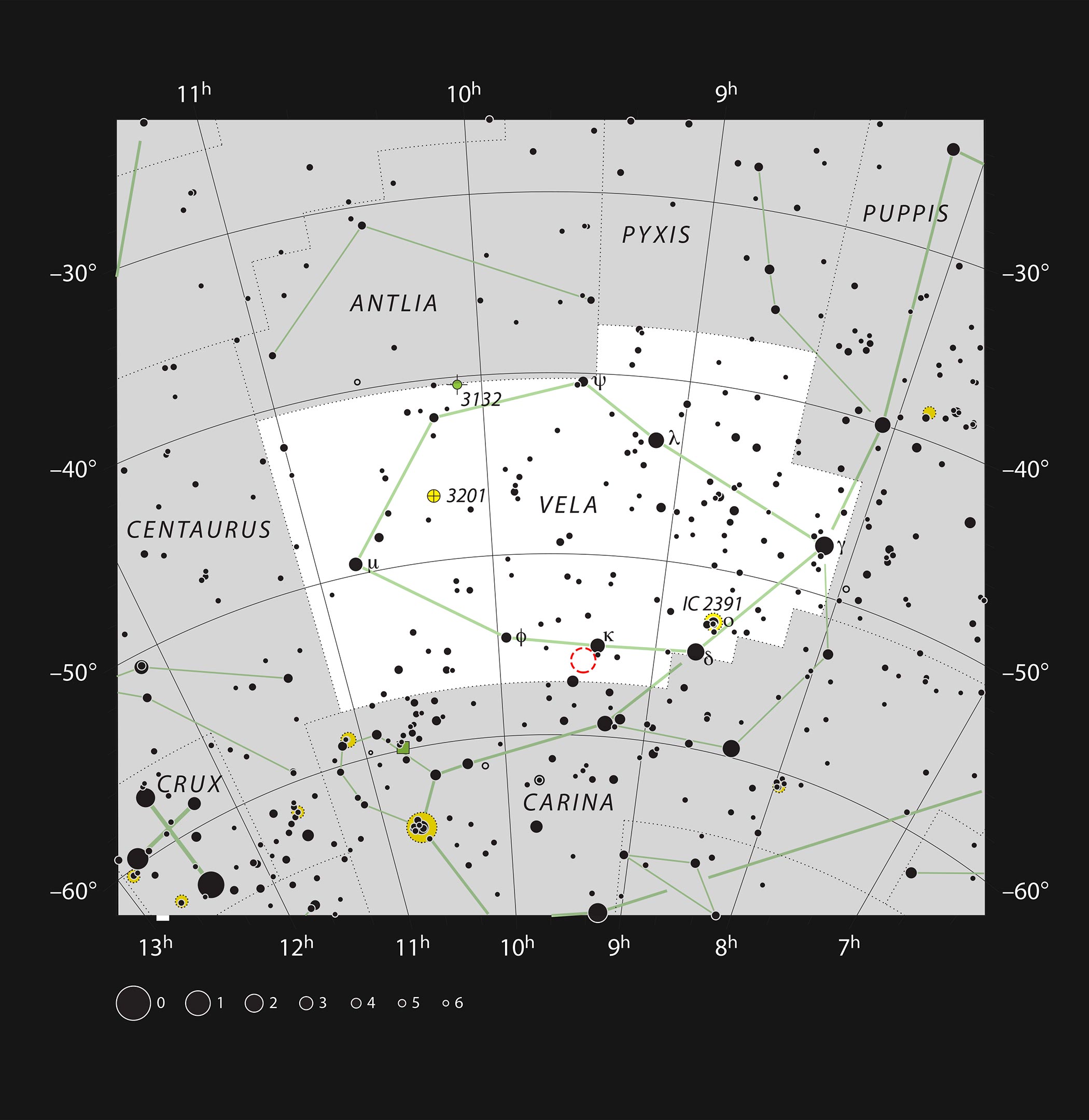
    NGC 2899 Star Chart Vela Constellation
    This chart shows the location of the planetary nebula NGC 2899 in the constellation of Vela (The Sails). The map includes most of the stars visible to the unaided eye under good conditions, and the location of the nebula is indicated by a red circle. Credit: ESO, IAU and Sky & Telescope

    This image was created under the ESO Cosmic Gems program, an outreach initiative to produce images of interesting, intriguing or visually attractive objects using ESO telescopes, for the purposes of education and public outreach. The program makes use of telescope time that cannot be used for science observations. All data collected may also be suitable for scientific purposes, and are made available to astronomers through ESO’s science archive.
    Notes

    [1] Unlike what their common name suggests, planetary nebulae have nothing to do with planets. The first astronomers to observe them merely described them as planet-like in appearance. They are instead formed when ancient stars with up to 6 times the mass of our Sun reach the end of their lives, collapse, and blow off expanding shells of gas, rich in heavy elements. Intense ultraviolet radiation energizes and lights up these moving shells, causing them to shine brightly for thousands of years until they ultimately disperse slowly through space, making planetary nebulae relatively short-lived phenomena on astronomical timescales.

    Never miss a breakthrough: Join the SciTechDaily newsletter.
    Follow us on Google and Google News.

    Astronomy Astrophysics European Southern Observatory Popular Very Large Telescope
    Share. Facebook Twitter Pinterest LinkedIn Email Reddit

    Related Articles

    “We Found Something Never Seen Before” – Mysterious Shock Wave Around Dead Star Surprises Astronomers

    Detailed Images of the Hypergiant Star VY Canis Majoris

    VLT/SPHERE Reveal a Star Giving Birth to a Butterfly-Like Planetary Nebula

    VLT Confirms G2 Survived Close Approach of Supermassive Black Hole

    VLT Reveals Alignment of Quasars Across Billions of Light-Years

    Astronomers View Stardust Being Made in Real Time

    Astronomers Measure the Length of an Exoplanet Day

    VLT Views a Gas Cloud Being Ripped Apart by a Black Hole

    Planetary Nebula Fleming 1 Likely Has Two White Dwarfs Circling Each Other at Its Center

    2 Comments

    1. ESTELLA DAVIS on August 2, 2020 2:42 pm

      The cosmic image seems like one of an angel with it’s aura surrounding it. The angels are in touch with earthly angels among us today. It seems angelic.

      Reply
    2. Live Wire on August 6, 2020 5:37 pm

      Better explanation than “bubble of gas.”

      https://www.thunderbolts.info/wp/2020/08/03/flutter-by/

      Reply
    Leave A Reply Cancel Reply

    • Facebook
    • Twitter
    • Pinterest
    • YouTube

    Don't Miss a Discovery

    Subscribe for the Latest in Science & Tech!

    Trending News

    Breakthrough Bowel Cancer Trial Leaves Patients Cancer-Free for Nearly 3 Years

    Natural Compound Shows Powerful Potential Against Rheumatoid Arthritis

    100,000-Year-Old Neanderthal Fossils in Poland Reveal Unexpected Genetic Connections

    Simple “Gut Reset” May Prevent Weight Gain After Ozempic or Wegovy

    2.8 Days to Disaster: Scientists Warn Low Earth Orbit Could Suddenly Collapse

    Common Food Compound Shows Surprising Power Against Superbugs

    5 Simple Ways To Remember More and Forget Less

    The Atomic Gap That Could Cost the Semiconductor Industry Billions

    Follow SciTechDaily
    • Facebook
    • Twitter
    • YouTube
    • Pinterest
    • Newsletter
    • RSS
    SciTech News
    • Biology News
    • Chemistry News
    • Earth News
    • Health News
    • Physics News
    • Science News
    • Space News
    • Technology News
    Recent Posts
    • After 37 Years, the World’s Longest-Running Soil Warming Experiment Uncovers a Startling Climate Secret
    • NASA Satellite Captures First-Ever High-Res View of Massive Pacific Tsunami
    • ADHD Isn’t Just a Deficit: Study Reveals Powerful Hidden Strengths
    • Scientists Uncover “Astonishing” Hidden Property of Light
    • Scientists Discover Stem Cells That Could Regrow Teeth and Bone
    Copyright © 1998 - 2026 SciTechDaily. All Rights Reserved.
    • Science News
    • About
    • Contact
    • Editorial Board
    • Privacy Policy
    • Terms of Use

    Type above and press Enter to search. Press Esc to cancel.