
Close Menu
    Facebook X (Twitter) Instagram
    SciTechDaily
    • Biology
    • Chemistry
    • Earth
    • Health
    • Physics
    • Science
    • Space
    • Technology
    Facebook X (Twitter) Pinterest YouTube RSS
    SciTechDaily
    Home»Health»Lung Ultrasound Reveals Duration and Severity of COVID-19
    Health

    Lung Ultrasound Reveals Duration and Severity of COVID-19

    By American Roentgen Ray SocietyAugust 2, 2020No Comments3 Mins Read
    Facebook Twitter Pinterest Telegram LinkedIn WhatsApp Email Reddit
    Share
    Facebook Twitter LinkedIn Pinterest Telegram Email Reddit
    Lung Ultrasound COVID-19
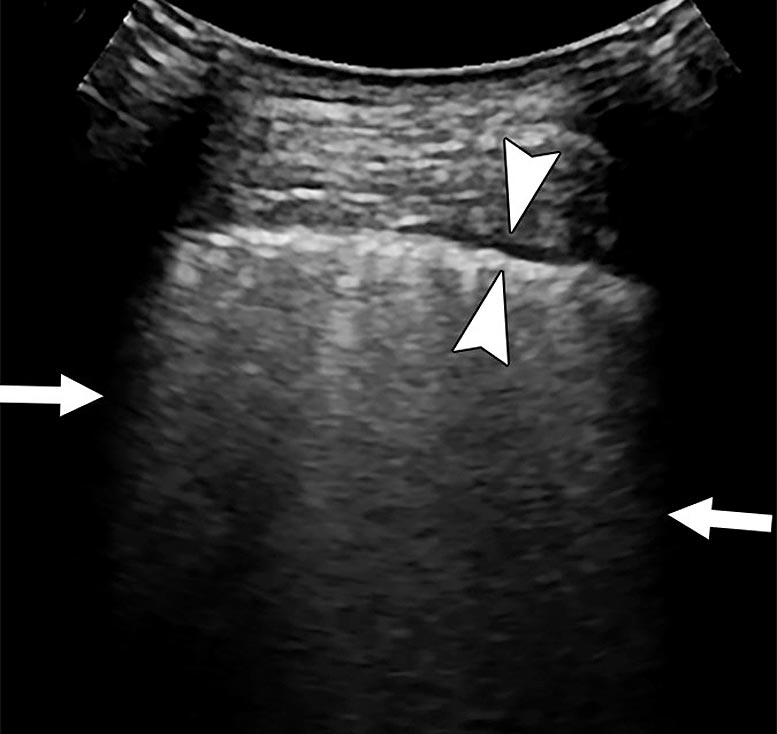
    Lung ultrasound image of 82-year-old man who presented with cough, dyspnea, and fever for 10 days obtained with convex probe. Multiple confluent B-lines (arrows) and thickened pleural line (between arrowheads) are visualized. Credit: American Journal of Roentgenology (AJR)

    Thickened pleural line more frequently observed in patients with longer time intervals after symptom onset; pulmonary consolidation more common in severe and critical cases.

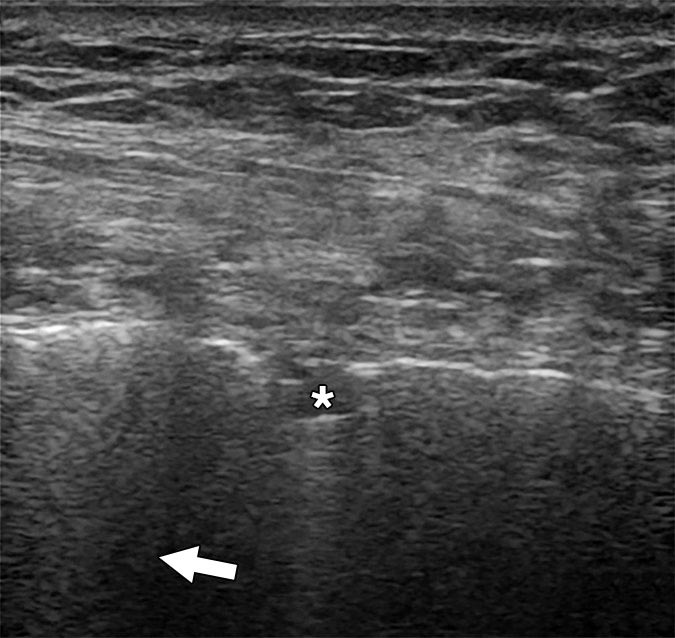
    According to an open-access article published in ARRS’ American Journal of Roentgenology (AJR), lung ultrasound (US) was highly sensitive for detecting abnormalities in patients with coronavirus disease (COVID-19), with B-lines, a thickened pleural line, and pulmonary consolidation the most commonly observed features.

    “In addition,” concluded Yao Zhang of China’s Beijing Ditan Hospital, “our results indicate that lung US findings can be used to reflect both the infection duration and disease severity.”
    COVID-19 Lung Ultrasound
    Lung ultrasound image obtained with linear probe. Multiple confluent B-lines (arrows) and patchy pulmonary consolidation (asterisk) are visualized. Credit: American Journal of Roentgenology (AJR)

    From March 3 to March 30, 2020, Zhang and colleagues performed lung US on consecutive patients with positive reverse transcriptase polymerase chain reaction (RTPCR) test results for severe acute respiratory syndrome coronavirus 2 (SARS-CoV-2), using the Fisher exact test to compare the percentages of patients with each US finding between groups with different symptom durations and disease severity.

    All 28 patients (14 men and 14 women; age range, 21–92 years) had positive findings on both lung US and chest CT. On US, B-lines were present in 100% of patients, and 19 (67.9%) patients had pulmonary consolidation. Thickened pleural lines were observed in 17 patients (60.7%), and only one patient (3.6%) showed a small amount of pleural effusion.
    Chest CT COVID-19
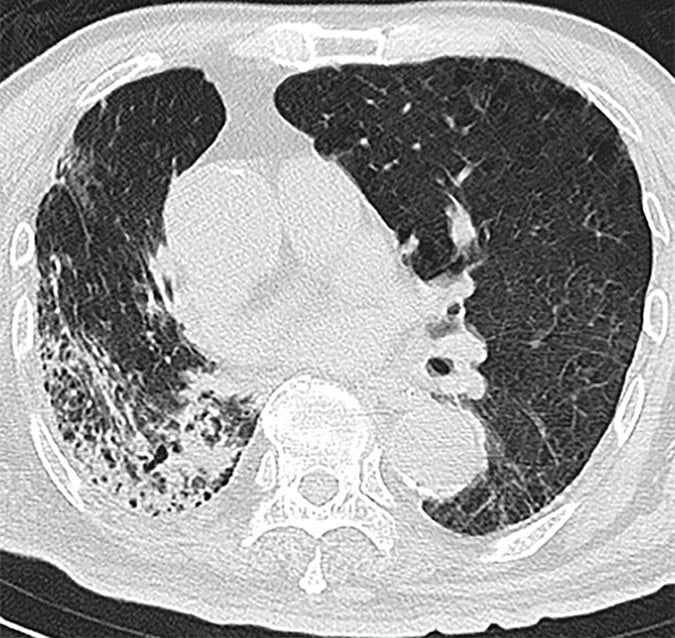
    Chest CT image shows reticular and interlobular septal thickening and patchy, focal opacities associated with architectural distortion. This patient was classified in critical group and was assigned to severe group for statistical analysis. Credit: American Journal of Roentgenology (AJR)

    “A thickened pleural line was more frequently observed on US in patients with longer time intervals after the initial onset of symptoms,” Zhang et al. noted, adding that pulmonary consolidations—visualized as tissuelike hypoechoic regions, reflecting highly reduced air flow and increased quantity of inflammatory cellular exudate—were more common in severe and critical cases.

    Acknowledging that portable radiography could be just as useful in evaluating consolidation, “a bedside portable, handheld US system or even a robot-assisted tele-US system (a unique technique for physicians to remotely scan patients) further minimizes the number of health care workers and medical devices exposed to COVID-19,” wrote Zhang and team.

    The authors of this AJR article also proposed that severity scoring for lung US, similar to CT severity scores, should be developed to facilitate more accurate comparisons in future studies.

    https://scitechdaily.com/images/COVID-19-Lung-Findings.mp3

    The latest AJR Podcast episode takes a closer look at “Lung US Findings in Coronavirus Disease-19 (COVID-19) Patients,” noting that compared to CT, US is portable, less costly, and does not use radiation—making US a useful tool for triage, particularly in pre-hospital/outpatient settings, and severity stratification and monitoring, especially for critically ill patients who may be challenging to transport and require careful ventilation management. Credit: American Journal of Roentgenology (AJR)

    Reference: “Lung Ultrasound Findings in Patients With Coronavirus Disease (COVID-19)” by Yao Zhang, MD, Heng Xue, MD, Mixue Wang, MD, Nan He, MD, Zhibin Lv, MD and Ligang Cui, MD, 23 July 2020, AJR.
    DOI: 10.2214/AJR.20.23513

    Never miss a breakthrough: Join the SciTechDaily newsletter.
    Follow us on Google and Google News.

    COVID-19 Lungs Popular Public Health Pulmonary
    Share. Facebook Twitter Pinterest LinkedIn Email Reddit

    Related Articles

    Why Aging Lungs Turn Mild Infections Into Life-Threatening Illness

    Superbug Slayer: New Antimicrobial Paint Kills Flu, MRSA, and COVID-19 on Contact

    The Widely Available Low-Cost Drug That Could Fight COVID-19

    COVID-19 Mortality Associated With 2 Signs That Are Easily Measured at Home

    Novel Molecules Discovered to Combat Asthma and COVID-Related Lung Diseases

    Most Lungs Recover Well After COVID-19 – According to Extensive Health Assessment 3 Months After Recovery

    Pneumolysis: High Altitude Specialists Explain COVID-19 Lung Destruction

    Investigations of Deceased COVID-19 Patients Reveal Lung Damage Caused by Persistence of “Abnormal Cells”

    New Blood Test Accurately Predicts Which COVID-19 Patients Will Develop Severe Infection

    Leave A Reply Cancel Reply

    • Facebook
    • Twitter
    • Pinterest
    • YouTube

    Don't Miss a Discovery

    Subscribe for the Latest in Science & Tech!

    Trending News

    Researchers Have Found a Dietary Compound That Increases Longevity

    Scientists Baffled by Bizarre “Living Fossil” From 275 Million Years Ago

    Your IQ at 23 Could Predict Your Wealth at 27, Study Finds

    320 Light-Years Away, a Planet Confirms a Fundamental Cosmic Assumption

    The Crown Jewel of Dentistry? Breakthrough Tech Could Transform Tooth Repair

    Python Blood Could Hold the Secret to Weight Loss Without Side Effects

    Naturally Occurring Bacteria Completely Eradicate Tumors in Mice With a Single Dose

    New “Nanozyme Hypothesis” Could Rewrite the Story of Life’s Origins

    Follow SciTechDaily
    • Facebook
    • Twitter
    • YouTube
    • Pinterest
    • Newsletter
    • RSS
    SciTech News
    • Biology News
    • Chemistry News
    • Earth News
    • Health News
    • Physics News
    • Science News
    • Space News
    • Technology News
    Recent Posts
    • Scientists May Have Found the Key to Jupiter and Saturn’s Moon Mystery
    • Scientists Uncover Hidden Clues to the Origin of the Genetic Code
    • Scientists Discover Unexpected Role of Alzheimer’s Protein in Cell Division
    • Scientists Uncover Brain Changes That Link Pain to Depression
    • A New Chapter in Chemistry? Scientists Uncover New Way Metals Bind Oxygen
    Copyright © 1998 - 2026 SciTechDaily. All Rights Reserved.
    • Science News
    • About
    • Contact
    • Editorial Board
    • Privacy Policy
    • Terms of Use

    Type above and press Enter to search. Press Esc to cancel.