
Close Menu
    Facebook X (Twitter) Instagram
    SciTechDaily
    • Biology
    • Chemistry
    • Earth
    • Health
    • Physics
    • Science
    • Space
    • Technology
    Facebook X (Twitter) Pinterest YouTube RSS
    SciTechDaily
    Home»Health»COVID Vaccine-Related Swelling Lasts Longer Than Initially Reported
    Health

    COVID Vaccine-Related Swelling Lasts Longer Than Initially Reported

    By American Roentgen Ray SocietyJune 23, 2022No Comments2 Mins Read
    Facebook Twitter Pinterest Telegram LinkedIn WhatsApp Email Reddit
    Share
    Facebook Twitter LinkedIn Pinterest Telegram Email Reddit
    COVID-19 Coronvirus Vaccine Illustration
    New research has discovered that axillary lymphadenopathy, a type of swelling in the armpits, detected after COVID-19 mRNA vaccination lasts longer than reported in initial vaccine clinical trials.

    The duration of axillary lymphadenopathy detected by breast ultrasound after COVID-19 mRNA vaccination is longer than previously reported in initial vaccine clinical trials.

    A new research published in ARRS’ American Journal of Roentgenology (AJR) shows that axillary lymphadenopathy detected by breast ultrasonography following COVID-19 mRNA vaccination lasts longer than reported in initial vaccine clinical trials.

    “The prolonged resolution time supports a follow-up interval of at least 12 weeks for suspected vaccine-related lymphadenopathy and avoidance of delaying screening mammography after vaccination,” wrote corresponding author Michele B. Drotman, MD.
    Left Axilla Breast Ultrasound
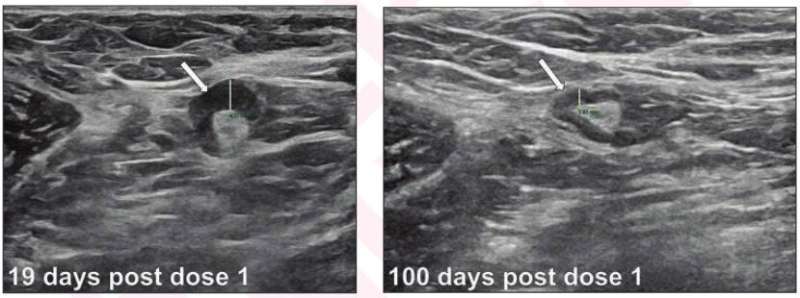
    Left: Transverse image of left axilla on initial breast ultrasound, 19 days after the first dose of Pfizer COVID-19 vaccination to left upper extremity, demonstrates the increased cortical thickness of 4 mm (arrow). Right: Transverse image of left axilla on follow-up ultrasound, 100 days after first COVID-19 vaccine dose, demonstrates the cortical thickness of 2 mm (arrow), consistent with resolution of left axillary lymphadenopathy (arrow). The patient underwent a second dose 2 days after the initial ultrasound. Credit: American Roentgen Ray Society (ARRS), American Journal of Roentgenology (AJR)

    Drotman and the Weill Cornell Medicine team extracted health record data from 111 patients (mean age, 52 years) with unilateral axillary lymphadenopathy ipsilateral to Pfizer or Moderna COVID-19 vaccine administration—performed within 8 weeks prior and detected on breast ultrasound (January 1-October 1, 2021) who underwent follow-up ultrasound examinations at 4-12 weeks.

    In this single-center study, axillary lymphadenopathy ipsilateral to COVID-19 mRNA vaccination resolved after a mean of 97 days since detection by breast imaging and 127 days since the first dose. Longer times to resolution were observed with Moderna (rather than Pfizer) vaccination, receipt of the second dose after presentation, and thicker cortical thickness at presentation.

    “The presence of subclinical lymphadenopathy and the long resolution time of lymphadenopathy,” the authors of this AJR article noted, “should reassure radiologists and patients when lymph nodes suspected to be vaccine-related persist over multiple visits.”

    Reference: “Time for Resolution of COVID-19 Vaccine-Related Lymphadenopathy and Associated Factors” by Elizabeth G. Lane, Carolyn S. Eisen, Michele B. Drotman, Katerina Dodelzon, Eralda Mema, Charlene Thomas and Martin R. Prince, May 2022, American Journal of Roentgenology.
    DOI: 10.2214/AJR.22.27687

    Never miss a breakthrough: Join the SciTechDaily newsletter.
    Follow us on Google and Google News.

    COVID-19 MRNA Vaccination Vaccine Weill Cornell Medicine
    Share. Facebook Twitter Pinterest LinkedIn Email Reddit

    Related Articles

    COVID-19 Vaccines and Fever: Scientists Have Discovered a New Potential Link

    Researchers Shed Light on Blood-Clotting After COVID-19 Vaccination

    No More Needles: Inhalable COVID-19 Vaccine Shows Promise

    New Breast Cancer Treatments Inspired by mRNA COVID-19 Vaccine Innovation

    MIT Expert on the Progress of mRNA Vaccines

    COVID-19 mRNA Vaccine Technique Shows Promise for Treating Heart Disease

    How mRNA and DNA Vaccines Could Soon Treat Cancer, HIV, Genetic Diseases, and More

    “Flatten the Curve” – Flu Shots and Measles Vaccines Could Help Against COVID-19

    mRNA Vaccines Highly Effective at Preventing Death From COVID-19 – But Less Effective at Preventing Infection

    Leave A Reply Cancel Reply

    • Facebook
    • Twitter
    • Pinterest
    • YouTube

    Don't Miss a Discovery

    Subscribe for the Latest in Science & Tech!

    Trending News

    Why Popular Diabetes Drugs Like Ozempic Don’t Work for Everyone: The “Genetic Glitch”

    Scientists Stunned After Finding Plant Thought Extinct for 60 Years

    Scientists Discover Tiny New Spider That Hunts Prey 6x Its Size

    Natural Component From Licorice Shows Promise for Treating Inflammatory Bowel Disease

    Scientists Warn: Popular Sweetener Linked to Dangerous Metabolic Effects

    Monster Storms on Jupiter Unleash Lightning Beyond Anything on Earth

    Scientists Create “Liquid Gears” That Spin Without Touching

    The Simple Habit That Could Help Prevent Cancer

    Follow SciTechDaily
    • Facebook
    • Twitter
    • YouTube
    • Pinterest
    • Newsletter
    • RSS
    SciTech News
    • Biology News
    • Chemistry News
    • Earth News
    • Health News
    • Physics News
    • Science News
    • Space News
    • Technology News
    Recent Posts
    • Simple “Gut Reset” May Prevent Weight Gain After Ozempic or Wegovy
    • 2.8 Days to Disaster: Scientists Warn Low Earth Orbit Could Suddenly Collapse
    • Scientists Uncover How Serotonin May Trigger Tinnitus
    • Common Food Compound Shows Surprising Power Against Superbugs
    • Ancient DNA Study Reveals Human Evolution Is Happening Faster Than We Thought
    Copyright © 1998 - 2026 SciTechDaily. All Rights Reserved.
    • Science News
    • About
    • Contact
    • Editorial Board
    • Privacy Policy
    • Terms of Use

    Type above and press Enter to search. Press Esc to cancel.